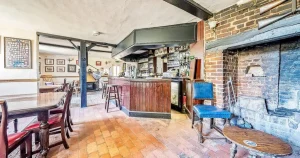


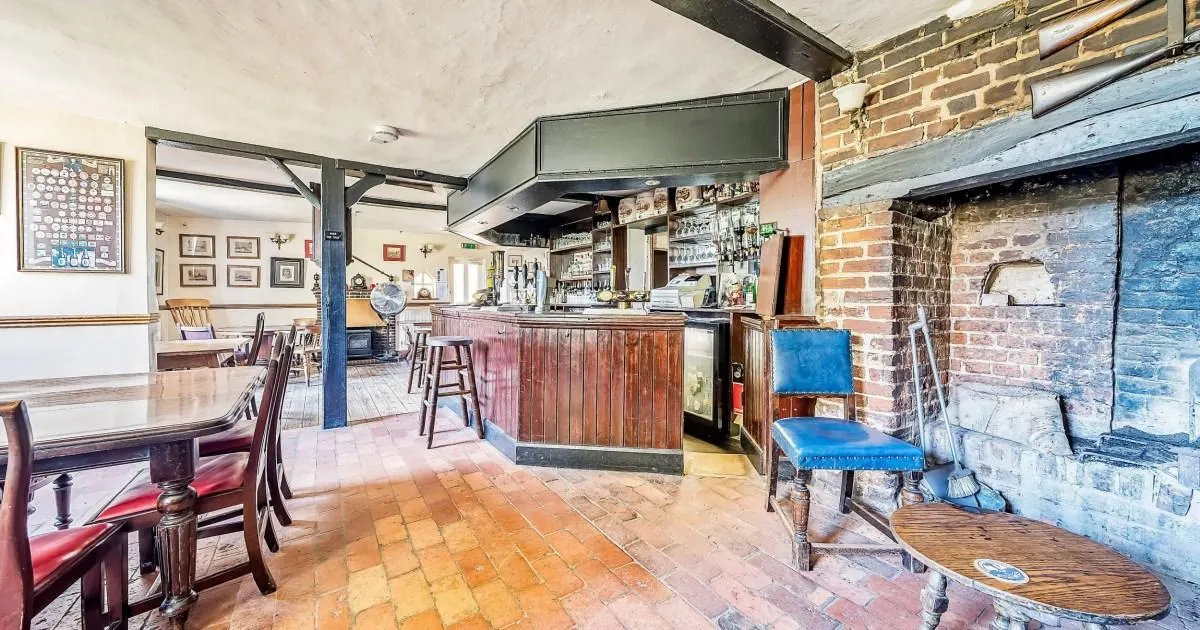
There are pubs that serve drinks, and then there are pubs that serve stories. The George Inn on Stone Street in Stelling Minnis, near Canterbury, Kent, is very much the latter. This Grade II-listed building, set in the rolling countryside of the North Downs, has long been a place where the past and the present sit side by side. It has drawn ghost-hunters, paranormal enthusiasts and curious visitors for years, all hoping to catch a glimpse of something beyond the ordinary. But now, this beloved and famously haunted pub is about to write a new chapter in its long and unusual history: it is going under the hammer at auction. The freehold of the building, along with its 1.8-acre site, is being offered with a guide price of £320,000 through Clive Emson Auctioneers. The sale includes a recently refurbished pub with self-contained accommodation, a beer garden, a car park and even a field that could potentially be used for campers. The pub closed its doors earlier this year, not because of a lack of character or charm, but because the owners were ready to retire from the trade. For them, The George Inn has been more than just a business — it has been a home, a community hub and a keeper of secrets. And for many local people, the news of the sale feels a little like losing a familiar character from the village.
The supernatural reputation of The George Inn is the kind of thing that makes a pub unforgettable. According to The Garden of England Paranormal Spirits website, visitors and staff have reported hearing the sound of muffled galloping hooves outside the pub for years. The noise is soft, distant, as though horses are passing by on an old road that no longer exists. Some believe these spectral hoofbeats are made by the ghosts of the four knights responsible for the murder of Thomas Becket, the former Archbishop of Canterbury. Becket was killed in Canterbury Cathedral on 29 December 1170, one of the most infamous crimes in English history. The four knights — Reginald Fitzurse, Hugh de Morville, Richard Brito and William de Tracy — rode from Normandy to England after falling out with King Henry II over the growing power of the Church. According to legend, they may have travelled along the very road that passes The George Inn on their way to Canterbury to confront the archbishop. If that is true, then the pub stands on a route soaked in history and blood. The sound of hooves outside the inn could be an echo of that fateful journey, a reminder of the violence that changed the course of English religious and political life. For those who believe in such things, the road outside the pub is not just a quiet country lane — it is a path that ghosts might still walk.
The haunting at The George Inn is not limited to sounds from the past. Visitors have also claimed to have seen a ghostly figure dressed in what appears to be 18th-century clothing, sitting inside the pub next to a strange and spectral black dog. This mysterious figure is often described as calm, almost as though he is waiting for someone or simply enjoying the warmth of the fireplace. While the Grade II-listed building itself was constructed in the mid-19th century, the land and the history beneath it are far older. Paranormal researchers believe the ghost could be a former pub landlord, a man who spent so much of his life serving drinks and hosting guests that he simply could not bear to leave after death. Or perhaps it is a local resident, someone who loved the atmosphere of the inn and decided to linger there long after their time on earth was over. The image of a ghostly figure resting beside a phantom black dog is deeply atmospheric. Black dogs are a common fixture in British folklore, often seen as omens, guardians or companions on the journey between worlds. It is easy to imagine this old pub, with its low ceilings, creaking floorboards and dim corners, being the kind of place where such legends take root. The George Inn has become a living museum of folklore, where every shadow seems to hold a story and every noise has a possible explanation — or at least a supernatural one.
The auction of The George Inn offers a rare opportunity for someone with imagination, courage or simply a love of historic buildings to take ownership of a piece of English heritage. The property has been recently refurbished, meaning that while it is steeped in old-world character, it also has the practical comforts expected by modern buyers. The self-contained accommodation makes it possible for an owner to live on-site, managing the pub without the need to travel. The beer garden and car park provide the kind of generous space that many village pubs would envy, while the adjacent field could be used for camping pitches, events or perhaps even a small wedding venue. With the growing popularity of paranormal tourism, some buyers might even see the ghost stories as an asset rather than a drawback. A haunted pub is a draw for visitors who want to stay the night in a place where the past feels present. The auction is scheduled for Thursday, September 24, at Clive Emson Auctioneers, and interested parties will need to register in advance. The guide price of £320,000 is just that — a guide — and the final price could go higher if the bidding heats up. Fleurets, the estate agents handling the sale, have described the building as being in good order and ready for a new chapter. But no matter how much preparation has gone into the sale, no amount of paperwork can erase the layers of history embedded in the walls.
The sale of The George Inn also speaks to a wider story about rural pubs in Britain. Pubs have always been more than just places to drink. They are community living rooms, places where people gather to celebrate, mourn, argue, laugh and tell stories. When a pub closes its doors, a village loses a vital part of its identity. The George Inn has served that role for decades, offering a warm welcome to locals and visitors alike. Its reputation as a haunted inn has made it a destination for ghost-hunters, who arrive with cameras, recording devices and open minds. Some leave disappointed, but many leave with strange recordings or unexplained photographs. The village of Stelling Minnis itself is a quiet and picturesque place, the kind of spot where time seems to move more slowly. It sits just outside Canterbury, a city famous for its cathedral and its rich spiritual history. The proximity to Canterbury adds another layer of significance to the pub’s ghost stories. After all, the murder of Thomas Becket transformed Canterbury into one of the most important pilgrimage sites in Europe. People have been travelling to the city for centuries, seeking healing, forgiveness or simply a connection to history. The road past The George Inn may have carried pilgrims too. In that sense, the pub is not just a building — it is a witness to centuries of human journeying, faith, hope and fear.
When the bidding ends and the gavel falls, a new owner will take on a building that carries an extraordinary amount of history. They will also inherit the ghost stories, whether they believe in them or not. There is something deeply romantic about the idea of owning a haunted pub. It is a chance to become part of a story that began long before you arrived and will continue long after you leave. The new owner could revive The George Inn as a welcoming village pub, leaning into its paranormal past to attract visitors from across the country. They could create a haunted guesthouse, offering overnight stays in a building where the supernatural is said to roam. They could host events, weddings, festivals or simply run it as a cosy local for the people of Stelling Minnis and the surrounding area. Whatever path they choose, they should know that they are not just buying property — they are becoming the guardian of a legend. The muffled sound of galloping hooves, the ghostly figure in 18th-century clothing, the spectral black dog by the fire — these stories will now belong to someone else. But in a way, they also belong to everyone who has ever heard them. The George Inn is more than a pub up for auction. It is a reminder that the past never really disappears. It lingers in old buildings, in quiet country roads and in the stories we choose to tell. And if the auction succeeds, the next chapter of this peculiar tale will begin. Whether the ghost moves with the property or simply stays where it has always been, one thing is certain: The George Inn will never be just another pub. It will always be the place where history, mystery and the human heart come together.