

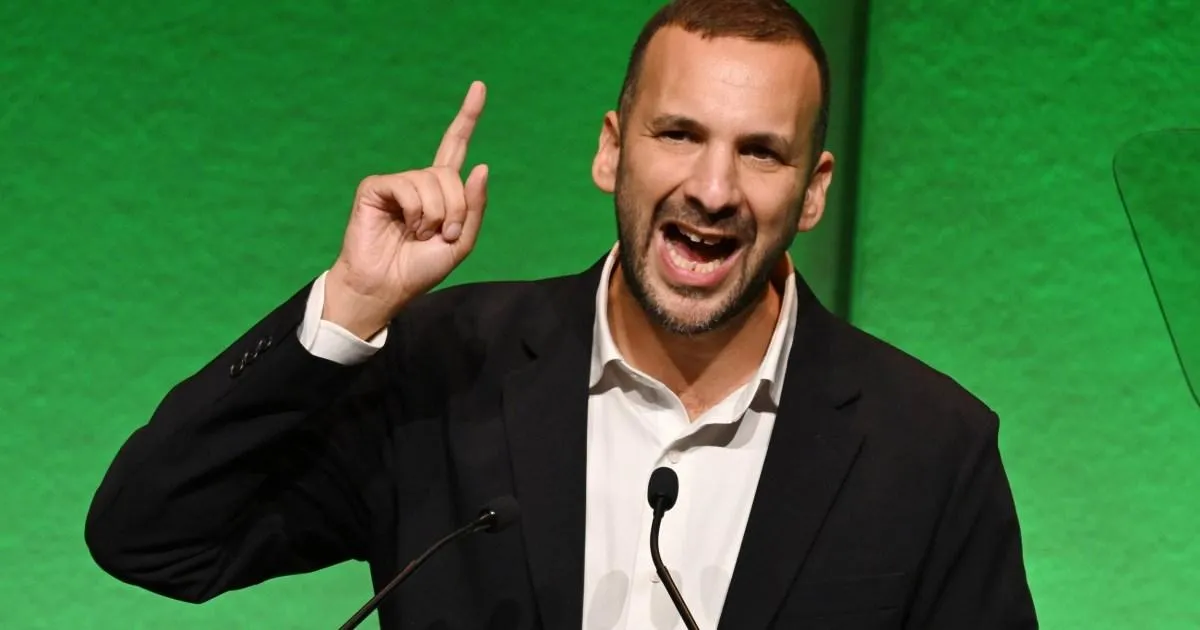
Politics can be a strange and unforgiving business, and right now Zack Polanski is learning that lesson at full speed. The Green Party leader and City Hall councillor, who took on the top job in September 2025, was once the kind of politician who seemed to be everywhere at once — young, energetic, and increasingly popular in a city that often warms to fresh voices. But according to leaked internal Labour polling obtained by Metro, the glow has faded. In December, Londoners viewed him in strikingly positive terms: competent, on their side, strong, trustworthy, and patriotic. By August 2026, the same kind of voters apparently see almost the exact opposite. Polanski is now widely seen as weak, untrustworthy, and even unpatriotic. The timing could hardly be worse. He is campaigning to be the Green candidate in the upcoming by-election in Holborn and St Pancras, the London seat that Sir Keir Starmer has given up after resigning from Parliament at the start of this month. The contest is supposed to be a moment for the Greens to prove they can take the fight to Labour in one of its safest seats. Instead, the man hoping to lead that charge is carrying polling numbers that would make any candidate nervous. Local party members in Camden were deciding whether to back Polanski or local councillor Hamza Chowdhury, meaning this most personal of political judgments is being made at exactly the moment his reputation has taken a beating. It is the kind of situation that separates political careers — and Polanski is now discovering how quickly goodwill can evaporate in the heat of a by-election campaign.
The leaked survey paints a stark before-and-after picture. At the end of last year, Polanski looked like a politician with genuine momentum. Net ratings — the share of people with a positive view minus the share with a negative view — put him above 20% on being competent and being on the side of ordinary people. He was also net positive when voters were asked whether he was strong, trustworthy, and patriotic. Those are the foundations any ambitious leader needs, especially in a capital where voters tend to punish politicians they see as out of touch. But the eight months between December and August changed all of that. The internal Labour research suggests that his ratings on those key leadership qualities declined steadily, and in some cases sharply. By the time the polling was carried out, more Londoners saw him as weak than strong — by a net margin of 22%. The shift is even more brutal on competence: where he once enjoyed a net positive rating of 20%, he now finds himself at minus 17. On trustworthiness and patriotism, the numbers have fallen into negative territory too. Perhaps most painful of all, his strongest issue — being on the side of ordinary working people — has collapsed from a net positive of more than 30% to a net negative of 8%. For a politician from a party that talks constantly about fairness and social justice, losing that particular marker is a serious blow. It is not just the headline figures that matter; it is what they represent. Londoners who once saw Polanski as a credible alternative to the old parties are apparently beginning to see something less reassuring. And while he remains more popular in London than in the rest of the country, that is not saying much. Voters outside the capital had already been more sceptical about his trustworthiness, strength, and connection to their lives before the recent controversies pushed his numbers even lower.
So what went wrong? The most obvious turning point came in May, after a terror attack in Golders Green, a north London area with a large Jewish community. In the aftermath, Polanski — who is himself Jewish — reposted an X post that criticised police officers for kicking the head of a stabbing suspect in order to get him to drop his knife. The officers were dealing with a live and dangerous situation, and the decision to criticise them did not go down well. The Metropolitan Police Commissioner, Sir Mark Rowley, and the Prime Minister both rebuked Polanski, and the Green leader later apologised. But the damage, according to pollsters, was already done. It was around that moment that his national approval ratings, which had been net positive until then, began to sink. Then, in July, he found himself in another mess when he “inadvertently” shared an image of a man wearing a T-shirt with the words “We’re only making plans for Nigel” alongside a picture of a guillotine. Whatever the intention, the image was easy to read as a veiled threat or at best an extremely poor joke, and it reignited the criticism. Taken together, these episodes created an unflattering narrative: a politician who reacts emotionally, posts first and thinks later, and struggles to show the judgement expected of a national leader. The irony is that many of these controversies had little to do with the policies the Greens actually campaign on, like rent controls and affordable housing. But in politics, character counts, and a handful of decisions made in the heat of the moment can reshape how an entire city sees you. The leaked Labour polling suggests that is exactly what happened to Polanski. The decline was not caused by one event alone, but by a pattern that made him look, to many voters, less like a potential MP and more like a risk.
Yet here is one of the strangest things about modern politics: a leader’s personal ratings and a party’s actual strength are not always the same thing. Despite Polanski’s slide, the Green Party itself remains a serious force in London. In the local elections in May, the party won three councils and two mayoralties — a sign that its ground game and grassroots appeal are very much alive. Public polling on voter intention in the capital, which Labour’s internal research apparently matches, shows Labour on 27% and the Greens on 17%. That still leaves Labour well ahead, but it makes the Greens the main challengers in a seat they have barely contested before. In Camden, the borough where Holborn and St Pancras sits, the Green surge has been even more dramatic. The party went from just one councillor to eleven in the May elections, a result that turned an also-ran into a genuine opposition force. That local strength is exactly why Polanski wants to stand there. A by-election caused by Sir Keir Starmer’s departure is a rare opportunity, and the Greens believe they can tap into both national dissatisfaction with Labour and local anger over issues like housing. The question is whether Polanski’s personal unpopularity will undermine that hope. There are plenty of examples in British politics of parties doing well even when their leaders are not loved, and there are also examples of unpopular leaders dragging their parties down. For now, the polling suggests that Labour sees Polanski himself as a weakness — why else would they be measuring his personal ratings so carefully? But the Greens can point to the fact that their support has not collapsed even as his numbers have worsened. The party is bigger than one man, and in Holborn and St Pancras, the campaign has already been out on the streets talking about rent controls and housing, issues that matter far more to voters than the latest Twitter storm.
The race itself is shaping up to be a fascinating test of strength. Labour has chosen Sagal Abdi-Wali, the leader of Camden Council, as its candidate — a well-known local figure who was selected on Wednesday evening. The Greens will confirm their candidate on Friday, but first the local membership has to decide between Polanski and Hamza Chowdhury, a local councillor who has made a pointed argument against the party leader’s candidacy. Chowdhury has suggested that Holborn and St Pancras does not need “a politician you’ll only see on a leaflet,” a swipe at Polanski’s profile as a national figure rather than a representative rooted in the area. That internal tension is itself a story. On one side, there is the argument that the Greens should seize the moment with their best-known name and capitalise on the national attention a by-election brings. On the other, there is the argument that local voters want someone who knows the community, not a parachuted celebrity candidate with baggage. Labour won the seat by more than 11,000 votes in 2024, which sounds like a comfortable margin. But the political landscape has shifted since then. The party’s national popularity has fallen, and the local election results in Camden suggest that Labour cannot take the seat for granted. The by-election will also be the first major electoral test for Andy Burnham, who became Prime Minister just six weeks ago. A Labour loss, or even a significantly reduced majority, would be a worrying sign for his government. For Polanski, if he is selected, the stakes are just as high. A strong showing would silence the critics and prove the polls wrong. Another controversy, or a disappointing result, could upend his leadership completely. In other words, this is not just a by-election. It is a crossroads for the Green Party, for Labour, and for the two men leading them.
The Green Party’s official response to the leaked polling was, predictably, cheeky. A spokesperson thanked Labour “for providing us with free polling,” noting that it showed the Greens were “the main challenger in one of their safest seats,” and joked that they “may even put it on a leaflet.” That light-hearted tone is a reminder that, in politics, internal leaks are not necessarily disasters — they can also be mobilised as evidence of a party being taken seriously. But behind the joke lies a serious point. Polanski may be down in the polls, but the race is still open, and the issues that matter in Holborn and St Pancras are not going to be decided by a poll taken weeks ago. Rent controls, affordable housing, the cost of living, and local services are the kind of things that voters actually talk about on the doorstep, and the Greens have spent months building a presence in Camden. The leaked numbers are undoubtedly uncomfortable for Polanski. They will be used by his opponents, highlighted in Labour materials, and weaponised in the internal argument against his candidacy. But they also give him a chance to show resilience. Every politician experiences bad polling at some point; what matters is how they respond. If he is selected, he will have a platform to answer the criticisms directly, calm the doubts, and demonstrate that he has learned from his mistakes. If he is not selected, the fallout will be even harder to manage. But one thing is already clear: the man who looked, only a few months ago, like one of the most popular figures in British politics has discovered how fragile political popularity can be. The next few days will tell us whether he can rebuild it — or whether the fall from grace is permanent. For now, the only certainty is that in Holborn and St Pancras, nothing can be taken for granted.