

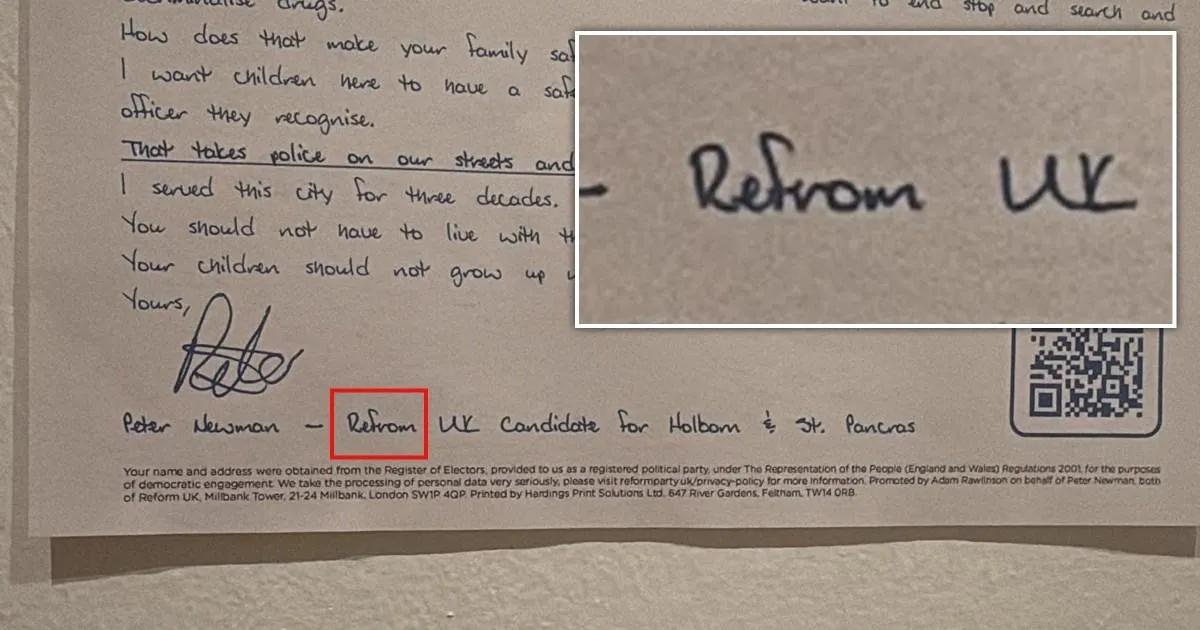
It began, as so many political disasters do, with a bit of junk mail and a missing letter. A by-election leaflet landing on doormats in Camden promised residents a vision of safer streets, more police and a new kind of politics. But when a local voter picked it up and tried to work out who had sent it, they found the answer only at the very bottom, tucked below a candidate’s signature. And there it was, in black and white: the word “Refrom.” Not Reform, the actual name of the political party, but a typo so glaring, so childishly simple, that it instantly became the most talked-about detail of the campaign. Reform UK, the party co-founded by Nigel Farage and currently trying to position itself as the tough-on-crime answer to Britain’s problems, had managed to misspell its own name on an official campaign letter. The word appeared exactly once, and it was wrong. The candidate himself, Pete Newman, a former senior Metropolitan Police detective, had signed off as the “Refrom UK Candidate,” apparently without anyone in the party bothering to check the proof before it went to print.
The reaction from ordinary residents was a mixture of disbelief, amusement and something close to pity. One Camden voter, quoted by a national newspaper, captured the mood perfectly, describing the error as “so embarrassing” and pointing out that the party’s only mention of itself on the entire leaflet was misspelled. She wondered aloud whether Reform “clearly don’t have a chance” in the constituency, and called the whole thing “slapdash” and “sloppy campaigning.” It is hard to argue with that assessment. In any election, the first thing a candidate needs voters to know is who they are and what they stand for. If a party cannot even spell its own name on its own literature, how can it be trusted to handle the complexities of policing, housing and public finances? The letter was supposed to be Mr. Newman’s big moment, his chance to introduce himself to thousands of potential voters as the man who could clean up crime in one of London’s most troubled boroughs. Instead, his introduction read like a joke, and the party was forced to send out a second letter with the correct spelling, a small but humiliating retreat.
Beneath the comedy, however, there is a deeper political significance to the typo. It happened in the run-up to the Holborn and St Pancras by-election, a contest caused by the departure of Sir Keir Starmer, the former Labour leader, from his parliamentary seat. The constituency has traditionally been a Labour stronghold, and Labour is throwing everything it has at keeping it, with candidate Sagal Abdi-Wali hoping to hold off a challenge from the Green Party’s new leader, Zack Polanski. George Galloway, the veteran left-wing firebrand, is also standing for the Workers Party, while Reform is very much playing second fiddle. Against that backdrop, the misspelling gave Labour an opening to paint Reform as amateurish and out of its depth. A source from the Labour campaign in the constituency was quick to pile on, saying it was “no surprise” that Reform’s candidate was “disowning the Nigel Farage brand.” Labour’s attack went further, accusing Reform of being “mired in sleaze” and of dodging questions about “mega gifts” from crypto-billionaires. In Labour’s telling, the typo was not an honest mistake but a symptom of a party in hiding, unable to say its own name because it is ashamed of what that name now means.
This is not the first time Reform has been forced to defend itself over money and morality. Since Andy Burnham became Prime Minister, a turn of events that has reshaped British politics in ways still being understood, Reform’s star has faded. Poll ratings have slipped, and the party has been buffeted by a series of damaging stories about its finances. In September, undercover journalists recorded senior party figures discussing a £500,000 gift from a foreign donor, a revelation that raised awkward questions about where Reform’s money is coming from and why. An internal investigation concluded that no laws had been broken, but the damage was already done. Voters who had flocked to Reform on a wave of anti-establishment anger began to wonder whether the establishment had simply found new ways to play the old game. The party’s response to the “Refrom” typo, or rather its silence, fitted the pattern. There was no witty comeback, no self-deprecating apology, just a corrected second letter and a request for comment that went unanswered. It is hard to escape the impression of a party that has lost its sure touch, a movement that once spoke for the voiceless but now cannot speak for itself.
The by-election itself has become a strange and messy contest, far more interesting than the usual political ritual of “holding the seat.” Zack Polanski, the Green Party leader, is trying to do something no Green has ever done: win a seat in inner London and become the party’s sixth MP. His campaign has energy, youth and a moral urgency that appeals to younger voters and activists, but it has also hit serious turbulence. Leaked Labour polling, reported in the press, appears to show that Polanski is viewed by London voters as weak, unpatriotic and untrustworthy. Those are harsh words, but they reflect a political environment in which the Greens are no longer seen as harmless idealists but as a serious threat to Labour’s dominance. Polanski’s leadership was further thrown into chaos over the weekend, when the Green Party conference passed a controversial motion declaring that “Zionism is Racism.” The motion was condemned by the European Greens, several members resigned from the party, and the row threatened to overshadow everything else Polanski has been trying to do. For a leader trying to project competence and seriousness, it was a disaster. And into that chaos stepped George Galloway, a politician who has made a career out of finding the exact word that makes everyone else wince, and who now hopes to turn Holborn and St Pancras into another chapter in his long and controversial career.
In the end, the “Refrom” typo is more than just a clumsy mistake. It is a small, almost perfect symbol of the moment we are living through. Politics in Britain has become fragmented, angry and increasingly absurd. Established parties are losing their grip, new movements rise and fall on the strength of a single speech or a single scandal, and the machinery of campaigning, the letters, the leaflets, the social media posts, is running faster and faster while the standards of proofreading, honesty and basic competence slide. Voters are not stupid. They noticed that Reform could not spell its own name, and they drew conclusions from it. They noticed that Labour was happy to exploit the error, and they understood that too. They watched the Greens tear themselves apart over a motion about a conflict thousands of miles away, and they wondered what any of this had to do with the price of rent in Camden. And somewhere in the middle of it all, a former detective who just wanted to talk about getting police officers back on the streets and keeping police stations open found himself reduced to a punchline. The tragedy of modern politics is not that parties make mistakes; that is human and forgivable. The tragedy is that they have become so disconnected from the people they are supposed to serve that a typo on a letter feels more honest than the carefully crafted promises that surround it. If Reform, or any other party, wants to regain the trust of the public, it could start by learning to spell its own name, then follow that up with a clear statement of what it actually stands for, and perhaps, just perhaps, a willingness to be judged on the substance rather than the spelling. Until then, the word “Refrom” will remain a reminder that in politics, as in life, the devil is in the details, and the details are often the only thing we can believe.