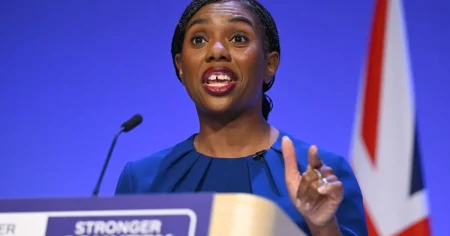

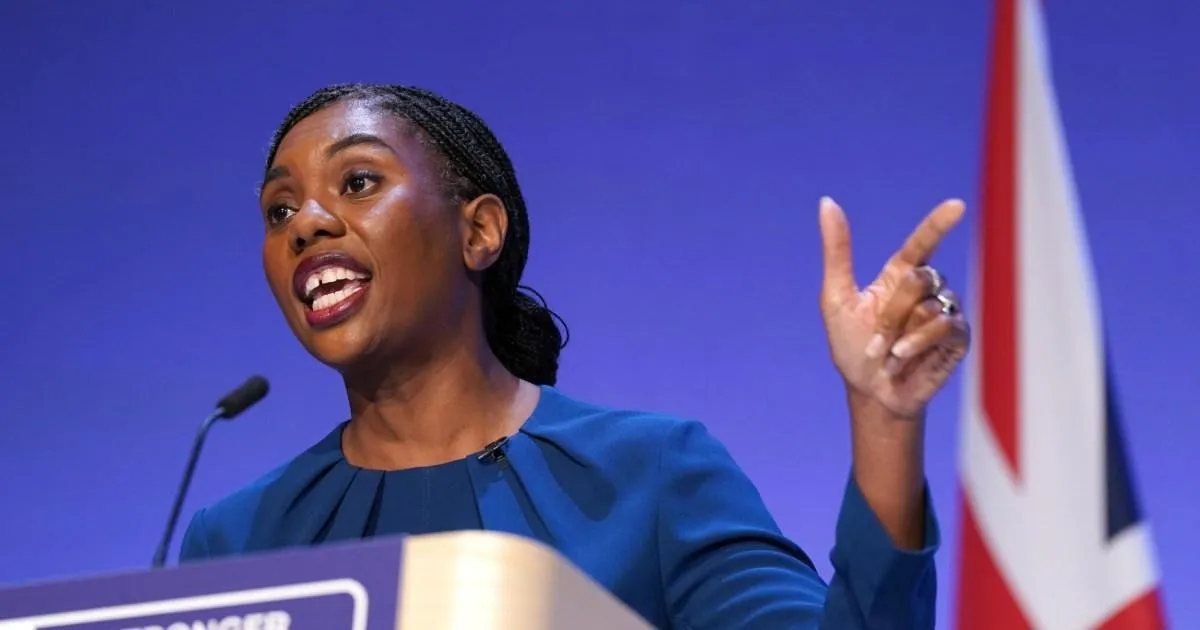
Politics is often about symbols, and this week the contrast was impossible to miss. Kemi Badenoch walked out to deliver her Conservative conference speech in Birmingham and stood firmly behind a lectern. No wandering around the stage, no theatrical roaming—just a deliberate, old-school political pose. That small choice said more than any policy announcement: she was not going to copy Andy Burnham. A week earlier, the Prime Minister had glided around a Liverpool stage, hands loose, voice measured, trying to sound above the fray. He didn’t mention the Conservatives. He didn’t mention Reform UK. He seemed determined to occupy a sunny, post-conflict space. Badenoch looked at that and effectively said: not for me. Her opening line “Conference, there is a fight coming in British politics” was a warning, a promise, and a branding exercise all at once. It was also a clear signal to her own party, to the media, and to voters that she sees politics as combat. Where Burnham strives to be statesmanlike and inclusive, Badenoch thrives on the scrap. She is the kind of politician who comes alive when she is landing a jab, and she clearly believes the Conservative Party needs a fighter, not a peacemaker. In that sense, the lectern wasn’t just a piece of furniture; it was a statement of identity. The body language, the tone, the first sentence—all of it was designed to draw a bright line between her approach and the Prime Minister’s. And for the activists in Birmingham, that was exactly what they wanted to hear. After years of defeat and drift, they didn’t want another cautious leader searching for consensus. They wanted someone willing to swing. Badenoch gave them that within seconds. The real question, of course, is whether a fight is enough. But in that hall, at that moment, the atmosphere was unmistakable. This was a leadership performance built on contrast, and she was clearly enjoying every second of it. Even before she got to the substance, the crowd had their answer: the Conservative Party under Kemi Badenoch will not try to out-Burnham Burnham. It will try to out-fight him.
Once she got going, Badenoch delivered exactly the kind of speech her supporters expected. She described the Prime Minister as a “Paddington Bear prime minister”—a line that was both funny and cruel, and likely to stick. The image is of a friendly, well-meaning leader who wants to please everyone, who smiles through every crisis, and who somehow ends up in a series of sticky situations despite his good intentions. It is a caricature, but political insults work best when they contain a grain of truth people recognize. Badenoch didn’t stop there. She also aimed a direct, powerful volley at Reform UK over the suggestion from senior figures, including Suella Braverman, that people descended from immigrants cannot call themselves English. This was the emotional core of her speech. She spoke about her son watching the England football team and wanting him to see black players as unquestionably English. She invoked Ian Wright and John Barnes, two legendary players from an earlier era, and noted that nobody back then was questioning their Englishness. The contrast with today’s political climate, where sitting MPs raise questions about identity, clearly angered her. “We must not let these people take us backwards,” she said. It was a rare, genuine moment in a conference speech—less about policy than about belonging. It was also clever politics, because it allowed Badenoch to position herself as both proudly Conservative and socially inclusive, while attacking Reform from a cultural angle rather than simply a numerical one. But Badenoch is not a one-note speaker, and she made sure to give the room a tasty policy moment as well. Her big flourish was a pledge to scrap inheritance tax on family homes, presented as a long-promised answer to a question she claimed “everybody’s been asking.” The room responded warmly. It is easy to see why: the policy speaks to the Tory heartland’s fear of losing a family property to the taxman, and it gave the audience something concrete to cheer. Yet even as she delivered that line, there was an unspoken tension. Inheritance tax has been a totemic issue for the Conservative base for years, but the wider country is less convinced it is the most urgent problem facing Britain. And despite her insistence that this was the question on everyone’s lips, the truth is that people have been asking her other things too—about the party’s dire polling, about the leadership’s internal divisions, and about what the Conservatives would actually do in government. Still, for one afternoon, she gave her audience a blend of attack, emotion, and old-school Tory promise. It was a speech designed to make them feel good about being Conservative again. The applause was real. But speeches are easy; the hard work of rebuilding trust is not. And while the “Paddington Bear” jibe may have delighted the room, it remains to be seen whether it changes the minds of voters who quite like a prime minister with a gentle touch.
The problem for Badenoch is not her performance; it is the party she is leading. You might think that as Reform UK’s support has gradually fallen since last autumn, the Conservatives would be the natural beneficiaries. That is how politics usually works: one party’s misfortune becomes another party’s opportunity. But this time, the expected bounce has not materialized. Tory poll numbers have barely moved, and they remain stuck below the level of their disastrous 2024 general election result. That is a sobering reality for any opposition leader. Personal approval ratings are a strange thing. Badenoch’s own numbers have improved over the past year. She is more recognized, more defined, and more talked about than she was when she first took over. Among Conservative members and even some swing voters, she is seen as a strong personality with clear instincts. But that relative popularity is not translating into support for the Conservative Party as a whole. People may like her, or at least respect her, and then tell pollsters they still wouldn’t vote Tory. It is a brutal disconnect, and it explains why the mood at the Birmingham conference felt more fragile than the applause suggested. In the hall, activists were upbeat. They had a leader who could land punches, a set of policies aimed at their core concerns, and a sense that the party was at least trying to define itself again. But outside the hall, the national polls tell a different story. The Conservatives are not climbing. They are not even creeping up. They are simply… there, flatlining, while the political landscape shifts around them. Part of the problem is trust. After years of chaos in government, from Brexit to partygate to the Truss budget, many voters simply do not want to hear from the Tories again. No amount of stagecraft can fix that quickly. Another part of the problem is the political space they occupy. Reform UK has squeezed them from the right, and even though Reform’s polling has faded, it hasn’t faded enough to hand Badenoch a revival. The two parties are fighting over the same territory, and the split on the right is as damaging as ever. Badenoch’s personal growth, in other words, is real but insufficient. It is like a tree growing taller without its roots spreading wider: impressive from a distance, but not stable enough to withstand a storm. And the storm is coming. If an election were held tomorrow, the arithmetic would be grim. The Tories would likely find themselves locked out of a majority, forced into a humiliating negotiation with a rival they despise, or watching from the sidelines as Labour and the SNP did a deal. None of those outcomes are appealing. So the conference speech, for all its energy, was really a defiant performance in the face of an uncomfortable truth: the party is still a long way from being competitive, and no single set-piece address can change that by itself.
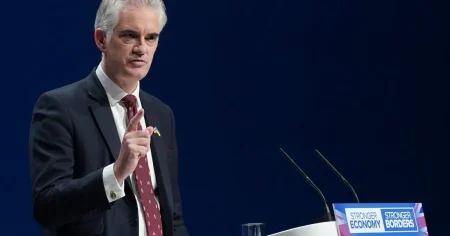
Nowhere was that underlying uncertainty clearer than in the Conservative Party’s own messaging about when an election should happen. On one level, the party seems eager to keep fighting. The media room at conference featured a freebie water bottle with the words “Bottler Burnham” printed on it—a cheeky reference to the Prime Minister’s decision not to call a snap election after entering Downing Street. The nickname is designed to frame Burnham as someone who bottles big decisions, who talks a big game but flinches when it matters. It is the kind of playground taunt that political parties love because it is simple, memorable, and easy to repeat. But then, at the same conference, the party chairman Kevin Hollinrake admitted something far more honest. At an event run by the pollster More in Common, he said the Tories “don’t want an election right now ideally” because “we are not where we need to be right now.” That is not the language of a party ready to govern. It is the language of a party hoping for more time, more polling recovery, more internal repair. And it stood in direct contradiction to the bravado of the water bottles. Later, Badenoch herself insisted: “We are ready for an election whenever it is called.” So which is it? Are they ready, or not? The confusion is not just a PR problem; it reveals the party’s strategic dilemma. The leadership knows that the current numbers are bad. They know that an early election would almost certainly produce a hung parliament or a comfortable Labour majority. And they know that if no party wins outright, Badenoch’s path to Downing Street might run through a deal with Reform UK—a deal she has publicly ruled out. That leaves her in an impossibly tight corner. If she refuses to work with Reform, she may have no route to power. If she agrees to work with Reform, she betrays the very “fight” she claims to embody and risks losing the voters who backed her in the leadership contest. Her answer to this riddle, as she explained in broadcast interviews, is extraordinary: if a hung parliament resulted from an election, she would simply call for another election straight away. The logic seems to be that the country would be so appalled by the mess that voters would return a clear Conservative majority the second time around. But would the public really be up for that? After years of carousel politics, with multiple elections, referendums, and leadership changes, most people are exhausted by political drama. Asking them to vote again immediately because the first result wasn’t convenient would likely go down very badly. It sounds less like a plan and more like a bluff—an attempt to sound decisive while avoiding the real question of how the Tories can win under current conditions. For now, the party’s fate appears to be largely out of its own hands.
This is where the Conservative strategy becomes almost painfully passive. Badenoch can stand at the lectern and promise a fight, but the truth is that her path to power depends more on her enemies failing than on her party succeeding. Reform UK, despite its recent fall in the polls, is still a threat. It has a massive £72 million funding windfall, a loud media presence, and a core of committed supporters who feel abandoned by the Tories. If Reform can get its act together—if it can stop scoring own goals, avoid civil war, and present itself as a credible right-wing alternative—then the Conservatives will be squeezed. The right-of-centre vote may split again, and the Tories will remain in second or third place. Badenoch seems aware of this, which is why she spent so much time in her speech attacking Reform rather than Burnham. The “Englishness” moment was aimed squarely at Reform’s identity politics. She was trying to show that the Tories can be just as patriotic, just as tough on immigration, and far more inclusive than Nigel Farage’s vehicle. It was a clever trap, but also a sign of weakness: she is fighting a two-front war, against Labour on the center-left and Reform on the right, and she cannot fully commit to either battle. Meanwhile, Burnham has the luxury of positioning himself as the steady, mainstream leader above the chaos. He can ignore the Tories entirely, as he did in Liverpool, and focus on projecting competence. That is a powerful stance, especially when voters are tired of conflict. Badenoch may have succeeded in showing she is not interested in mimicking Burnham’s style, but she will have a much tougher job proving she is actually able to beat him. Style is not the same as substance. Being different is not the same as being better. A fighter without a strategy is just an easy target. And while her supporters in the hall were energized, the wider electorate appears unconvinced. The Conservative brand has been damaged in ways that one speech cannot repair. It will take years, not months, to rebuild trust on the economy, on public services, and on national security. Every attack on Burnham may delight the faithful, but it also reminds the rest of the country that the Tories spend more time attacking their opponents than offering a coherent vision. The fundamental question—why should Britain vote Conservative again?—remains unanswered.
In the end, Kemi Badenoch’s Birmingham speech was a performance full of fight, but the fight itself is full of risk. She stood behind that lectern and drew a clear line between herself and Andy Burnham. She mocked him, attacked Reform, defended English identity, and promised to protect family homes from inheritance tax. The room cheered, and for a few hours, the Conservative Party looked alive again. But the broader picture is less encouraging. The polls are stuck, the election strategy is contradictory, and the party’s future depends on factors beyond its control. Badenoch’s personal approval is rising, but that has not lifted her party. The Reform vote is falling, but it has not fallen enough to give the Tories a path back to power. Her solution to a hung parliament—get elected anyway and call another election immediately—feels like a fantasy, not a strategy. For all her rhetorical aggression, she has not yet figured out how to turn a good line into a winning coalition. Maybe the “Paddington Bear” jibe will take hold. Maybe the inheritance tax pledge will win back some anxious homeowners. Maybe the Reform threat will fizzle out, and the Tories will finally recover. But maybe not. The truth is that British politics is in a strange, volatile place, and nobody really knows how the pieces will fall. What we do know is that Badenoch has chosen her path. She is going to be a fighter, not a peacemaker. She is going to attack her rivals, embrace controversy, and speak her mind even when it makes people uncomfortable. That approach has earned her attention and even admiration. It has not yet earned her the trust of the country. As the conference ended and activists headed home, they could feel proud of their leader’s performance. They might even have believed that the fight is finally coming. But the mountain remains exactly where it was. One speech, no matter how sharp, cannot move it. The real task—winning an election, forming a government, and governing a divided nation—requires more than a good left hook. It requires a vision, a plan, and a party that looks ready to lead. Kemi Badenoch has proven she is not Andy Burnham. That was never in doubt. What she has not proven is that she can beat him. And that, in the end, is the only fight that matters.