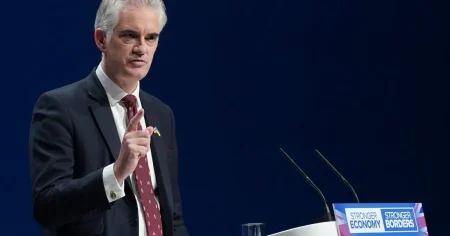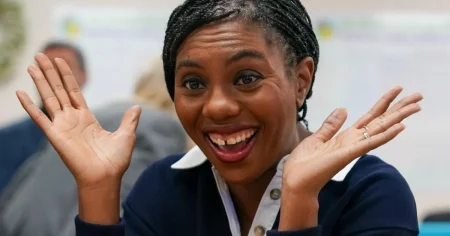


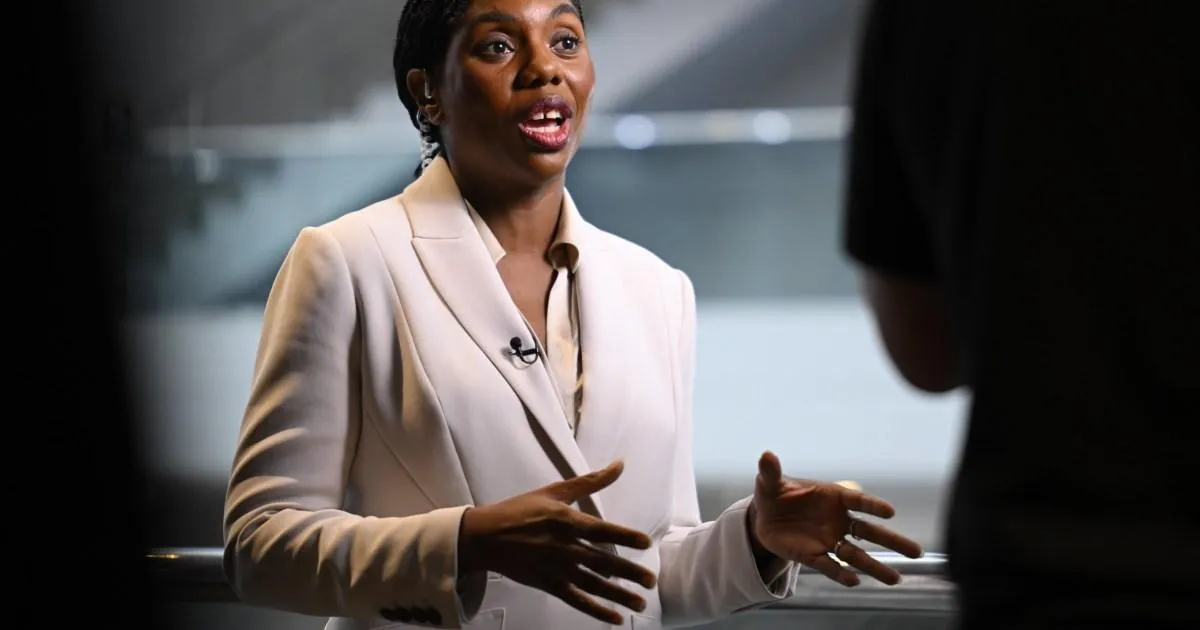
Autumn in British politics is a strange and slightly feverish season, a time when politicians gather in drafty conference halls, deliver carefully scripted speeches, and then spend most of their energy trying to control the story that follows them out of the building. This year, the plot has been unusually messy, because the loudest confrontation is not between the two biggest parties but between the Conservative leader, Kemi Badenoch, and the Green Party. The backdrop was set over the weekend, when Green members meeting in Brighton voted to adopt a policy paper with a blunt and deliberately provocative title: “Zionism is racism.” The motion called for a single democratic Palestinian state across all of historic Palestine, which means, in practice, dismantling the current state of Israel and replacing it with one state in which Israelis and Palestinians would live as equal citizens. It also explicitly rejected the two-state solution that has been the official position of successive British governments for decades. By the time Badenoch took to the stage in Birmingham for the Conservative Party Conference, she had clearly decided that this was too important — or too useful — to let go. She told ITV that she was “embarrassed” that any political party in the United Kingdom would adopt such a policy, and went much further, saying that the Green Party is “full of a lot of people who are antisemites.” She called the motion “disgusting,” declared that these are not people whose opinions should be respected, and said they should be called out as shameful. It is a remarkable level of political venom, and it turned an internal Green Party debate into a full-blown national scandal.
To understand why this one conference motion has caused such an explosion, you have to look at what the Green delegates actually agreed to. The idea that “Zionism is racism” is not new. It echoes a 1975 United Nations General Assembly resolution that was later repealed, and it has long been a slogan used by hardline critics of Israel. But the Green Party’s motion goes well beyond a slogan. It describes Israel’s existence itself as a form of racial supremacy and demands a single Palestinian state “in all of historic Palestine.” That means no majority-Jewish state at all, and it is a position that even the Palestinian Authority, which officially supports a two-state arrangement, does not endorse. For many Jewish Britons, including those who are deeply sympathetic to Palestinian rights, this crosses a line. They point out that there are dozens of Muslim-majority countries and dozens of Christian-majority countries, but if the Green Party is saying that the one Jewish homeland in the world is racist by definition, then Jewish people are being singled out for exclusion from the global family of nations. The party’s own supporters would likely argue that the motion is not about hating Jewish people but about opposing Israeli state policy and the occupation. They would say that a single secular state would be more equal, that Palestinians have been denied self-determination for too long, and that criticism of Israel should never be confused with antisemitism. That distinction, however, gets lost in the noise. The wording of the motion is so absolute, and the phrase “Zionism is racism” is so loaded, that it becomes almost impossible to have a calm conversation about it. And when a political party chooses to make that phrase an official policy, it is not just expressing an opinion. It is making a judgment about the legitimacy of the state of Israel and the Jewish national movement itself.
Badenoch, for her part, did not try to have a calm conversation. Her remarks at the Conservative conference were blunt, angry, and aimed squarely at the headlines. “I think the Green Party is full of a lot of people who are antisemites and are quite frankly not OK,” she said. “This is disgusting. These are not people whose opinions we should be respecting. These are people who we should be calling out as being shameful. I’m embarrassed that a political party in this country would actually do something like that.” It is hard to think of a Conservative leader using language this fierce about a minor party in recent memory. It may have been calculated. The Tories know that the Green Party is not a direct electoral threat to them in the same way Labour is, but they also know that the issue of antisemitism has been a political minefield across the British left for years. By hammering the Greens, Badenoch could position herself as the defender of Jewish communities and as a leader willing to call out what she sees as intolerance, even when it comes from a party that likes to present itself as progressive. The Green Party’s response was equally brutal. A spokesperson fired back a single, sharp line: “These are not people whose opinions we should be respecting” perfectly describes the Conservative Party. It was a clever retort, but it did not really answer the substance of the accusation. Instead, it turned the moment into a classic Westminster wrestling match, with each side grabbing at moral high ground and daring the other to make the first mistake. In that atmosphere, the actual human beings caught in the middle — Jewish members of the Green Party, voters who support Palestinian justice but fear hatred, party workers trying to make sense of the storm — became less important than the political point-scoring.
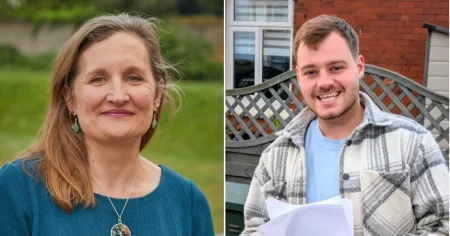
That human cost has been the quiet and painful undercurrent of the whole affair. The Green Party leader, Zack Polanski, did not participate in the vote because he was out campaigning for the Holborn and St Pancras by-election. Afterward, he released a statement that carefully avoided addressing the policy directly but stressed that antisemitism and criticism of the Israeli state are “completely distinct.” He said his role as a movement for justice is to protect both the rights of Palestinians and Jewish communities in the UK, and that he would not accept exclusion or refusal to engage with anyone because of the religious or communal body they are part of. It was an elegant attempt to hold the party together, but the pressure has clearly been unbearable. Within days, Polanski was banned from entering Israel, a diplomatic rebuke that turned the domestic political row into an international one. And inside the Green Party itself, there are people who say they can no longer stay. Vivien Lichtenstein, the chair of Jewish Greens, told BBC Radio 4’s Today Programme that there are “certainly some antisemites in the party,” even if she did not believe that was the case at senior levels. She said it was “quite possible” she would leave over the policy, and that she needed time to speak with colleagues. Two other Green Party members, Andrée Frieze and Kieran Dams, have already told Metro they are quitting. Frieze said she believes the motion makes Jews unsafe in the party. She put the dilemma in stark human terms: there are 53 Muslim-majority nations and 120 Christian-majority countries, she said, but this motion is saying that Jewish people cannot have a nation. That is not an abstract political argument for someone who sits in a party meeting and suddenly feels that her identity is being treated as a weapon.
Amid all of this, the Conservative Party Conference has tried to move on to the kind of policy announcements that usually dominate this week. Badenoch has announced that the Tories would cut the amount of National Insurance employers pay for workers aged 21 to 24. The proposal would reduce the rate from 15 percent to 7.5 percent for that age group, a change the party says would remove a “cliff edge” for young people trying to enter the workforce. The money would be found, according to the Tories, by redirecting funds from a previous policy called the First Job Bonus. It is the kind of carefully targeted tax cut designed to sound practical and pro-business. There have also been ambitious promises about national security — including something called the Britannia Shield, a proposed missile defense system to protect critical national infrastructure — and a plan to reduce the price of a newly built home by £50,000. These are all the materials of a conventional opposition party trying to build an election platform: jobs, security, housing, and the cost of living. But no matter how many glossy policy documents the Tories produced, the conversation kept drifting back to the Greens. That is the strange thing about conference season. It is supposed to be a time for parties to set out their vision for the country, but so often it becomes a stage for them to reveal who they think the enemy is. For the Conservatives, the enemy is obvious — anyone on the political left who they can paint as extreme, careless with money, or soft on antisemitism. For the Greens, the enemy has become their own motion, an eight-page piece of policy that has now overshadowed everything their conference was meant to be about. And for Jewish members of small political parties, the whole spectacle is not a game at all. It is a painful reminder that debates about the Middle East can turn ordinary people into symbols, and that political language has consequences far beyond the conference hall.
If we step back from the shouting, it is possible to see a deeper story underneath this week’s chaos. The Green Party’s decision is not simply about Zionism and racism. It is about how progressive parties talk about Israel and Palestine, and whether the language of anti-colonial justice can ever be separated from the language of antisemitic conspiracy. The party insisted that the motion is a plea for equality and a rebuke to military occupation. But by framing Israel’s very existence as a racist project, it has made it impossible for many Jewish people to feel welcome in the movement. At the same time, Badenoch’s response shows how easy it is for political leaders to use the fight against antisemitism as a partisan weapon. Accusing an entire party of being “full of antisemites” is a serious claim, and it deserves serious evidence. If the charge is based on a single conference vote, it is dangerously broad. Real antisemitism is a genuine and rising problem in Britain, and it is not a joke. But when the term is thrown around as a rhetorical grenade, it risks losing some of its power, and it gives genuine antisemites the “actually it’s a political smear” excuse they love to hide behind. None of this is easy or comfortable. There is no clean way to support the rights of Palestinians without engaging with the deep, historical trauma of Jewish people. And there is no clean way to criticise a political party for a hateful motion without making sure the criticism is fair and precise. What happened this week, in both Brighton and Birmingham, was neither fair nor precise. It was raw, angry, and deeply human. The Green Party chose a slogan over nuance, and it is now paying the price in resignations and public anger. The Conservatives chose to exploit that pain, and they will no doubt benefit from it in the short term. But the underlying questions remain unanswered. Can a party call for a single state in all of historic Palestine without making Jewish people feel erased? Can a political leader call out antisemitism without turning every policy disagreement into a battle between good and evil? The conference halls are empty now, the stages are being packed away, and the politicians have gone home. But the arguments they have left behind are far from over. They are, in fact, exactly the arguments that will shape British politics for a long time to come.