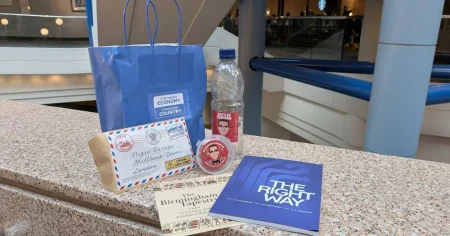


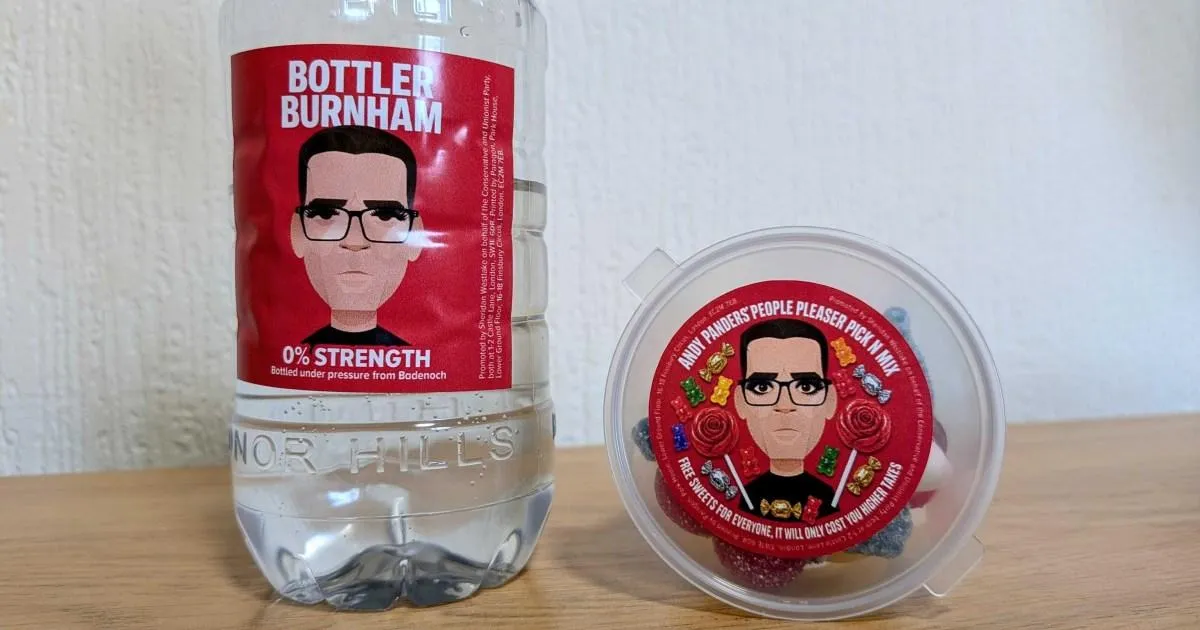
At the Conservative Party conference, the freebies handed to journalists were never going to be just a bottle of water and a few sweets. Party press teams know that the media pack likes a bit of colour, a talking point, something to photograph and tweet about. There was a certain festive atmosphere, the kind of low-key buzz that comes before the main speeches. But when reporters opened their goodie bags this year, they found themselves staring at something that blurred the line between political joke and artistic theft. There was a bottle of water labelled “Bottler Burnham” and a small tub of sweets called “Andy Panders People Pleaser Pick N Mix”. Both carried a cartoon of the Prime Minister that looked unmistakably like the work of Stanley Chow, the acclaimed illustrator whose portrait of Andy Burnham has become a fixture of British political imagery. Chow’s style is clean, bold and instantly recognisable; it has appeared on album covers, magazine covers and advertising campaigns, and it has a way of capturing a public figure’s essence with a few confident strokes. The image on the freebie was tweaked just enough to make it feel different—longer eyelashes, perhaps a softer line—but the resemblance was immediate and, for the artist, unmistakable. It was the kind of recognition that makes an artist’s heart sink: your work, your name, your craft, suddenly repurposed in a way you never agreed to. Journalists took photos, posted them online, and the image began to spread. Within hours, the artist himself was being tagged in comments and messages. It was a cheeky, satirical gift, the kind of thing party strategists love to hand out, designed to generate a chuckle and maybe a headline. Yet for all its playfulness, the gift raised a pointed and uncomfortable question: had anyone actually asked the artist if his work could be used? And more importantly, did anyone think they needed to? The answer, as it turned out, was no—and the artist was not going to let it slide.
Stanley Chow is not a household name in the way politicians are, but in the worlds of illustration, music and design, his work is widely admired. Born in Manchester, he has built a career creating images that feel both modern and timeless, from portraits of musicians to striking editorial illustrations. His cartoon of Andy Burnham, in particular, has become almost inseparable from the man himself. Burnham has used it as his profile picture on social media for years, long before he entered Downing Street, and it played a starring role in his by-election campaign in Makerfield, appearing on “For Us” posters across the constituency. For Chow, seeing that familiar face repackaged as a Tory conference trinket was not flattering. It was a violation. Taking to Instagram, he made his feelings clear: “It seems like @conservatives have been using my artwork without my permission at their conference party… Regardless of whatever your political allegiances are, it’s still copyright infringement… I’ll be seeking legal advice.” The post was blunt, and it struck a chord with anyone who has ever had their work used without credit or consent. This was not a politician complaining about unfair attack ads. This was an artist watching his creation being dragged into a partisan fight without being asked. The image had been a source of pride; now it was a source of frustration. And the fact that the Conservatives had altered it slightly—lengthening the eyelashes, softening a line here and there—made it worse, because it showed they knew they were borrowing something recognisable but hoped they could get away with it. To Chow, that was not just careless; it was disrespectful. He had given the Labour Party permission to use the image, and they had done so properly. There was a right way and a wrong way. The Conservatives, in his view, had chosen the wrong way. He also knew that this was not an isolated incident. The same cartoon had already been dragged into another political controversy months earlier, and that history made this new appropriation feel even more deliberate. He was not prepared to stay silent.
Chow later expanded on his frustration in an interview with the Manchester Evening News. He pointed out that he had not given the Conservatives permission to use his illustration, and that the party had not even considered his intellectual property rights. “They have not taken my IP rights into consideration, and have just done that,” he said. He also noted that while the Labour Party had used the image in the past, that was with his blessing. “The Labour Party could have owned that image, they could have infringed the Labour Party’s copyright. But the fact is, I licensed it to the Labour Party and it was okay for them to use.” The distinction matters. For Chow, this was not about party politics. It was about control. An artist’s work is their livelihood, their identity, their name. When a political party picks it up and stamps it on a bottle of water, it is no longer art. It is a weapon. And this was not the first time his work had been caught up in political controversy. He had previously taken legal action against Reform UK, after Nigel Farage’s party posted an AI-generated image on social media showing asylum seekers on a small boat holding signs that read “Vote Andy, For Us”, using Chow’s illustration. Reform later said it was removing the posts “in good faith and without any admission of liability”. It was not just about money, though damages would have been welcome. It was about the principle that creators deserve the same respect as any other professional. If a builder had been asked to erect a stage at the conference, the party would have paid for it. If a caterer had supplied the water, they would have expected a fee. But an illustrator’s work was somehow seen as free for the taking. For Chow, the pattern was becoming familiar. Politicians saw his art as a useful tool, something to be borrowed, tweaked and deployed for maximum impact, with no thought for the person who had made it. Each time, he had to raise his voice to be heard. Each time, the response was a half-apology, a quiet retreat, a hope that the story would go away. But he was determined not to let it go away.
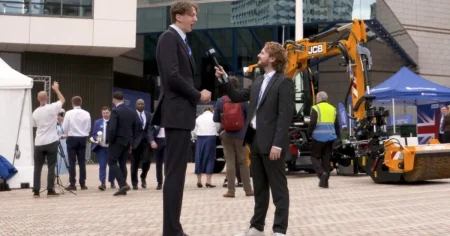
Context matters here. The Conservative Party Conference, which opened with a speech by leader Kemi Badenoch, is a moment when the party tries to frame the political narrative. It is a chance to set the tone, to show supporters and the wider public what the party stands for. The media goodie bag was clearly designed to be playful, even biting. Alongside the Burnham water and sweets were an invitation to the “Birmingham Tapestry”—an 80-foot parody of the Bayeux Tapestry depicting events since the 2024 election—and a brown envelope containing chocolate “Bitcoin” addressed to Nigel Farage. There is a long tradition of parties handing out witty, mocking gifts to journalists. It is part of the theatre of conference season, a way of softening the hard edges of politics and creating a shared moment of amusement. But there is a difference between inventing your own satire and borrowing someone else’s art to make a point. The “Bottler Burnham” bottle and “Andy Panders” sweets were not original creations; they were cheap, clever repackagings of an image that an artist had spent time and talent creating. For Chow, the fact that the Conservatives thought they could simply lift the cartoon and alter it slightly—lengthening eyelashes, adding a pun—was an insult. It suggested that the work of a creative professional was disposable, free for the taking, as long as the end product was a laugh. The party might have thought the gesture was harmless. But for artists, it was a familiar story: their craft, their hours of work, reduced to a party favour. A good satire should stand on its own feet. If the joke needs someone else’s artwork to land, it is not much of a joke. And if that artwork is used without permission, it is not satire at all—it is appropriation. The Conservatives, of all parties, should understand the value of original work. They had commissioned a huge tapestry, after all. They could have commissioned a cartoon too. Instead, they reached for something that already existed, something they did not own, and hoped no one would notice. Stanley Chow noticed.
The broader lesson is about ownership in an age where images are everywhere. Political parties, like the rest of us, have become accustomed to grabbing whatever visual works online. But for artists, that casual appropriation is anything but harmless. Stanley Chow’s work has a distinctive style, a particular energy. It is recognisable because of the skill behind it. When a party uses it without permission, they are not just stealing an image; they are stealing the artist’s voice. Chow’s threat of legal action is not about being precious. It is about principle. He made that clear when he said that political allegiances should not matter. “Regardless of whatever your political allegiances are, it’s still copyright infringement,” he wrote. That sentence cuts through the noise. In a hyper-partisan world, where every action is seen through a red or blue lens, Chow was insisting on a basic, non-negotiable truth: a creator’s rights do not disappear because you disagree with them, and they do not become irrelevant because you agree with the politician they depict. If the Conservatives wanted to use his art, they could have asked. They could have licensed it, as Labour did. Instead, they decided to take it, and then make it look slightly different. That is not satire. That is stealing. And the same goes for any party, on any side of the political spectrum. The artist’s frustration was not aimed at one party or another; it was aimed at a culture that treats creative work as a public resource, to be harvested whenever it is convenient. That culture is everywhere. Memes are shared without credit, photographs are cropped without permission, and illustrations are repurposed without a second thought. But the law is clear, and so is the principle: the person who made the work gets to decide how it is used. For Chow, the issue was not that the Conservatives had made fun of Andy Burnham. Political satire is as old as politics itself. It was that they had done it with someone else’s property, and then tried to disguise the theft with a few cosmetic changes. That is not clever. It is lazy. It is the sort of shortcut that devalues the work of every illustrator, designer and photographer who has ever been told, “It’s only a small project,” or “We’ll credit you later.”
Ultimately, this small controversy over a bottle of water and a tub of sweets is a reminder that political communication is not just about words. Images matter. They carry emotional weight, cultural memory and personal meaning. For Andy Burnham, Stanley Chow’s cartoon has been a symbol of his political identity. For Chow, it is a piece of his portfolio, a creation he nurtured and licensed carefully. For the Conservatives, it was apparently just a convenient prop for a joke. But the artist’s reaction has turned a trivial freebie into a story about respect—respect for intellectual property, for creative work, and for the people who make the visuals that decorate our political discourse. As the conference continues, and as journalists sip their “Bottler Burnham” water and unwrap their “Andy Panders” sweets, the taste may be a little sour. Because behind the clever packaging is a simple question: who owns the image, and who gets to decide how it is used? For Stanley Chow, the answer is clear. He does. And he is willing to fight for it. That may seem disproportionate for a party favour, but it is not. Every time a powerful institution takes something without asking, it sends a message that the creator does not matter. Every time an artist speaks up, it sends the opposite message. This story will probably be forgotten before the next conference season rolls around. The bottle of water will be recycled, the sweets will be eaten, the joke will fade. But the principle should remain. If you want to use someone’s work, ask. If you want to make a point, make your own. And if you find yourself lengthening an artist’s eyelashes so that you can pretend the artwork is yours, take a step back. You are not being clever. You are being caught. It is a lesson that extends far beyond politics. In schools, workplaces and social media, the same rules apply. Creativity is not a free resource. It is the product of time, talent and imagination. When we respect that, we respect the people behind it. When we ignore it, we invite the very reaction Stanley Chow gave the Conservatives: a public rebuke, a legal warning, and a reminder that art has an author. The Tories may have wanted a laugh. Instead, they got a lesson. And it is a lesson they will remember.