



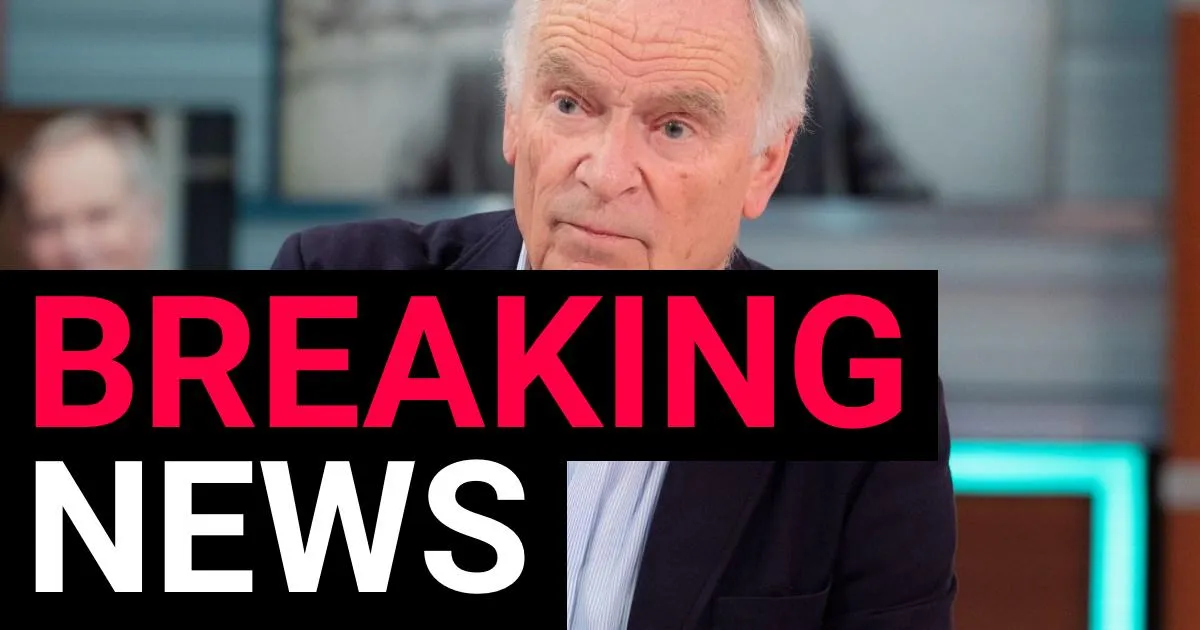
Jeffrey Archer has died suddenly at his home at the age of 86, leaving behind a literary empire and a life that always seemed too eventful to be contained by any single biography. His publisher, HarperCollins, confirmed that the former Conservative deputy chairman passed away peacefully on Monday, just as the world was preparing for the release of Adam & Eve, the novel he had insisted would be his last. The timing was almost unbearably symmetrical: a man whose entire existence had revolved around stories, deadlines, and second acts, slipping away on the threshold of one final publication. The day before his death, he had been at the Leicester Square Theatre in central London, surrounded by a sold-out crowd, signing books and sharing a stage with his friend, the broadcaster Gyles Brandreth. It was, by all accounts, a luminous evening. Archer was humorous, energetic, self-deprecating, and in magnificent form. He laughed, he charmed, he told stories. No one in that room could have imagined that within twenty-four hours the applause would turn into an obituary. For a man who had spent so many years manufacturing suspense, he could not have written a more haunting final scene: one last performance, one last book, and then silence. The “master storyteller” had promised that Adam & Eve would be his farewell, and in the strangest way, he kept that promise.
Archer was never a simple public figure. Before he became the world-famous author of Kane and Abel and dozens of other bestsellers, he was a political man with ambitions that reached far beyond the page. He served as a Conservative MP for five years and eventually rose to become deputy chairman of the Conservative Party. For a time, it seemed that his future lay in Westminster, not in the writing studio. But politics, like fiction, has a habit of delivering unexpected reversals. Archer found himself in financial ruin, a humiliation that might have ended many careers and crushed many ambitions. Instead, it became the turning point of his life. He turned to writing with the same hunger, discipline, and competitive fire that he had once reserved for elections. The early effort was not simply an attempt to make money; it was an attempt to remake himself. When Kane and Abel appeared, it transformed his fortunes and made him one of the most recognizable names in modern fiction. Millions of copies followed, and the man who had once been ruined became rich beyond his earlier imagination. It was a classic Archer plot: the hero loses everything, enters the wilderness, and returns stronger. In his case, the wilderness was the blank page. He had discovered that he could create worlds, control destinies, and please millions of readers in a way that politics never allowed. The reinvention was so total that it seemed to erase the earlier life, but the lessons of politics remained in his fiction: ambition, loyalty, betrayal, power, and the long shadow cast by secrets. He understood that people loved watching someone rise, and he gave them that story again and again.
Yet no life, especially one as dramatic as Archer’s, could be allowed to move in a straight line. His political career came to an abrupt and catastrophic halt in 2001, when he was jailed for perjury. The conviction followed an Old Bailey jury’s finding that he had lied in a libel action he had brought against The Star newspaper thirteen years earlier. In that original case, Archer had been awarded £500,000 in damages, a verdict that seemed to vindicate him. The later trial revealed that the testimony underpinning his victory was untruthful, and suddenly the comfortable role of aggrieved celebrity was replaced by something far more uncomfortable: the role of convicted criminal. It was a fall from grace that the tabloids devoured, and it appeared to mark the end of his public story. But Archer did not behave the way a disgraced figure was supposed to behave. He did not disappear into silence or self-pity. Instead, he took his prison sentence and turned it into material. While serving his time, he documented the drab rituals, the strange alliances, the boredom, and the occasional brutality of prison life in a three-volume non-fiction series called A Prison Diary. The subtitles—Hell, Purgatory, and Heaven—turned an institutional experience into a moral drama. He was not merely enduring his punishment; he was narrating it, shaping it, and, in a sense, rising above it. The series became a bestseller, proof that even behind bars Archer could still command the attention of the reading public. His release in 2003 did not signal a quiet retirement. He returned to the House of Lords, where he remained until he retired in 2024. To many, this second-act resurrection was as improbable as any twist he had ever written, and perhaps that was the point. Archer never allowed failure to become his final chapter.
HarperCollins’ tribute to Archer described his career as “the stuff of publishing legend,” and the evidence is difficult to argue with. He spent a total of fourteen years and five months on the Sunday Times bestseller lists and five and a half years on the New York Times bestseller lists. His books sold approximately three hundred million copies across one hundred and nineteen countries and were translated into forty-nine languages. Those are staggering numbers for any author in any era, but they only tell part of the story. The publisher’s statement emphasized that Archer was not just a storyteller but a relentless craftsman: an editor’s dream, phenomenally hard-working, utterly committed to completing draft after draft until every word was as perfect as possible. He believed in publishing as a team effort, and he never lost sight of what he owed to the readers who had made him rich and famous. For him, those readers “meant everything.” That devotion is visible in the way he approached Adam & Eve, the novel he knew would be his goodbye. He wanted to get it right. He wanted to leave on a high note. The book is set to be released later this month, and its arrival will now inevitably be read as an epitaph rather than simply a publication. It is hard not to imagine Archer plotting this ending himself, aware that death could not be edited out of his script. Even in leaving, he managed to remain at the center of attention, exactly where he always believed he belonged.
Perhaps the most human image of Archer’s final hours comes from Gyles Brandreth, who was with him the day before he died. Brandreth wrote on X that they had done a show together to celebrate the new novel, and that Archer had called it his last. “He was in the most wonderful, ebullient form and had such a great reception from a packed house. He was funny, engaging and self-deprecating—a great storyteller to the last.” The phrase “to the last” now carries a weight that no one expected when it was written. Archer had also been scheduled to appear at the Cheltenham Festival on Saturday to discuss Adam & Eve, meaning that his diary was still full, his story still being told, and his voice still in demand. There is something fitting about a man who spent so much of his life seeking applause receiving one final standing ovation before slipping away. He had met and signed books for hundreds of fans at that sold-out event in Leicester Square, a ritual he had performed countless times throughout his career. He was used to being the center of the room, but he was also genuinely aware of the people who had supported him for decades. They were not statistics to him; they were the reason he kept going. In his final public moments, he gave them what they had come for: the sparkle in his eyes, the easy anecdote, the sense that the story was far from over. Then, as morning broke, the story ended. There was no long illness, no slow fade, no chance to say goodbye in the conventional way. There was only the silence that follows a final chapter.
Behind the public legend was a private life that steadied him. Archer and his wife Mary had celebrated their sixtieth wedding anniversary this year, and they had two sons and five grandchildren. That long marriage, begun long before fame and scandal, is perhaps the most substantial source of stability in a life that was otherwise defined by turbulence. It is easy to remember Archer solely as the swaggering celebrity, the politician turned prisoner turned bestselling author, but those who loved him saw something else: a man capable of loyalty, humor, and warmth. Human beings are rarely simple, and Archer was a walking contradiction. He was a peer of the realm who spent time in prison; a politician who was ruined by a lie and then, without shame, returned to public life; a writer who turned even his own disgrace into profitable art; a millionaire who understood that readers had made him what he was. His legacy will always be contested. Some will remember the bestsellers; others will remember the courtroom. But both sides of the ledger add up to the same astonishing fact: Jeffrey Archer never stopped becoming someone else. He was an MP, a deputy chairman, an author, a convict, a diarist, a survivor, and finally a beloved legend who outlived his own disgrace. Now he is gone, and the world he leaves behind is quieter. Yet his stories remain, in millions of homes and in dozens of languages, and new readers will discover Kane and Abel long after his name has faded from the headlines. In that sense, he achieved what every storyteller secretly hopes for: a place in the afterlife of the imagination. On the eve of his final book, Jeffrey Archer died; but as with all great stories, the ending simply invites a new beginning.