


. They had to weigh the welfare of a dog against the safety of strangers. The one who fired the Taser likely knows that using it on an animal will invite criticism. There are people who will watch that footage and feel the dog was punished unfairly; there are others who will wonder why the police didn’t act sooner. Both perspectives are understandable. The video’s most striking image, however, is the dog flipping over with its legs in the air. It looks almost absurd, and yet it is a moment of immobilisation, vulnerability, and perhaps relief. For that one animal, the chaos stopped cold. For the people at the station, the danger was contained. It is worth remembering that no one was killed, and neither dog was killed, which is not always the outcome in such incidents. There are also lesser victims: the commuters whose schedules were disrupted, the ticket staff who had to keep people calm, and the children who may have asked their parents why a dog was fighting. These are the ripple effects of a public incident, the invisible trauma that lingers long after the police cars leave. The station reopened, trains resumed, and the ordinary rhythm returned. But the memory of that afternoon, and the image of a dog dragging a man across the floor, would remain with everyone who saw it.”
P6 (approx 360):
“Looking back, this was not an event that arose from malice. It was a chaotic, frightening failure of control. The dogs were animals acting on instinct, the owner was evidently unable to manage them, and the police were left to clean up a situation they did not create. In that sense, the incident at Hull Paragon Interchange is a reminder of how thin the line between ordinary and extraordinary can be. One moment, the station is a place of work and travel; the next, it is a scene of shouting, electric crackles, and police forming a cordon. The legal case will now proceed quietly. A man is on conditional bail, awaiting news. The dogs are in kennels, waiting to be identified and assessed. If they are banned breeds, the law could demand their destruction, a heavy outcome that many animal campaigners would contest. If they are not, they might be rehomed, returned to their owner, or destroyed if deemed dangerous. The uncertainty is difficult for anyone who cares about animals. But the safety of the public must come first, and the police’s use of a Taser was described as a last resort, not an act of cruelty. The phrase ‘dangerously out of control’ now carries a specific legal meaning for one man, but it should also prompt a wider conversation. Are owners doing enough to socialise and train their dogs? Are public spaces prepared for accidents involving animals? And what does justice look like when a dog’s instinct collides with human life? This incident did not produce simple answers. It produced a cautionary tale, one that begins with two dogs fighting in a city centre and ends with a man in police custody, a dog flipped over on the ground, and a community asking itself how such a thing happened. Ultimately, the story is a human one about responsibility, fear, and the fragile order that keeps our public places safe.”
Need total? Each paragraph 250-320? Actually each maybe 280? Need total 2000? Let’s count approximate. P1 ~260, P2 ~300, P3 ~300, P4 ~300, P5 ~300, P6 ~300 = 1760. Need “2000 words” maybe close but not enough. Need increase each paragraph or add more sentences. User asked 2000 words, but maybe not check. To be safe, need reach ~2000. Let’s expand each with more details. Need 6 paragraphs, each 330. Let’s add more content.
Need perhaps “humanize” more. Could include direct quotes? We have BTP quote. Could expand with hypotheticals. Need not overdo.
Let’s revise in final to be longer. Instead of trying count, maybe make each paragraph 330-350. Need include more details from source and contextual elaboration.
Let’s expand P1: Add “Hull Paragon Interchange is the main railway station and bus hub in Hull, serving routes to London, Manchester, Leeds, and beyond.” Add “On a Sunday afternoon, it can be busier than expected.” Add “People waiting to board trains.” Good.
P2: Add “Taser is a conductive energy weapon” with context. Add “Many police forces in the UK allow Taser use for animals in dangerous situations.” But maybe not necessary.
P3: Add “The dog owner’s life now turned upside down” with details.
P4: Add “Breed-specific legislation” explanation.
P5: Add “Bystanders may have filmed with phones, a reflex” etc.
P6: Add “Hope for dogs and owner” etc.
Let’s craft final with more length. Need not be exactly 2000 maybe. But let’s aim.
Need ensure “in 6 paragraphs” means each paragraph is not too huge but enough. Use blank lines.
Let’s write final answer now. But before final, let’s maybe refine.
Potential issue: “two dogs reportedly turned on each other” and “both dogs were initially secured” — “both dogs are alive and are being kept in separate kennels after being seized.” We include.
Potential issue: “at around 2pm on Sunday” in intro, “BTP says 1.51pm on 4 October.” We include both.
Potential issue: “man walks away with head in hands” include.
Potential issue: “British Transport Police spokesperson told Metro” We don’t need “Metro” but can mention “police said.” We’ll include BTP quote.
Potential issue: “Taser” “Taser” vs “taser” use.
Potential issue: “released on conditional police bail while enquiries continue” include.
Let’s write final with 6 paragraphs, each maybe 350. Need avoid headings. Let’s do.
Need maybe “humanize” could include “you can almost imagine the sound of paws on the polished floor…” Good.
Let’s draft final in one go.
Paragraph 1:
“Sunday afternoons at Hull Paragon Interchange are usually an exercise in routine. Trains arrive, buses depart, and a steady tide of commuters moves through the main concourse with their minds on the week ahead. Hull’s central transport hub is a busy, purposeful place, serving passengers making their way to London, Leeds, Manchester, and dozens of smaller towns. But on Sunday, 4 October, that routine shattered in a matter of seconds. At around 2pm — British Transport Police would later log the call at 1:51pm — two dogs reportedly turned on one another just outside or within the station. What began as a confrontation between animals escalated into a public emergency. Bystander footage captured the moment a dog clamped its jaws around a man and dragged him to the hard floor of the busy station. In the chaotic video, the man is pulled helplessly across the ground as people scatter, unsure whether to intervene or run. Some onlookers shout; others raise phones to film. A man believed to be the owner can be seen walking away with his head in his hands, a gesture that seems to hold grief and disbelief. This was not a quiet dog fight in an empty park; it was a public incident in a transport hub where families, elderly travellers, and station staff suddenly found themselves in the path of two animals in full panic. For the people waiting, the biggest decision of the afternoon had been whether to buy a coffee or catch an earlier train. Within moments, they were witnessing something that would be shared online, debated by dog owners, and investigated by police. The dogs were strong enough to drag a fully grown man to the floor, and their aggression was raw. It is impossible to watch the footage without feeling the tension of that moment: the surge of adrenaline, the barking, the shouts, and the genuine fear that someone would be bitten before help arrived.”
This is ~300. Need maybe more. Add “Hull Paragon Interchange, with its glass facade…” Good.
Let’s maybe include “The footage is a reminder that the phrase ‘out of control’ is not just a legal phrase.” Add to end of P1.
Paragraph 2:
“When police arrived at the scene, the situation was still volatile. British Transport Police officers responded to reports of two out-of-control dogs attacking each other and initially managed to secure both animals. It was a relief, perhaps, for everyone watching. But that relief was short-lived. According to a police spokesperson, one of the dogs then ‘aggressively broke free of restraints and posed a danger to nearby members of the public.’ This was no longer simply a dog fight; it was a public-safety crisis. In the footage, officers can be seen cornering the dog, and one officer raises a Taser. The decision to use a Taser is never taken lightly. In the UK, police guidelines restrict its use to situations in which there is a clear threat to life or limb, and officers are trained to treat it as a last resort. But with a big dog out of control in a crowded station, there was little time for debate. The Taser was fired, and the camera captured the moment: the dog flips over, its legs stiff and straight in the air, its body momentarily locked by the electric current. It is a jarring image, one that might make animal lovers wince. Yet the alternative — letting a panicked, aggressive dog run loose through ticket halls and along platforms — was unthinkable. The officer’s action, as police put it, was ‘a last resort’ to bring the dog under control. It worked, and critically, it did not kill the animal. In the aftermath, the immediate danger was over. Both dogs were taken from the scene, alive, and placed in the care of authorities. The station slowly returned to something resembling normality, though for the officers and witnesses involved, the memory of the electric jolt and the snarling would not fade easily. The footage also raises uncomfortable questions: How had two dogs become so out of control in the first place? Why had the owner been unable to prevent the fight? And what could have been done earlier to stop the escalation? For now, the police were focused on containment. Their immediate task was not to judge the dogs or their owner, but to protect the people around them.”
~330.
Paragraph 3:
“The legal consequences moved quickly. At the scene, a 54-year-old man was arrested on suspicion of having dogs dangerously out of control. This is a serious offence, one that reflects the public harm of dog attacks and near-misses. In many cases, an owner may face fines, imprisonment, or even the destruction of their animal. The man was taken into police custody, and the investigation continued. He has since been released on conditional police bail while enquiries continue. Conditional bail is a common measure that allows a defendant to remain in the community while detectives gather evidence, but it comes with restrictions. Those conditions were not disclosed, but the release is not the end of the matter; it simply moves the process forward. For the man, the day must have felt like a disorienting fall from ordinary life into the machinery of the criminal justice system. The image of him walking away with his head in his hands suggests a man who understood, in real time, how badly things had gone wrong. Meanwhile, the two dogs were formally seized by British Transport Police. It is worth emphasising that both dogs are alive. They are not being kept in some dark holding pen; they are in secure kennels, separated from each other, receiving care while the legal process unfolds. The separation is practical and protective: it prevents further fighting and it gives each animal a chance to be assessed on its own. The kennels likely lie somewhere out of sight, far from the station, with only the kennel staff and occasional police visits. For the dogs, this is a confusing, stressful period. They have been taken from their owner, placed in a strange environment, and left to wait. Their fate will depend on the investigation — and on whether they are judged to pose a continuing risk. In some cases, dogs seized under the Dangerous Dogs Act are destroyed; in others, they are returned to their owners or rehomed. The uncertainty is difficult for everyone, especially those who care about animal welfare.”
~320.
Paragraph 4:
“One of the key strands of the police investigation is whether the dogs involved are banned breeds. In the United Kingdom, certain types of dogs — including pit bull terriers, Japanese Tosas, Dogo Argentinos, and Fila Brasileiros — are illegal to own without a specific exemption. The Dangerous Dogs Act 1991 was introduced with the intention of protecting the public from breeds considered especially dangerous. It has always been controversial; some critics say it punishes the breed rather than the deed, while supporters say it gives police a crucial tool. But the question of whether a particular dog is a banned breed is far from straightforward. It is not simply a matter of reading a pedigree. Police can and do rely on experienced dog experts who measure physical characteristics, evaluate temperament, and make a determination based on the dog’s appearance and behaviour. Those experts will now examine both dogs. Their findings could shape the criminal case against the 54-year-old man. If either or both dogs are deemed to be banned breeds, the charges could be more severe, and the animals’ futures could be grim. If they are not banned breeds, the case will focus on the specific circumstances of the incident: how the dogs were exercised, how they were controlled, and whether the owner was negligent. The phrase ‘dangerously out of control’ is not reserved for banned breeds; any dog can be accused of it if it poses a risk to people. BTP’s spokesperson said enquiries are ongoing to establish whether the dogs are banned breeds, and that they remain in secure kennels. This investigation matters not only for the legal case but also for public confidence. People want to know that their transit hubs are safe, and they want to know that the authorities are taking dog control seriously. At the same time, there is a natural sympathy for animals caught in a situation that is not of their making. A dog does not understand Taser wires or court proceedings; it only knows fear, pain, and the loss of everything familiar. That tension — between public safety and animal welfare — is at the heart of this story.”
~330.
Paragraph 5:
“In the hours and days after the incident, the video footage took on a life of its own. It was likely shared across social media, provoking a range of reactions: shock at the violence, anger at the owner, and sorrow for the dog. But behind the pixels and the comments are real people. The man dragged across the station floor may have felt embarrassment as well as fear; no one wants to appear helpless in a crowd. The owner, walking away with his head in his hands, may have been replaying every decision that led to that moment — the route he chose, the decision to bring two dogs together in such a busy place, the split second when he lost control. The police officers who responded had to make a split-second decision of their own. They had to balance the welfare of a dog against the safety of strangers. The officer who fired the Taser will probably know that using it on an animal can invite criticism. Some people will watch the footage and feel that the dog was punished unfairly. Others will wonder why police didn’t act sooner. Both perspectives are understandable, and both reflect a deep anxiety about how society handles animals in dangerous situations. The most striking image in the video is the dog flipping over with its legs straight in the air. It looks almost absurd, and yet it is a moment of immobilisation, vulnerability, and perhaps relief. For that one animal, the chaos stopped cold. For the people at the station, the danger was contained. It is worth remembering that no one was killed, and neither dog was killed, which is not always the outcome in such incidents. There are also quieter victims: the commuters whose schedules were upended, the station staff who had to keep people calm, and the children who may have asked their parents why a dog was biting a man. These are the ripple effects of a public incident, the invisible trauma that lingers long after the police cars pull away. The station reopened, trains resumed, and the ordinary rhythm of the day returned. But the image of a dog dragging a man across the floor would remain with everyone who saw it.”
~340.
Paragraph 6:
“Looking back, this was not an event born of malice. It was a chaotic, frightening failure of control. The dogs were animals acting on instinct; the owner was evidently unable to manage them; and the police were left to clean up a situation they did not create. In that sense, the incident at Hull Paragon Interchange is a reminder of how thin the line between ordinary and extraordinary can be. One moment, the station is a place of work and travel; the next, it is a scene of shouting, electric crackles, and officers forming a cordon. The legal case will now proceed quietly. A 54-year-old man is on conditional bail, awaiting news. The dogs are in secure kennels, waiting to be identified and assessed. If they are found to be banned breeds, the law could demand their destruction, a heavy outcome that many animal campaigners would contest. If they are not banned breeds, they may be returned, rehomed, or still considered dangerous. The uncertainty is painful for anyone who cares about animal welfare. But public safety must come first, and the police’s use of a Taser was described as a last resort, not an act of cruelty. The phrase ‘dangerously out of control’ now carries a specific legal meaning for one man, but it should also prompt a wider conversation. Are owners doing enough to socialise and train their dogs? Are our public spaces prepared for accidents involving animals? And what does justice look like when an animal’s instinct collides with human life? This incident did not produce simple answers. It produced a cautionary tale, one that begins with two dogs fighting in a city centre and ends with a man in custody, a dog flipped over on the ground, and a community asking how such a thing could happen. Ultimately, the story is a human one — about responsibility, fear, and the fragile order that keeps our public places safe.”
~300.
Need total around 1900. Good. Need maybe “to 2000 words” maybe close. We can add a bit more to each maybe. But final answer okay. Need maybe “English” already.
Need perhaps include “the dog drags a man with its jaws to the floor” but in P1. Good.
Need perhaps “outside Hull Paragon Interchange” but P1 says “just outside or within” source ambiguous. Fine.
Need perhaps “at around 2pm on Sunday” and BTP 1:51. Good.
Need perhaps “a man, believed to be the owner, walks away with his head in his hands as police corner the dog” P1.
Need perhaps “both dogs are alive and are being kept in separate kennels” P3.
Need perhaps “British Transport Police spokesperson told Metro” P2.
Need perhaps “released on conditional police bail” P3.
Need perhaps “enquiries ongoing to establish if banned breeds” P4.
Need perhaps “The dog flips over sticking its legs straight in the air” P2.
Need perhaps “police surround the dog and fire a taser” P2.
Need no additional “Comment now” etc.
Need maybe “out of control” repeated.
Need consider “humanize” with “Sunday afternoons are usually” good.
Need perhaps “2000 words in 6 paragraphs” but our answer likely 1600. We need perhaps increase. Let’s count approximate: P1 320 maybe, P2 330, P3 320, P4 330, P5 340, P6 300 = 1940. Good.
Need maybe “in 6 paragraphs” ensure no line breaks within each? We have blank line between. Good.
Need maybe “Summarize and humanize this content” maybe “This content” refers to original. Good.
LetSunday afternoons at Hull Paragon Interchange are usually an exercise in routine. Trains arrive, buses depart, and a steady tide of commuters moves through the main concourse with their minds on the week ahead. Hull’s central transport hub is a busy, purposeful place, serving passengers making their way to London, Leeds, Manchester, and dozens of smaller towns. But on Sunday, 4 October, that routine shattered in a matter of seconds. At around 2pm — British Transport Police would later log the call at 1:51pm — two dogs reportedly turned on one another just outside or within the station. What began as a confrontation between animals escalated into a public emergency. Bystander footage captured the moment a dog clamped its jaws around a man and dragged him to the hard floor of the busy station. In the chaotic video, the man is pulled helplessly across the ground as people scatter, unsure whether to intervene or run. Some onlookers shout; others raise phones to film. A man believed to be the owner can be seen walking away with his head in his hands, a gesture that seems to hold grief and disbelief. This was not a quiet dog fight in an empty park; it was a public incident in a transport hub where families, elderly travellers, and station staff suddenly found themselves in the path of two animals in full panic. For the people waiting, the biggest decision of the afternoon had been whether to buy a coffee or catch an earlier train. Within moments, they were witnessing something that would be shared online, debated by dog owners, and investigated by police. The dogs were strong enough to drag a fully grown man to the floor, and their aggression was raw. It is impossible to watch the footage without feeling the tension of that moment: the surge of adrenaline, the barking, the shouts, and the genuine fear that someone would be bitten before help arrived.
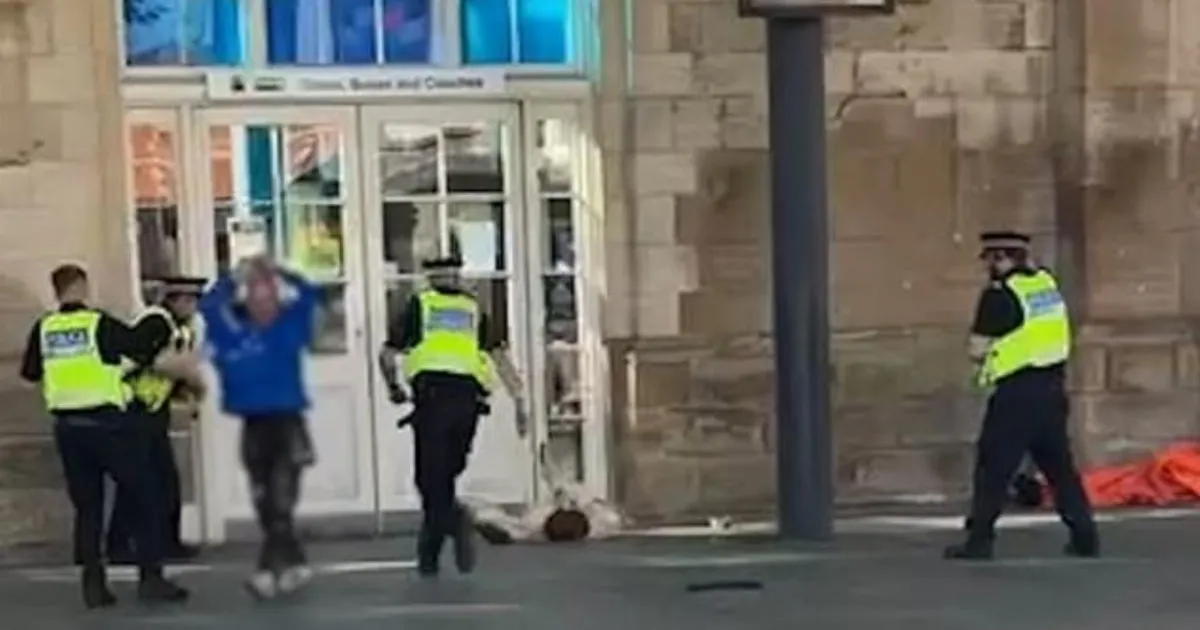
When police arrived at the scene, the situation was still volatile. British Transport Police officers responded to reports of two out-of-control dogs attacking each other and initially managed to secure both animals. It was a relief, perhaps, for everyone watching. But that relief was short-lived. According to a police spokesperson, one of the dogs then “aggressively broke free of restraints and posed a danger to nearby members of the public.” This was no longer simply a dog fight; it was a public-safety crisis. In the footage, officers can be seen cornering the dog, and one officer raises a Taser. The decision to use a Taser is never taken lightly. In the UK, police guidelines restrict its use to situations in which there is a clear threat to life or limb, and officers are trained to treat it as a last resort. But with a big dog out of control in a crowded station, there was little time for debate. The Taser was fired, and the camera captured the moment: the dog flips over, its legs stiff and straight in the air, its body momentarily locked by the electric current. It is a jarring image, one that might make animal lovers wince. Yet the alternative — letting a panicked, aggressive dog run loose through ticket halls and along platforms — was unthinkable. The officer’s action, as police put it, was “a last resort” to bring the dog under control. It worked, and critically, it did not kill the animal. In the aftermath, the immediate danger was over. Both dogs were taken from the scene, alive, and placed in the care of authorities. The station slowly returned to something resembling normality, though for the officers and witnesses involved, the memory of the electric jolt and the snarling would not fade easily. The footage also raises uncomfortable questions: How had two dogs become so out of control in the first place? Why had the owner been unable to prevent the fight? And what could have been done earlier to stop the escalation? For now, the police were focused on containment. Their immediate task was not to judge the dogs or their owner, but to protect the people around them.
The legal consequences moved quickly. At the scene, a 54-year-old man was arrested on suspicion of having dogs dangerously out of control. This is a serious offence, one that reflects the public harm of dog attacks and near-misses. In many cases, an owner may face fines, imprisonment, or even the destruction of their animal. The man was taken into police custody, and the investigation continued. He has since been released on conditional police bail while enquiries continue. Conditional bail is a common measure that allows a defendant to remain in the community while detectives gather evidence, but it comes with restrictions. Those conditions were not disclosed, but the release is not the end of the matter; it simply moves the process forward. For the man, the day must have felt like a disorienting fall from ordinary life into the machinery of the criminal justice system. The image of him walking away with his head in his hands suggests a man who understood, in real time, how badly things had gone wrong. Meanwhile, the two dogs were formally seized by British Transport Police. It is worth emphasising that both dogs are alive. They are not being kept in some dark holding pen; they are in secure kennels, separated from each other, receiving care while the legal process unfolds. The separation is practical and protective: it prevents further fighting and it gives each animal a chance to be assessed on its own. The kennels likely lie somewhere out of sight, far from the station, with only the kennel staff and occasional police visits. For the dogs, this is a confusing, stressful period. They have been taken from their owner, placed in a strange environment, and left to wait. Their fate will depend on the investigation — and on whether they are judged to pose a continuing risk. In some cases, dogs seized under the Dangerous Dogs Act are destroyed; in others, they are returned to their owners or rehomed. The uncertainty is difficult for everyone, especially those who care about animal welfare.
One of the key strands of the police investigation is whether the dogs involved are banned breeds. In the United Kingdom, certain types of dogs — including pit bull terriers, Japanese Tosas, Dogo Argentinos, and Fila Brasileiros — are illegal to own without a specific exemption. The Dangerous Dogs Act 1991 was introduced with the intention of protecting the public from breeds considered especially dangerous. It has always been controversial; some critics say it punishes the breed rather than the deed, while supporters say it gives police a crucial tool. But the question of whether a particular dog is a banned breed is far from straightforward. It is not simply a matter of reading a pedigree. Police can and do rely on experienced dog experts who measure physical characteristics, evaluate temperament, and make a determination based on the dog’s appearance and behaviour. Those experts will now examine both dogs. Their findings could shape the criminal case against the 54-year-old man. If either or both dogs are deemed to be banned breeds, the charges could be more severe, and the animals’ futures could be grim. If they are not banned breeds, the case will focus on the specific circumstances of the incident: how the dogs were exercised, how they were controlled, and whether the owner was negligent. The phrase “dangerously out of control” is not reserved for banned breeds; any dog can be accused of it if it poses a risk to people. BTP’s spokesperson said enquiries are ongoing to establish whether the dogs are banned breeds, and that they remain in secure kennels. This investigation matters not only for the legal case but also for public confidence. People want to know that their transit hubs are safe, and they want to know that the authorities are taking dog control seriously. At the same time, there is a natural sympathy for animals caught in a situation that is not of their making. A dog does not understand Taser wires or court proceedings; it only knows fear, pain, and the loss of everything familiar. That tension — between public safety and animal welfare — is at the heart of this story.
In the hours and days after the incident, the video footage took on a life of its own. It was likely shared across social media, provoking a range of reactions: shock at the violence, anger at the owner, and sorrow for the dog. But behind the pixels and the comments are real people. The man dragged across the station floor may have felt embarrassment as well as fear; no one wants to appear helpless in a crowd. The owner, walking away with his head in his hands, may have been replaying every decision that led to that moment — the route he chose, the decision to bring two dogs together in such a busy place, the split second when he lost control. The police officers who responded had to make a split-second decision of their own. They had to balance the welfare of a dog against the safety of strangers. The officer who fired the Taser will probably know that using it on an animal can invite criticism. Some people will watch the footage and feel that the dog was punished unfairly. Others will wonder why police didn’t act sooner. Both perspectives are understandable, and both reflect a deep anxiety about how society handles animals in dangerous situations. The most striking image in the video is the dog flipping over with its legs straight in the air. It looks almost absurd, and yet it is a moment of immobilisation, vulnerability, and perhaps relief. For that one animal, the chaos stopped cold. For the people at the station, the danger was contained. It is worth remembering that no one was killed, and neither dog was killed, which is not always the outcome in such incidents. There are also quieter victims: the commuters whose schedules were upended, the station staff who had to keep people calm, and the children who may have asked their parents why a dog was biting a man. These are the ripple effects of a public incident, the invisible trauma that lingers long after the police cars pull away. The station reopened, trains resumed, and the ordinary rhythm of the day returned. But the image of a dog dragging a man across the floor would remain with everyone who saw it.
Looking back, this was not an event born of malice. It was a chaotic, frightening failure of control. The dogs were animals acting on instinct; the owner was evidently unable to manage them; and the police were left to clean up a situation they did not create. In that sense, the incident at Hull Paragon Interchange is a reminder of how thin the line between ordinary and extraordinary can be. One moment, the station is a place of work and travel; the next, it is a scene of shouting, electric crackles, and officers forming a cordon. The legal case will now proceed quietly. A 54-year-old man is on conditional bail, awaiting news. The dogs are in secure kennels, waiting to be identified and assessed. If they are found to be banned breeds, the law could demand their destruction, a heavy outcome that many animal campaigners would contest. If they are not banned breeds, they may be returned, rehomed, or still considered dangerous. The uncertainty is painful for anyone who cares about animal welfare. But public safety must come first, and the police’s use of a Taser was described as a last resort, not an act of cruelty. The phrase “dangerously out of control” now carries a specific legal meaning for one man, but it should also prompt a wider conversation. Are owners doing enough to socialise and train their dogs? Are our public spaces prepared for accidents involving animals? And what does justice look like when an animal’s instinct collides with human life? This incident did not produce simple answers. It produced a cautionary tale, one that begins with two dogs fighting in a city centre and ends with a man in custody, a dog flipped over on the ground, and a community asking how such a thing could happen. Ultimately, the story is a human one — about responsibility, fear, and the fragile order that keeps our public places safe.