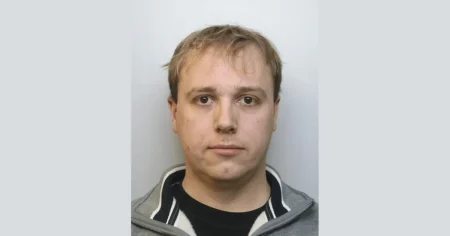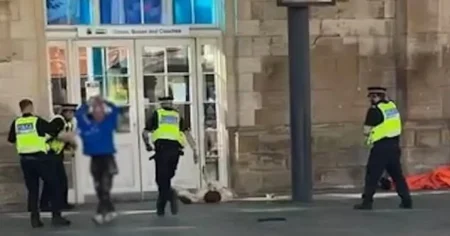


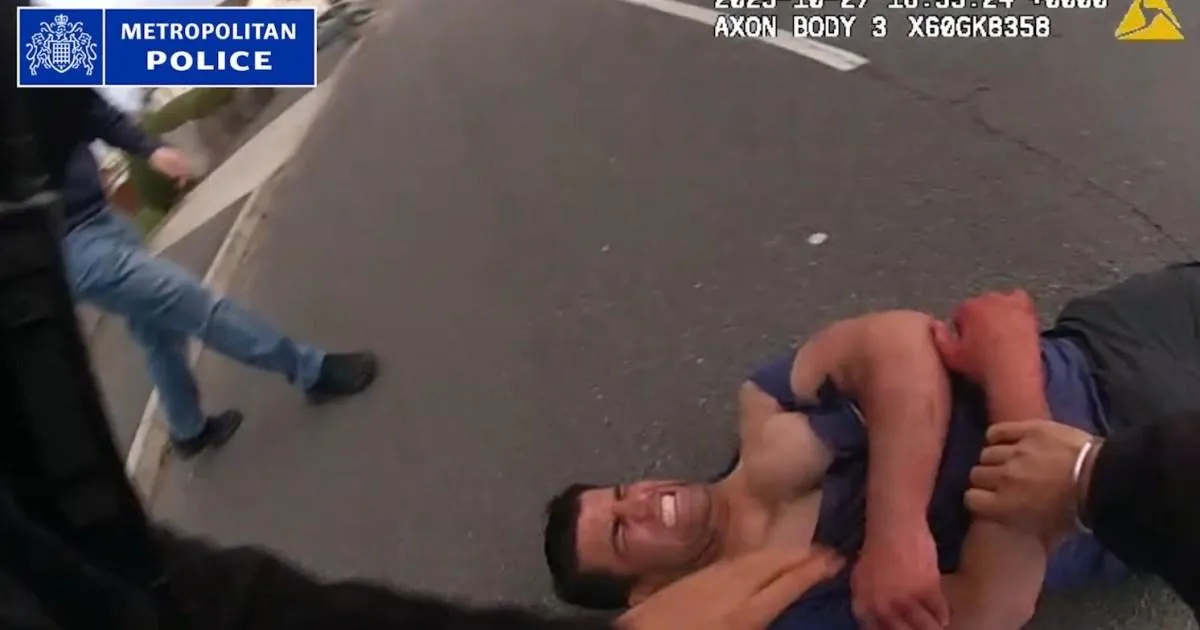
It began, as these tragedies often do, on an ordinary street in Uxbridge, in the kind of late-autumn evening when people are walking home from work, buying milk, checking their phones, and thinking about nothing more urgent than dinner. Wayne Broadhurst, a 49-year-old street cleaner, was doing what he likely did every day: taking his dog for a walk. Neighbors would later describe him as quiet, gentle, and unassuming—a man who moved through life without fuss and without wanting to be noticed. That stillness was shattered on the evening of October 27 when Dawood Safi, a 28-year-old Uber driver, erupted from his home on Midhurst Gardens in the middle of a terrifying knife rampage. In the space of a few minutes, Safi attacked his landlord, stabbed a 14-year-old boy, and finally caught up with Mr. Broadhurst on the street. He lunged at him with a knife and killed him. Wayne Broadhurst, a man described only as quiet, was stabbed to death while walking his dog, simply because he was in the wrong place at the wrong time—a phrase we use to make sense of the senseless, even though it never truly works.
The loss of Wayne Broadhurst leaves behind a grief that no court sentence can fully address. He was not a public figure, not a man whose name would have been recognized beyond his own circle. He was, by every account, one of those people who form the quiet backbone of a community: a street cleaner, someone who keeps the neighborhood tidy, someone whose work is easy to overlook until it stops being done. The word “quiet” appears over and over in the way people remembered him. It speaks to a personality that did not crave attention, a life built around small rituals—his dog, his route, his familiar streets. Those rituals are precisely what make his death so unbearable. He was not in a dangerous place. He was not engaged in a risky activity. He was walking his dog, perhaps enjoying the cool air, perhaps thinking about nothing at all, and then a man in the grip of a violent mental collapse came at him with a knife. There is something deeply cruel in that randomness. It reminds us that safety can disappear as suddenly as a shadow crossing a streetlight, and that the ordinary world we trust to hold us can, in a flash, become the setting for our worst nightmare. His family and friends are left with a chasm that no explanation will ever fill.
To understand how such a moment happened, you have to look at the long and troubled path that brought Dawood Safi to Britain. Safi was an Afghan refugee who arrived in the UK in 2020, hidden in the back of a lorry—a journey thousands of desperate people make every year, fleeing war, poverty, and persecution. But Safi’s story was not straightforward. In order to secure leave to remain, he lied about his age, claiming to be younger than he was. By the time the true facts came out, he had been granted a legal foothold in the country. For a time, he appeared to be building a life. He found work as an Uber driver. He had a home, a landlord, a routine. On the surface, he was the kind of migrant that many people would point to as a success story: someone who had arrived with nothing and was trying to make something of himself. Yet behind that surface lay serious instability. The same mind that had learned to adapt to a new country, a new language, a new identity, was quietly unraveling. In the days before the attack, he experienced what the court later described as a collapse in his mental health. He became convinced that his family was conspiring against him, that imagined enemies were closing in. He began hearing voices. Paranoid delusions took root and grew until they overwhelmed his ability to distinguish between what was real and what was not.
The attack itself was swift and terrifying. It began inside Safi’s home, where he attacked Shahzad Farrukh, his landlord—a contractor who also worked for Thames Valley Police. Safi was in a state of profound psychosis, gripped by the belief that the people around him were threats. After the attack on his landlord, the violence spilled out onto the street. A 14-year-old boy was stabbed. And then Wayne Broadhurst, walking his dog, came into view. Witnesses who saw Safi that evening described him as looking “possessed,” his eyes wild, his movements uncontainable. It is a chilling phrase, but it also points to something important: the man who killed Wayne Broadhurst was not a calculating killer carrying out a plan. He was someone in the grip of a medical emergency so severe that his own mind had become his enemy. That does not lessen the suffering of his victims, and it does not bring Wayne back, but it helps explain how a harmless evening walk could end in murder. It also raises hard questions about mental health care, about the limits of responsibility, and about the many warning signs that must have existed before this catastrophe. The court heard that Safi was suffering from paranoid delusions and auditory hallucinations. He believed his own family was plotting against him. In such a state, every face is a threat, every shadow an ambush, every innocent person a potential assassin.
On January 24, Southwark Crown Court sentenced Safi to an indefinite hospital order for manslaughter. This is not the same as a fixed prison sentence. It is an order that recognizes both a serious offense and a serious mental disorder. Safi will be detained in a secure psychiatric hospital, where he will receive treatment for the psychosis that drove him to kill. He will not be released simply because a certain number of years have passed. His release will depend on evidence that his condition has improved to the point where he no longer poses a danger to the public. In practical terms, this could mean decades in a hospital, or it could mean the rest of his life. The court was not giving him a free pass; it was acknowledging that he was not acting with full criminal intent when he took Wayne Broadhurst’s life, because his mind had collapsed under the weight of severe mental illness. For the family of Wayne Broadhurst, this may feel like a hollow or even insulting outcome. A man is dead, and his killer will receive treatment instead of punishment. But the law has long recognized that people who commit violent acts while in the grip of psychosis are not the same as people who commit cold-blooded murder. The tragedy is that so many people, long before this night, could have intervened to prevent the illness from becoming a catastrophe.
If there is any lesson to be drawn from this awful case, it is that the systems meant to protect us all are pressed to their limits. Safi lied about his age when he arrived in Britain, and the Home Office was unable or unwilling to properly assess that claim. He was granted leave to remain on the basis of a false identity, and no one seems to have noticed or, if they did notice, no one acted in time. He was employed, housed, and connected to a landlord who had no way of knowing that the man renting a room from him was descending into psychosis. The mental health services that should have caught him before he reached the point of no return were absent, inadequate, or unresponsive. And well before all of that, the fact that a child fleeing Afghanistan had to endure such a dangerous journey, and such an uncertain welcome, points to deeper failures in how we treat refugees and asylum seekers. None of this excuses the crime. None of it brings back Wayne Broadhurst, and none of it lessens the terror that the 14-year-old boy and the landlord experienced that night. But if we are truly going to humanize this story, we must see all of the people in it as human beings: Wayne, whose ordinary life was cut short; the teenage boy who survived but will carry the memory forever; the landlord, recovering from an attack by someone he trusted; and Safi himself, a man who came to Britain seeking a life and ended up becoming a killer because his mind broke and no one was there to hold it together. Justice has been served in the only way the law could serve it. But the real justice would have been preventing the knife from ever coming out, and that demands not only better punishment after the fact, but better care before the collapse. Wayne Broadhurst deserved his quiet evening walk. He deserved safety in a neighborhood he helped keep clean. And in the end, the best way to honor his memory is not simply to condemn the man who killed him, but to ask why so many warning signs were missed—and to promise that the next quiet person walking their dog will be protected by a system that sees danger before it strikes.