

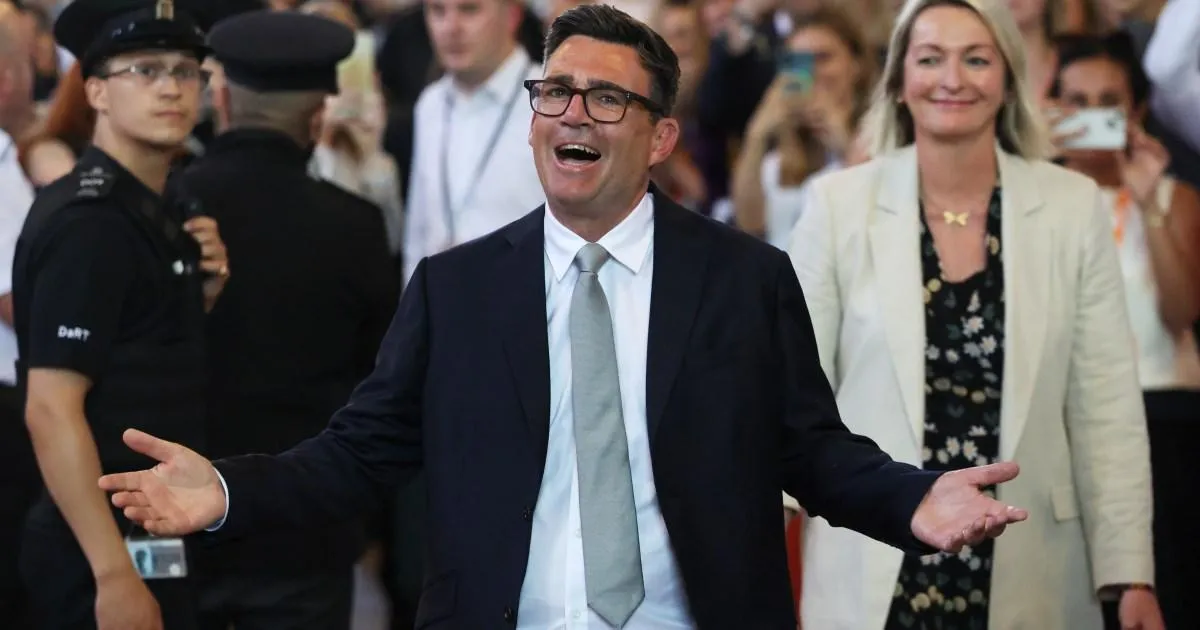
The transition of power in British politics is rarely a smooth affair, yet the current political climate feels particularly volatile. Andy Burnham, recently returned to the halls of Westminster following a successful by-election, finds himself in an enviable yet precarious position. As the dust settles on Keir Starmer’s departure, Burnham has emerged as the clear frontrunner for the Labour leadership. Recent polling data from Ipsos paints a picture of a nation searching for a steady hand, with many voters viewing the former Mayor of Greater Manchester as the most capable candidate among his peers. However, the path to Downing Street is paved with both public confidence and significant underlying skepticism regarding the broader state of the Labour Party.
The numbers provide a fascinating insight into how the public perceives the current crop of political leaders. Burnham currently enjoys a favorable rating, with 35% of respondents believing he would do a good job as Prime Minister—a notable contrast to the 24% who suspect he would struggle. In a political landscape often defined by intense polarization, he stands out as the only major figure in the survey with a net-positive trust score. In comparison, Tory leader Kemi Badenoch faces an uphill battle, with 37% of the public predicting a lackluster performance, while more than half of those surveyed expressed doubts about Nigel Farage’s suitability for the top office. This data suggests that while Burnham has the public’s initial goodwill, his rivals are struggling to foster similar feelings of security among the electorate.
Despite this momentum, Burnham’s journey is not without its internal friction. There was long-standing speculation that Darren Jones, a prominent Starmer loyalist, might launch a challenger campaign to represent those frustrated by the abrupt transition of power. However, that threat has largely evaporated following a productive, private dialogue between the two regarding the nation’s economic future. With Jones stepping aside, the prospect of a quiet, streamlined coronation for Burnham seems increasingly inevitable. Yet, this “coronation” narrative carries its own distinct risks; the public, it seems, is wary of an unchallenged transition, with a significant 39% of voters explicitly calling for a fair contest rather than a pre-ordained promotion.
The desire for a democratic process during this leadership transition speaks volumes about the current mood of the country. Many voters clearly crave a sense of vigorous debate and accountability, feeling that a contest would provide a more legitimate mandate for the next Prime Minister. This sentiment is amplified by a deeper, more pervasive doubt concerning Labour’s ability to provide “strong and stable leadership” in the vacuum left by the previous administration. With over six out of ten voters expressing skepticism about the party’s current capability, Burnham faces an immediate burden of proof. He must not only secure his position but must also swiftly convince a weary public that Labour possesses a concrete, long-term vision for the country’s stability.
Experts monitoring these trends suggest that while Burnham is arguably the most palatable option currently on the table, he is inheriting a mountain of work. Keiran Pedley, the Director of Politics at Ipsos, notes that while Burnham’s positive polling compared to Farage and Badenoch is a strong starting point, it is far from a guarantee of success. Once he assumes office, the honeymoon period will likely be brief, if it exists at all. The electorate is not just looking for a new face; they are looking for solutions to systemic uncertainty. Burnham’s task is to transition from being the “King of the North” to a national leader who can soothe anxieties about the future and prove that his party is more than just a collection of successors.
Ultimately, we are watching a significant pivot point in British governance. Whatever path Burnham takes—whether through the friction of a leadership contest or the swiftness of an appointment—he is stepping onto a stage defined by heavy scrutiny. The public is paying closer attention than usual, perhaps desperate for the kind of consistent leadership that feels absent from recent headlines. As he prepares for the realities of the Premiership, Burnham will need to bridge the gap between his current, favorable approval ratings and the broader, nagging doubts about his party’s stability. In the coming weeks, the focus will shift from the political maneuvering in Westminster to the substantive policies the new administration proposes, and whether those plans can truly restore faith in the office of the Prime Minister.