


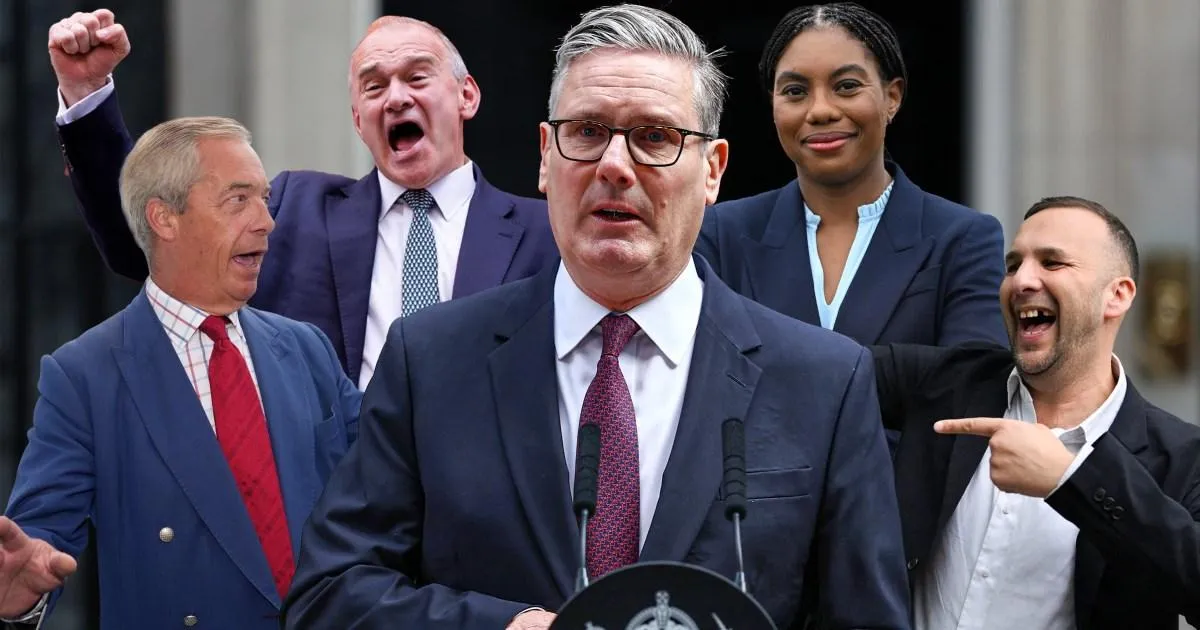
The resignation of a Prime Minister from the steps of Downing Street has become a wearying punctuation mark in British public life, transforming what should be a solemn constitutional moment into a routine performance. Yet, beyond the grand speeches and the moving vans, there is a secondary, quieter, and arguably more cynical drama that unfolds: the reaction of the opposition. It is a peculiar political tightrope where leaders must balance the impulse to gloat with the risk of appearing ungracious. History tells us that even the most embattled leaders receive a sudden, paradoxical boost in public sympathy the moment they announce their departure—a “dignity dividend” that catches out those who lean too heavily into mockery. As Sir Keir Starmer steps down after a tumultuous period in office, the political landscape is buzzing not just with his exit, but with the calculated responses of his rivals, who must decide whether to be magnanimous or predatory.
For Sir Keir, the final curtain comes after less than two years in the job—a period often defined by a sense of accelerating chaos and persistent disconnection from the public. While the Westminster bubble is already pivoting toward his all-but-certain successor, Andy Burnham, the airwaves remain filled with the post-mortem of Starmer’s leadership. The shift is constant, and the political machinery is already grinding into its next cycle, leaving little room for reflection. As the dust settles on the Starmer era, the various party leaders have offered responses that range from standard, stiff-upper-lip pleasantries to the sharp, metallic tang of partisan warfare, revealing more about their own brands and anxieties than about the man who has just been ushered out of Number 10.
Nigel Farage, characteristically, opted for the role of the agitator, bypassing the traditional media to frame Starmer’s exit as his own personal trophy. Writing on his Substack, the Reform leader cast himself as a political kingmaker, claiming credit for “deposing” not just Starmer, but a string of predecessors including Cameron, May, and Sunak. There was no room for farewell courtesies in his assessment; instead, Farage utilized the moment to establish a new frontline against the impending arrival of Andy Burnham. By questioning the democratic legitimacy of a leader who was not present in Parliament during the last general election, Farage is setting the stage for his next campaign, framing a Burnham premiership as an undemocratic appointment by a “uniparty” that refuses to listen to the will of the people.
Farage’s rhetoric is a masterclass in populist positioning, shifting the focus from the outgoing leader to a demand for a fresh general election. He paints the current political turnover as a repetitive cycle of “washed-up has-beens” being swapped out by the establishment, positioning his own party as the only vehicle for “real change.” It is a sharp, aggressive narrative designed to appeal to those who feel the Westminster system is a closed loop, uninterested in the concerns of ordinary voters. By preemptively attacking the legitimacy of a potential Burnham government, Farage isn’t just looking backward at Starmer’s failure; he is proactively trying to delegitimize the transition before it even begins, keeping the pressure on the Labour Party as it attempts to stabilize its leadership.
On the other side of the divide, Conservative leader Kemi Badenoch chose a path that stands in stark contrast to the performative politeness politicians often adopt when a rival exits the stage. While Starmer previously offered a relatively gracious tribute to Rishi Sunak regarding his decency and service, Badenoch clearly decided that such pleasantries were not in order. Instead of observing the customary quiet of a transition period, she went on the offensive immediately, sharing a litany of grievances and what she categorized as failures of the Starmer administration. From tax policies and welfare reform to the controversial appointment of Peter Mandelson, her statement functioned more as a scorched-earth critique than a reflection on a departing colleague, signaling the specific tone she intends to strike in opposition.
Ultimately, these reactions underscore a shift in the modern political climate, where the art of the “statesmanlike goodbye” is rapidly being replaced by the immediacy of digital warfare. There is little appetite for the performative unity of the past; instead, the race to frame the past, present, and future is instantaneous. Whether the public tires of this constant combat or remains energized by it, the departure of Sir Keir Starmer serves as yet another reminder that in Westminster, the only thing that moves faster than a Prime Minister’s exit is the desperate, hungry scramble to control the narrative that follows. As the baton passes to a new generation, the cynicism remains, proving that while the players change, the high-stakes game of post-resignation positioning remains a constant, often brutal, feature of our national life.