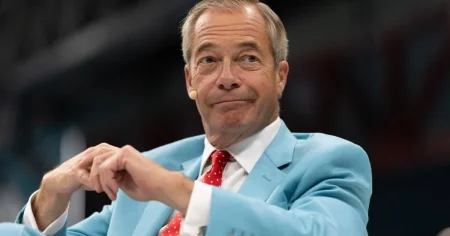



Nigel Farage’s campaign to retain his seat in Clacton recently took a detour that felt more like a scene from a sitcom than a high-stakes political contest. While canvassing in the seaside town—a maneuver he initiated by resigning his post to trigger a snap by-election—the Reform UK leader found himself stumbling, quite literally, into a private birthday celebration. It was the kind of surreal, human moment that often punctuates the grind of modern campaigning. As he was chatting up locals, word filtered back that a party was underway nearby. Never one to turn down a photo opportunity or a chance at engagement, Farage decided to march straight into the event, leaving the guests momentarily stunned before the surprise shifted into the kind of polite, bewildered cordiality that British culture famously demands.
The encounter itself was surprisingly warm. The man celebrating his birthday, perhaps caught off guard by the sudden appearance of one of Britain’s most polarizing figures, didn’t recoil; instead, he shook Farage’s hand and openly declared himself a “big supporter.” Farage, ever the showman, played the role of the affable guest, soaking up the brief, upbeat atmosphere before heading back to the business of the campaign trail. For a few minutes, the partisan vitriol that usually surrounds the Reform UK leader was replaced by the simple, awkward politeness of strangers meeting at a party. Farage later remarked that the interaction was “great fun,” a rare moment of light-heartedness in what has otherwise been a challenging and contentious fight to convince the electorate of Clacton that they should place their trust in him once again.
However, the levity of a chance party meeting sits in stark contrast to the mounting professional and legal pressures darkening Farage’s campaign horizon. Farage has framed this self-imposed by-election as a bold act of defiance against the political “establishment,” yet he is doing so while operating on a battlefield where most major parties have opted out, leaving him to spar with niche figures like Count Binface and the Monster Raving Loony Party. Beneath the surface of this unconventional race, the real tension isn’t coming from his electoral opponents, but from the relentless scrutiny being applied to his party’s coffers. The optics of a “man of the people” narrative are being increasingly strained by complex and concerning reports regarding the origin of the millions of pounds funding Reform UK’s operations.
The core of the storm involves intense scrutiny from both the Parliamentary Standards Commissioner and the Metropolitan Police. Specifically, investigators are digging into allegations that a £5 million “gift” from crypto billionaire Christopher Harborne was either improperly declared or handled. Adding a layer of intrigue and scandal to the mix is the ongoing probe into £500,000 worth of donations tied to Fiona Cottrell, the mother of George Cottrell, a convicted fraudster who served time in a US prison. Reports suggest that substantial amounts of money were shuttled from the son to the mother’s account before filtering into the party’s financial veins. These aren’t just minor administrative hiccups; they are serious allegations concerning the integrity of party financing that threaten to undermine the very populist platform Farage is running on.
The complexity of these financial trails is daunting, involving intricate transfers between foreign accounts, family members, and holding companies like “Britain Means Business”—a firm controlled by Farage’s deputy, Richard Tice. While both Farage and his party leadership have consistently maintained their innocence, the Metropolitan Police have launched a formal investigation into suspected offenses under the Political Parties, Elections and Referendums Act. This isn’t a mere partisan spat; it is a serious legal process. Two individuals have already been interviewed under caution as detectives from the Met’s special inquiry team scrutinize how these funds moved through the system. For a leader who prides himself on transparency and “straight-talking,” this opaque financial labyrinth is becoming a persistent thorn in his side.
Ultimately, Farage’s return to Clacton is defined by this duality: the man shaking hands at a birthday party, attempting to project stability and connection, versus the man navigating a political storm of institutional scrutiny and donor controversy. He may find the voters of Clacton receptive in the short term, but the long-term viability of his movement is now inextricably linked to the outcomes of these police inquiries. As he tries to “stick two fingers up” to the political establishment, he is finding that the establishment—through its regulators and investigators—is closing in on him. Whether he can win the seat remains to be seen, but the road to maintaining his authority as a political leader has become significantly more perilous than a simple walk through a seaside town.