
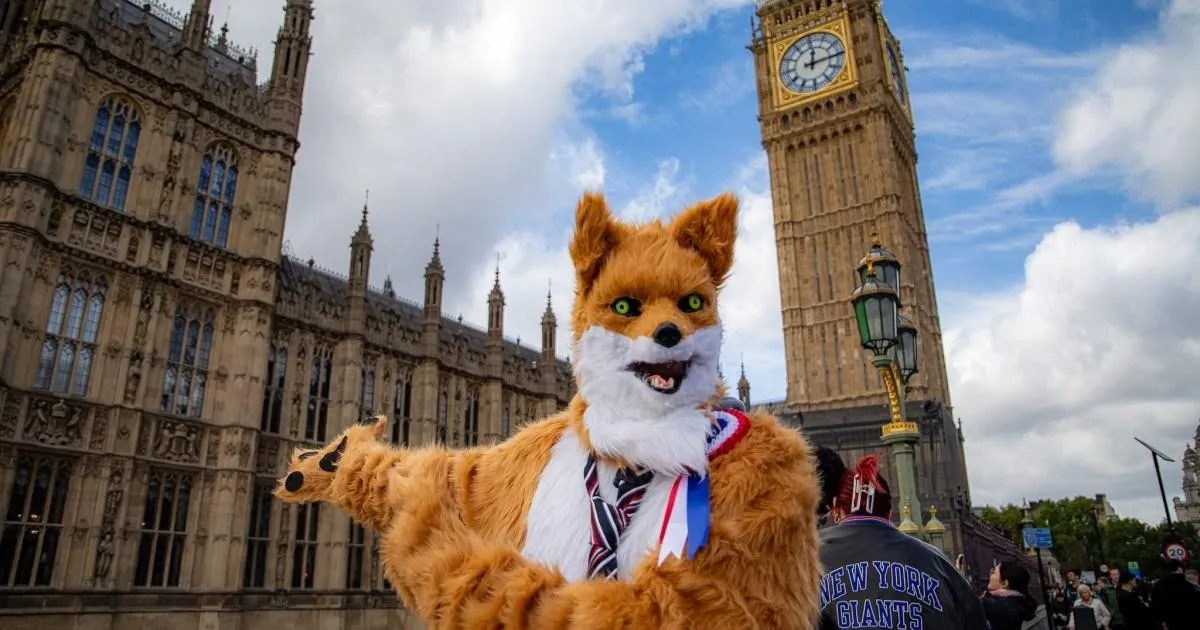
The world of British politics has always had a flair for the eccentric, but the upcoming Clacton by-election took a turn for the truly surreal when Rob Pownall, a 27-year-old animal welfare campaigner, threw his hat into the ring. Dressed in a fox costume with piercing yellow eyes—a gimmick designed to highlight the plight of British wildlife and draw attention to Nigel Farage’s historical support for fox hunting—Pownall had hoped to turn the ballot box into a platform for environmental activism. Having previously run in the Makerfield by-election and the Scottish Parliament elections dressed as various species, Pownall was no stranger to the unconventional, yet his entry into the Clacton race was met with an unexpected backlash from those who feared he might dilute the impact of the “protest vote.”
As the political atmosphere in Clacton grew increasingly chaotic, Pownall found himself caught in an unintended struggle for relevance. While he viewed his campaign as a serious attempt to champion animal rights, many online critics saw his presence as a mere distraction that could fracture the vote among “novelty candidates.” The narrative surrounding the by-election quickly shifted to frame it as a symbolic clash between Reform UK’s Nigel Farage and the wildly popular “independent space warrior,” Count Binface. Despite Pownall’s campaign group, Protect the Wild, repeatedly insisting that his candidate footprint would be statistically negligible, the pressure of navigating this crowded field clearly took its toll.
Ultimately, the circus-like atmosphere proved too much for Pownall to stomach. In a candid video released to his followers last night, the campaigner officially withdrew from the race, bluntly labeling the entire by-election a “farce.” Pownall expressed his growing discomfort with the shifting landscape of the election, specifically citing the influx of polarizing figures such as right-wing provocateur Laurence Fox and television personality Luke Worley. He reasoned that his environmental cause, which requires genuine, thoughtful discourse, could not possibly be served by sharing a stage with such disruptive and high-profile contrarians, lamenting that the event had devolved from a political debate into something far closer to a spectacle.
The backdrop to this withdrawal is the ongoing drama surrounding Nigel Farage, who unexpectedly resigned his seat to force this by-election under the guise of fighting “the establishment.” His move has been widely dismissed by major political parties as an expensive vanity project, essentially clearing the stage for a bizarre collection of fringe players, celebrity candidates, and political spoilers. With traditional political discourse largely absent from the contest, the void has been filled by figures like Piers Corbyn and, most notably, Count Binface. The latter has managed to capture the public imagination in a way that few could have predicted, becoming a vessel for genuine voter frustration.
Count Binface, the satirical, intergalactic-themed character, has somehow emerged as the frontrunner in the public’s sentiment, if not their serious political aspirations. His appeal is so vast that even senior cabinet figures like Rachel Reeves and David Lammy have found themselves forced to acknowledge him, while major polls have shown a significant portion of the electorate cheering for his victory as a means of mocking the Reform UK leader. Even political heavyweights like Andy Burnham have publicly signaled their support, framing the bin-headed candidate as the bearer of the nation’s hopes, a sentiment that stands in stark contrast to Farage’s attempts to dismiss the conflict as merely “silly.”
By stepping away, Rob Pownall has highlighted the inherent irony in modern political stunts: when everyone is trying to make a statement, the message becomes white noise. While Pownall’s attempt to bring animal welfare to the heart of a by-election failed under the crushing weight of the “Clacton circus,” his exit serves as a quiet reminder of the limitations of performative politics. Whether one agrees with his methods or finds them absurd, his brief run demonstrates just how crowded and surreal the political arena has become, leaving voters to navigate a landscape where it is increasingly difficult to distinguish between legitimate political protest and a total breakdown of serious democratic process.