


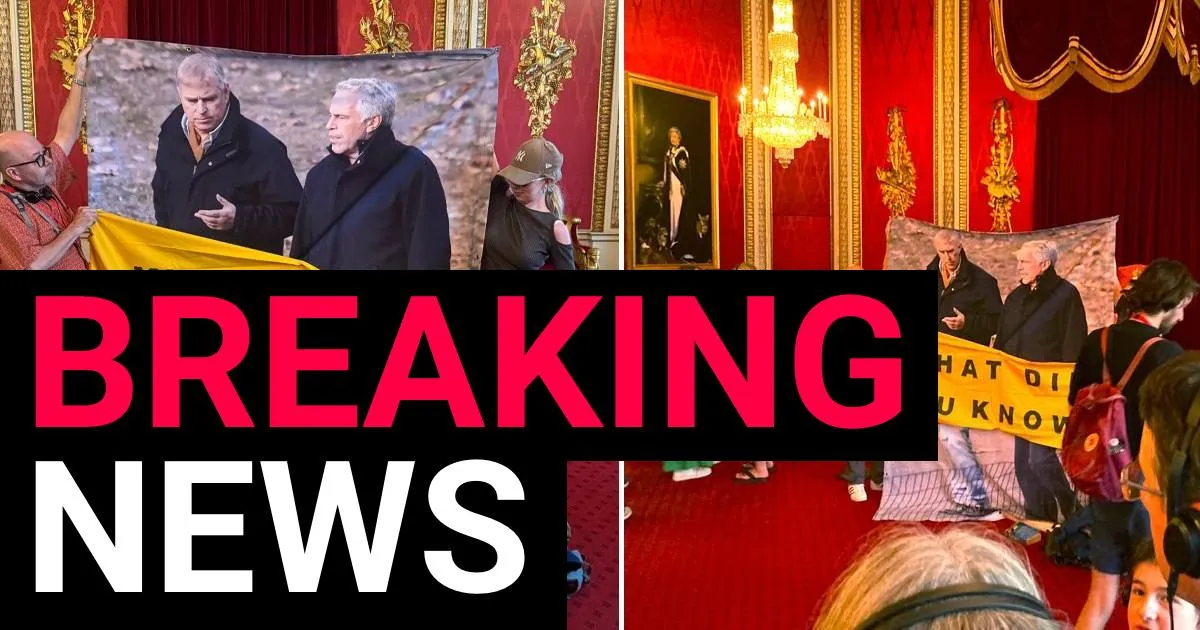
In a striking display of protest, activists from the anti-monarchy campaign group Republic managed to infiltrate the heart of the British establishment, staging a daring demonstration inside Buckingham Palace. By simply purchasing standard tourist tickets and blending in with the crowds, these protesters gained access to the Throne Room, where they unfurled a banner featuring a photograph of Prince Andrew alongside the late, notorious sex offender Jeffrey Epstein. The banner, boldly emblazoned with the provocative question, “What did you know?”, served as a stark reminder of the lingering shadows that continue to haunt the Royal Family long after the Prince was forced to retreat from public life.
The ease with which the activists maneuvered through such a high-security location has sparked significant questions regarding the protection of the King’s official residence. Graham Smith, the chief executive of Republic, noted that the security environment within the Palace felt unexpectedly lax, suggesting that an ordinary visitor could access sensitive areas with surprising freedom. According to Smith, when wardens eventually intervened, the group was already in the process of departing, having successfully made their point without meeting any significant resistance. While the Royal Collection Trust, which manages tours of the Palace, declined to address the security breach, the incident highlights a growing vulnerability for an institution that prides itself on both tradition and absolute protection.
The focus of this protest remains the controversial and extensively documented relationship between Prince Andrew and Jeffrey Epstein. This association, which became a global scandal, ultimately led to the Prince stepping back from his royal duties in 2019 and being stripped of his military titles and patronages by King Charles last year. The gravity of the situation was compounded by allegations from Epstein survivor Virginia Giuffre, who claimed she was trafficked to the Prince as a minor. While Prince Andrew has consistently and vehemently denied any wrongdoing, and a civil lawsuit filed by Giuffre was settled in 2022, the public’s appetite for transparency remains unquenched.
For the activists at Republic, the protest was not merely a reaction to the past, but a demand for accountability regarding the present Royal leadership. The banner acted as a confrontational tool, pushing the narrative that the scandal surrounding the former Duke of York was never a singular issue confined to one man, but a matter that should have prompted earlier introspection from the highest echelons of the monarchy. By physically placing the incriminating image within the Palace walls, the protesters aimed to force a conversation that the institution would perhaps prefer to leave firmly in the archives.
Graham Smith’s rhetoric remains pointed, emphasizing his skepticism toward the idea that King Charles or the Prince of Wales were unaware of the gravity of the allegations against Andrew for years. He argues that the public finds it difficult to believe that the inner circle of the Royal Family was not briefed on the nature of these accusations long before the press brought them into the harsh light of public scrutiny. This growing lack of public trust is a central pillar of Republic’s campaign, suggesting that the monarchy’s silence on the matter is interpreted not as discretion, but as a failure of moral responsibility that continues to undermine their authority.
Ultimately, this incident serves as a symbolic victory for those who advocate for a dramatic shift in how the monarchy is handled in modern Britain. Whether the Palace responds with increased security measures or, more significantly, with a formal statement addressing these ongoing concerns, the protest serves as a reminder that the “mad world” of British politics is evolving. As the line between private life and public accountability continues to blur, protesters are finding that even the most secure royal fortresses are not immune to the demands of a public that is increasingly unwilling to accept silence in the name of tradition.