



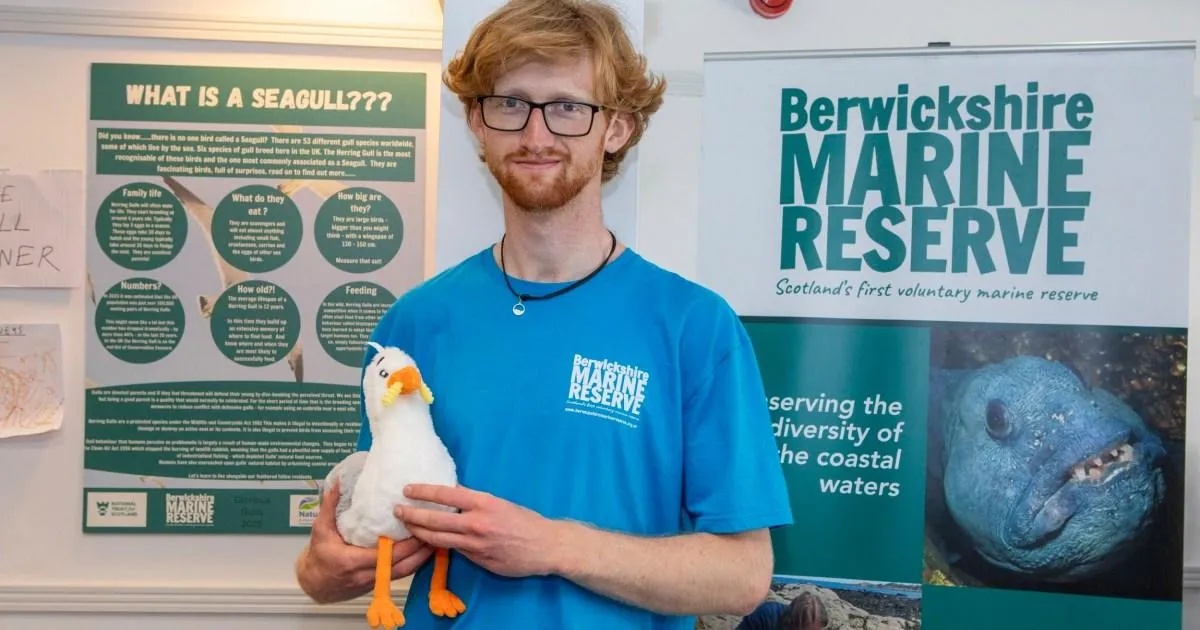
In the picturesque coastal town of Eyemouth, Scotland, a refreshing and unconventional experiment in coexistence is currently underway. Faced with rising tensions between residents and the local seagull population—often characterized by aggressive food-snatching and territorial swooping—the Berwickshire Marine Reserve has taken a bold step. They have appointed Patrick Safford, a 24-year-old ecological consultant and avid birdwatcher, as Britain’s inaugural “gull ranger.” This unique position was created not to drive the birds away, but to bridge the gap between two species that are increasingly forced to share the same urban environment. Patrick’s mission is simple yet profound: to re-establish a balanced relationship between humans and gulls through patient education, community engagement, and a deeper scientific understanding of avian behavior.
Patrick’s approach to his new role is rooted in a genuine respect for the animals, whom he describes as remarkably intelligent and highly adaptable creatures. He openly acknowledges the frustration caused by the “minority” of gulls that engage in antisocial behavior, noting that their aggressive antics have unfairly tarnished the reputation of the species as a whole. For Patrick, the goal is to shift public perception from fear to understanding. By working closely with the locals, he is gathering vital data on nesting patterns and conflict hotspots, helping to draw a map of where and why these confrontations occur. His work serves as a reminder that the creatures we often view as “pests” are simply organisms trying to survive in environments that have been drastically altered by human activity.
One of the cornerstones of Patrick’s philosophy is the skepticism he holds toward common anti-gull deterrents. In many coastal towns, the solution to seagull problems has been to deploy fake predators, plastic netting, and sharp metal spikes. However, Patrick points out the irony he observes daily in Eyemouth: gulls often build their nests right next to these supposed “deterrents.” It seems the birds are too smart for such rudimentary psychological tricks; they quickly realize that a stationary hawk model poses no real threat. Furthermore, while physical barriers like spikes can be somewhat effective, they are costly and unsightly. Patrick argues that human inventiveness in defense is rarely a match for the evolution-honed adaptability of the gull, suggesting that our resources would be better spent on managing our own behavior rather than trying to engineer theirs.
A key piece of evidence in Patrick’s argument for coexistence is his assertion that only about 25% of the gull population is actually aggressive toward humans. He explains that the vast majority of these birds are perfectly content to mind their own business, yet it is the bold, opportunistic outliers that dominate the headlines and create a climate of fear. This media-driven narrative creates a cycle where residents become anxious, reacting defensively, which can, in turn, increase tension. By identifying this “vocal minority” of problematic birds, Patrick hopes to show the community that the reality of the situation is far less threatening than the common perception suggests. He views his role as a mediator, helping people realize that they are observing a tiny fraction of the population, rather than a town under siege by an army of avian invaders.
To turn the tide on conflict, Patrick offers practical, actionable advice that focuses on modifying human habits rather than punishing the gulls. He encourages visitors and locals to eat safely by sitting near walls or under awnings, which disrupts the flight paths that gulls use to swoop down and steal food. Furthermore, he emphasizes the importance of basic sanitation, noting that overfilled bins and littered waste are essentially invitations for gulls to scavenge in residential areas. He also offers a compassionate perspective on protecting chicks; if a bird acts aggressively, it is usually because it is defending its young. By simply giving these nesting areas a little more space during the six-week maturation period, humans can easily avoid most defensive attacks. It is a lesson in mindfulness: small, thoughtful adjustments in our own routines could lead to a far more peaceful summer.
Ultimately, this initiative highlights an important shift in how we approach urban wildlife management. Instead of opting for hostility, the Berwickshire Marine Reserve is betting on the idea that education and empathy can solve problems that force and deterrents cannot. Patrick Safford’s stint as a gull ranger, funded by Fauna and Flora International, is a testament to the idea that nature doesn’t need to be kept at arm’s length. By understanding the biology and the limitations of the gulls around us, we can stop viewing them as an inconvenience and start seeing them as the fascinating, resilient neighbors they truly are. Through this experiment, Eyemouth is setting a standard for how human communities can foster a more sustainable and less stressful relationship with the natural world, proving that a little understanding can go a long way.