


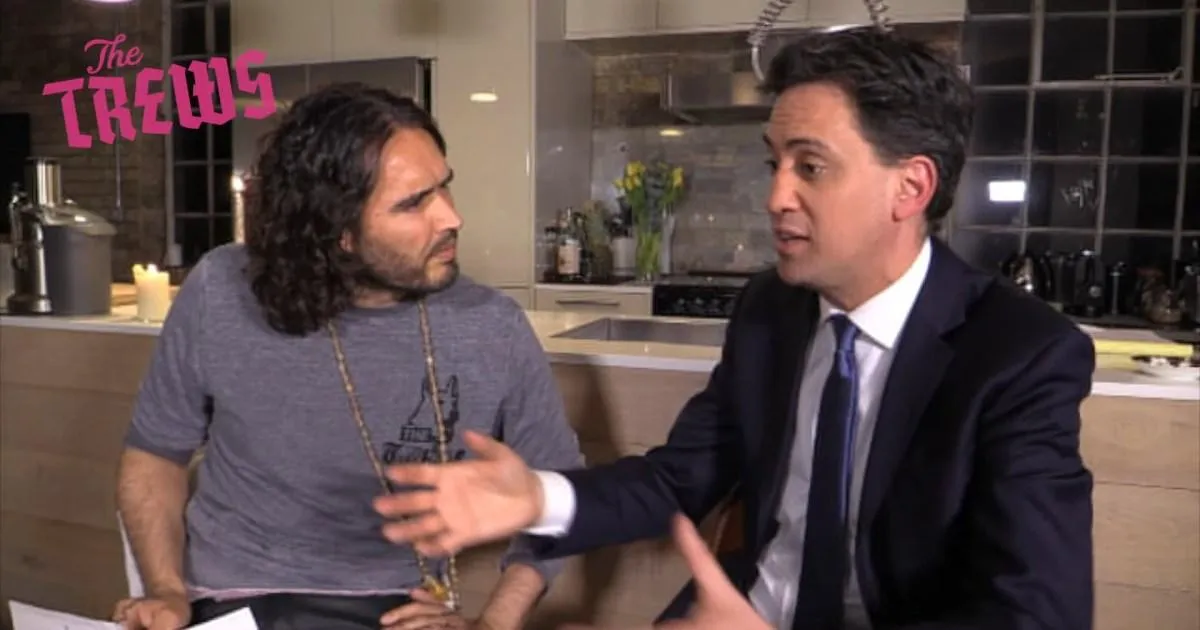
There are moments in political life that seem strange at the time but become almost unbearably painful in retrospect. The 2015 YouTube interview between Ed Miliband and Russell Brand is one of those moments. On the surface, it looked like a slightly awkward attempt by the then Labour leader to reach voters who had switched off from traditional politics. Miliband, in a suit and tie, sat opposite Brand, who was dressed in a grey sweater and an extraordinarily long bead necklace, swigging from a glass bottle of water while candles flickered on a kitchen worktop behind them. Brand, then styling himself as a voice for people who felt betrayed by the political system, spoke in long, winding monologues about the role of politics and politicians. Miliband, clearly frustrated, kept responding with a polite but firm insistence that Brand was “totally wrong” and that what he was saying was “just not true.” The video was posted just over a week before Britain went to the polls, and it drew massive public and media attention. It still sits on YouTube with around 1.4 million views, a strange time capsule of a moment when a comedian with a reputation for being outrageous was treated as a legitimate political interviewer. Now that Brand has been convicted of rape and sexual assault and sentenced to more than a decade in prison, that footage has acquired a dark and involuntary footnote, and the people who helped make it happen are having to look back and ask themselves what they were thinking.
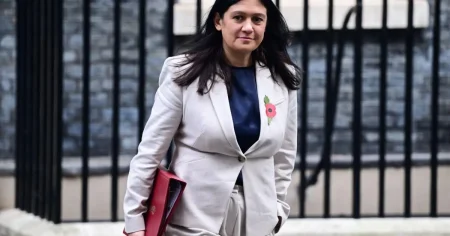
Lucy Powell, who is now the education secretary, was Miliband’s chief of staff during his time as Labour leader, and she played a prominent role in the 2015 general election campaign. She has now admitted that she “really regrets” the interview and her role in setting it up. Speaking to Sky News, Powell said that if she or Miliband had had any idea that Brand was a sexual predator, the interview would never have taken place. “That interview I’m sure would not have happened, history would have been very, very, different,” she said. The weight of that sentence is difficult to overstate. It captures not only the professional regret of a political adviser who helped arrange a strange publicity stunt, but also the deeper, more human discomfort of realising that you were in the orbit of someone capable of terrible things without knowing it. Powell was careful not to present herself as a victim. She acknowledged that “those things unfortunately weren’t known at the time,” and she framed her regret as something shared by anyone who encountered Brand in a professional or social capacity. “I think, like anybody who paid to go to his show or watched him on TV, or who was his employer at the time, who had interactions with him, anybody — including those of us who were involved in that at the time — would look back and really regret that, knowing today what we now know.” It is a human response rather than a purely political one, and it speaks to the way in which ordinary decisions, made in good faith at the time, can later feel contaminated by information that was hidden from view.
The phrase “a different era” is often used as a shield against uncomfortable questions, but Powell used it in a more sincere way. In 2015, rumours about Brand’s behaviour were less easy to find than they are now. The internet was full of his performances, his podcasts, his books and his political rants, but the allegations that would eventually lead to his conviction had not yet coalesced into a clear public picture. That does not mean there were no warning signs. The interview had taken place seven years after Brand was sacked from his BBC Radio 2 show over a vulgar prank involving the Fawlty Towers actor Andrew Sachs, and only months after he had launched a crude verbal attack on the shadow chancellor Ed Balls on television. These incidents were widely covered at the time, but they were mostly treated as examples of Brand’s bad-boy comedy persona, not as cracks in a facade that concealed something far more sinister. Powell’s comment about “a different era” is therefore not an excuse. It is an honest admission that hindsight changes everything. She is saying that people made judgments based on the information available to them, and that those judgments now feel naive and unsettling. This is not unique to politics. Every public figure who is eventually exposed for abuse leaves behind a trail of people who met them, worked with them, laughed at their jokes, or gave them a platform, and all of those people have to come to terms with the same uncomfortable truth: they did not know, but now they cannot pretend they never saw anything at all.
Miliband himself has already expressed a similar regret. In 2023, when allegations about Brand’s behaviour began to emerge in the media, he appeared on Radio 4’s Today programme and explained why he had agreed to the interview in the first place. Brand had been notoriously going around telling people not to vote, because voting made no difference. Miliband wanted to challenge that message directly, in front of the audience that Brand was influencing. “That’s why I did an interview with him,” he said, “because I wanted to get to the people who he was influencing to say voting does make a difference.” There is a logic to that decision. Engaging with a popular but hostile figure can be a way of breaking through to people who have stopped listening to mainstream politicians. But Miliband was also clear that, knowing what he knows now, he would not do it again. “I was not aware of these allegations at the time about Russell Brand,” he said. “I wouldn’t have done that interview and I regret doing it.” That regret is not just about the political calculation. It is about the fact that, on that kitchen-worktop set, with the candles and the water bottle and the endless monologues, a Labour leader sat opposite a man who would later be convicted of rape. The interview may have been awkward and strange, but it was also a moment of legitimacy. It gave Brand something he seemed to crave: proximity to the political world he claimed to despise. For Miliband, the memory now carries a weight that no amount of political justification can remove. He was not just someone who crossed paths with Brand in passing. He was the main guest, sitting a few feet away, politely arguing with a man who would eventually be sent to prison.
The conviction last week changed everything. Brand was found guilty of raping a woman in 2009 and of three counts of sexual assault between 2004 and 2009. Yesterday, he was sentenced to ten years and six months in prison. The sentence was a moment of justice for the women who came forward, but it also sent shockwaves through the wider culture that had once embraced Brand as a lovable, chaotic figure. The consequences are still unfolding. Netflix has reportedly hidden Brand’s stand-up comedy film from viewers, though it has not removed it entirely. Police have said they are investigating new abuse claims after receiving “multiple reports.” Brand’s former partner, Jemima Goldsmith, has been reported to have had to call police after a violent incident. Each new development adds another layer to the story that Powell and Miliband are now reflecting on. It is one thing to regret an interview from a decade ago in the abstract, when the allegations are still unresolved. It is another to watch that same person sentenced to prison and know that you once helped give him airtime. There is no way to rewrite the past. The interview cannot be undone, the millions of views cannot be unread, and the platform that was extended to Brand cannot be reclaimed. But the public reckoning with his crimes is forcing everyone involved to think more deeply about how predators are able to operate for so long, and why people around them are so often willing to dismiss warning signs as high spirits or eccentricity.
What does it mean to humanize a story like this? It means recognising that the people caught up in it are not simply political figures performing regret for a news cycle. Lucy Powell is a woman looking back at her younger self, at a decision she once thought was reasonable, and seeing it in a harsher light. Ed Miliband is a man who believed he was doing something worthwhile by confronting a popular anti-voting voice, only to discover that the voice belonged to a convicted rapist. And beyond them are the many unnamed people who were also caught in the same web: the audience members who paid for tickets, the interviewers who laughed along, the producers who booked him, the executives who hired him, the fans who defended him. For all of them, the sentence against Brand is not just a legal outcome. It is a call to examine their own memories and ask uncomfortable questions. Powell’s answer, in essence, is that we should look back and regret, not with theatrical self-punishment, but with honesty. “Knowing today what we now know” is a phrase that applies to everyone who ever shared a stage with Brand, gave him a second chance, or accepted his persona at face value. There is no neat ending to this story, no way to undo the past, and no single person whose regret can stand in for everyone else’s. But there is something important in the willingness to say, plainly and without evasion, that if we had known then what we know now, things would have been different. That is not weakness. It is the beginning of accountability, and it is the least that the women who waited years for justice deserve.