


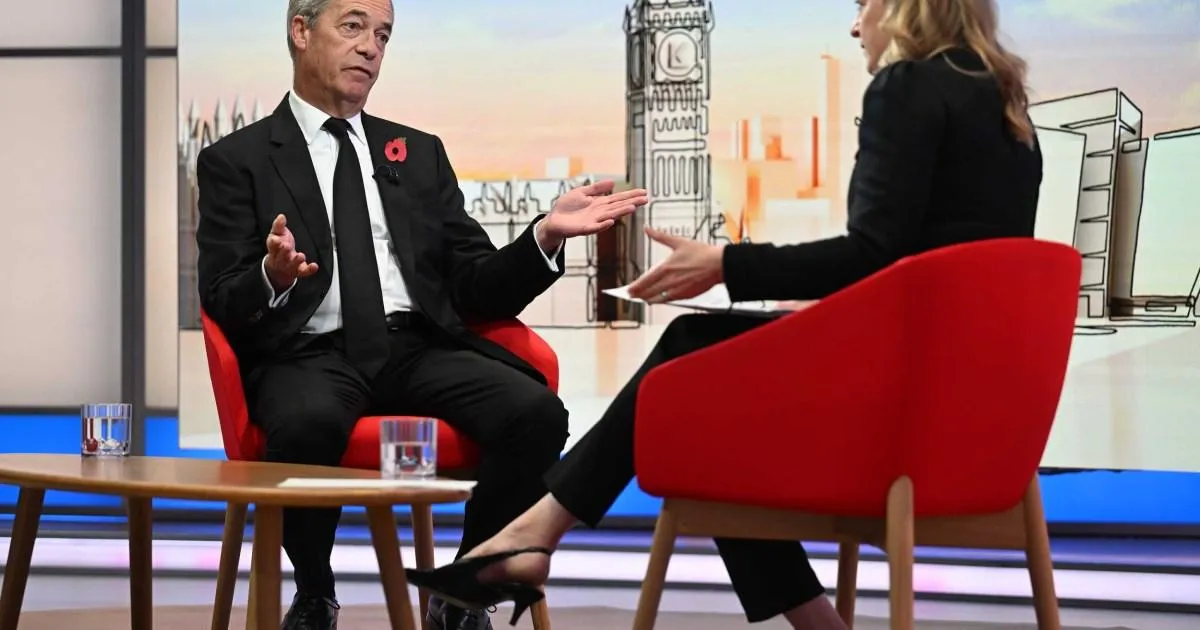
The midterm elections had barely been called before Nigel Farage stepped into the spotlight with a chilling prediction. Speaking on the BBC’s Sunday with Laura Kuenssberg, the Reform UK leader and longtime friend of Donald Trump said he expected a “very, very sharp increase in military action in Iran” in the aftermath of what was widely described as an electoral disaster for the Republican Party. The midterms had stripped Republicans of their control of the Senate and the House of Representatives, handing the Democrats a powerful mandate to challenge the president on nearly every front. Commentators, pollsters, and even Trump’s own vice president had spent the days after the vote trying to make sense of the losses, and most settled on the same explanation: the war in Iran. Voters, already frayed by relentless inflation, were tired of seeing their paychecks stretched thin by rising energy and grocery prices, and they blamed the president’s foreign policy for the chaos. But Farage, watching from across the Atlantic, offered something far more unsettling than a simple recap of election results. He didn’t claim to have spoken to Trump directly. He didn’t cite leaked memos or insider intelligence. Instead, he said he could “see it” and “feel it,” pointing to what he called “style changes” in the president’s behavior over the previous 48 hours. It was the kind of language friends use when they recognize something shift beneath the surface, and it painted a picture of a president who, rather than retreating from his most divisive decision, was preparing to double down in a way that could reshape the Middle East for years to come.
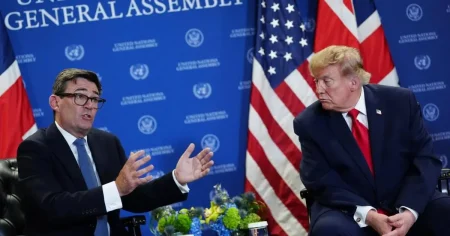
For ordinary American families, the connection between a distant war and the cost of living had become painfully concrete. The Republican losses were not just a political story; they were the sound of people speaking through their ballots, telling the administration that they were exhausted. Every trip to the supermarket was a reminder that the world felt unstable, and every utility bill seemed to carry the weight of international turmoil. The war in Iran had been Trump’s signature military undertaking, a conflict he framed as necessary for long-term security, but for many voters it had become synonymous with inflation, uncertainty, and the feeling that Washington was focused on the horizon rather than the kitchen table. Vice President JD Vance, in a lengthy social media post that immediately grabbed national attention, put it bluntly: “The reason we lost is the war.” Trump, in his typical defiant style, said Vance’s assessment was “largely true” but made it clear he had no regrets. “If I had it to do again, I’d have to do it again,” he told reporters, “because long term, it’s the only answer.” That combination of defensiveness and conviction is classic Trump, but it also reveals a deeper reality: the war has become personal. It is not merely a policy choice; it is a piece of his legacy, and admitting it was a political mistake would be an admission he seems structurally incapable of making. Meanwhile, the human toll continues to unfold in ways that are easy to forget in the buzz of Washington analysis. Military families wait anxiously for news, civilians in Iran try to preserve some semblance of normal life under the shadow of strikes, and diplomats across the world scramble to interpret signals that grow more contradictory by the day.
Farage’s warning carried extra weight because he is not a detached pundit. He is someone who has known Trump for more than a decade, who has celebrated alongside him, defended him, and maintained a personal friendship that transcends typical political alliances. So when he says he expects a sharp increase in military action, it feels less like speculation and more like a warning from someone who has learned to read the weather in Trump’s moods. But he also brought a note of caution, one that suggested he was not simply cheerleading his friend’s aggression. Iran, he said, is a theocracy, and that makes it a very different battle from earlier US interventions in Libya and Iraq. He called it “a very hard one to win.” That phrase lingers in the mind because it evokes the long shadow of past American wars, the grinding insurgencies, the unexpected consequences, the ways in which easy initial victories turned into decades of entanglement. Farage knows that if Trump follows through on this instinct, the United States could be walking into something far more complex than a punitive campaign. Iran has a sophisticated military, a deeply entrenched government, and a population that may not welcome American intervention even if they are unhappy with their own leadership. The comparison to Iraq and Libya is not reassuring; it is a reminder that military action in the region rarely unfolds as planned. Yet Farage’s tone was not entirely analytical. There was a hint of helplessness in his voice, the sense of a friend watching another friend drive toward a cliff and being unable to grab the wheel.
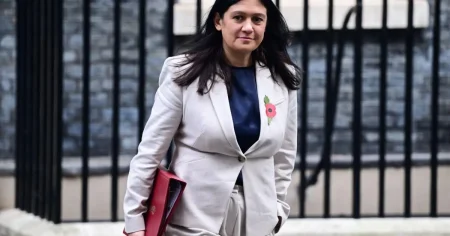
Across the Atlantic, British politicians were also bracing for what came next. Dame Emily Thornberry, chair of the Foreign Affairs Committee, said she was “of course” concerned about the possibility of escalation. Her analysis was grounded in political mechanics: she speculated that Trump would want to bring some form of resolution in Iran before the new Congress was sworn in on January 3, because the incoming Democrats would almost certainly give him a hard time over the war. “So it’s best to get it sorted for that one way or the other,” she said, adding with a note of doubt, “and whether he’s capable of doing that, of course, is another matter.” That last phrase is significant. It suggests that even Trump’s opponents are not sure whether he will choose to escalate and try to claim victory, or quietly explore some kind of off-ramp, or simply let the chaos continue until it reaches a boiling point no one can control. Thornberry is no alarmist; she is a seasoned politician who understands the difference between a threat and a feasible policy. Her concern is not just about what Trump might do, but about what he might be unable to stop himself from doing. The two-month window between the midterms and the new session of Congress is a strange limbo period. The president still holds enormous power, but his political shield has been cracked. In past moments like this, leaders sometimes become more cautious, aware that their freedom of action is shrinking. But they also become less predictable, because they no longer have to worry about immediate electoral consequences. Farage’s prediction suggests he believes Trump is heading toward the latter, using the last moments of relative freedom to reshape the situation on his own terms.
The blame game following the midterms was almost as fierce as the election itself. Vice President Vance’s decision to publicly pin the losses on the war was a striking political move, because it placed a wedge between him and the president on a deeply sensitive issue. Trump’s response, acknowledging that Vance was “largely true” while simultaneously insisting he would do it all again, revealed a man caught between self-justification and political reality. There is something almost tragic in that stubbornness. Trump has built his entire career on refusing to admit weakness or error, and this issue seems to have become the ultimate test. He seems to genuinely believe that history will vindicate him, that the pain of the present will be forgotten in the security of the future. But that belief is precisely what makes him dangerous in the eyes of his critics. They see a leader whose refusal to back down is not strength but rigidity, and they fear that his need to be right will outweigh his concern for the lives that might be lost in an expanded conflict. The war has already become a defining feature of his presidency, and escalation would be a way of proving that the losses were not in vain. In a strange way, pulling back after the election would be an admission that the war was a mistake, and that is an admission Trump has never been able to make. So the world waits, watching for signs of movement, wondering whether the next few weeks will bring air strikes, diplomatic maneuvers, or a terrifying combination of both.
Finally, in the midst of this international tension, Trump made a significant personnel decision that added another layer of uncertainty. He dismissed his chief of staff, Susie Wiles, and elevated Stephen Miller, a long-time advisor known for his passionate public defenses of the very conflict that had just cost the Republicans so dearly. The New York Times reported that Miller, in his pitch for the job, had actually argued for winding down the war, which suggests at least a pragmatic awareness that the conflict is politically toxic. But Miller is also one of the most unapologetically loyal figures in Trump’s inner circle, and his public commentary since the war began has been full of fiery rhetoric in favor of military action. This contradiction is enough to make anyone’s head spin. Does Miller represent a path toward de-escalation, a quiet voice in the president’s ear urging restraint? Or is he simply telling Trump what he needs to hear to get the job, with every intention of continuing the aggressive approach once he is secure in his position? The answer to that question could shape the Middle East for years. Palace intrigue in Washington often feels distant from the realities of ordinary life, but this is not just internal political drama. The people who are most affected by these decisions are not the advisors or the pundits, but the families who live in the regions where bombs may fall, and the soldiers who may be ordered to carry them. As Trump recalibrates his administration in the wake of a disastrous election, the world holds its breath. Farage’s prediction may turn out to be wrong, but his instinct that something is shifting feels undeniable. The next few weeks will reveal whether the man who said “long term, it’s the only answer” is prepared to follow that conviction all the way to its end, or whether the weight of a political disaster will finally force him to stop before it is too late.