


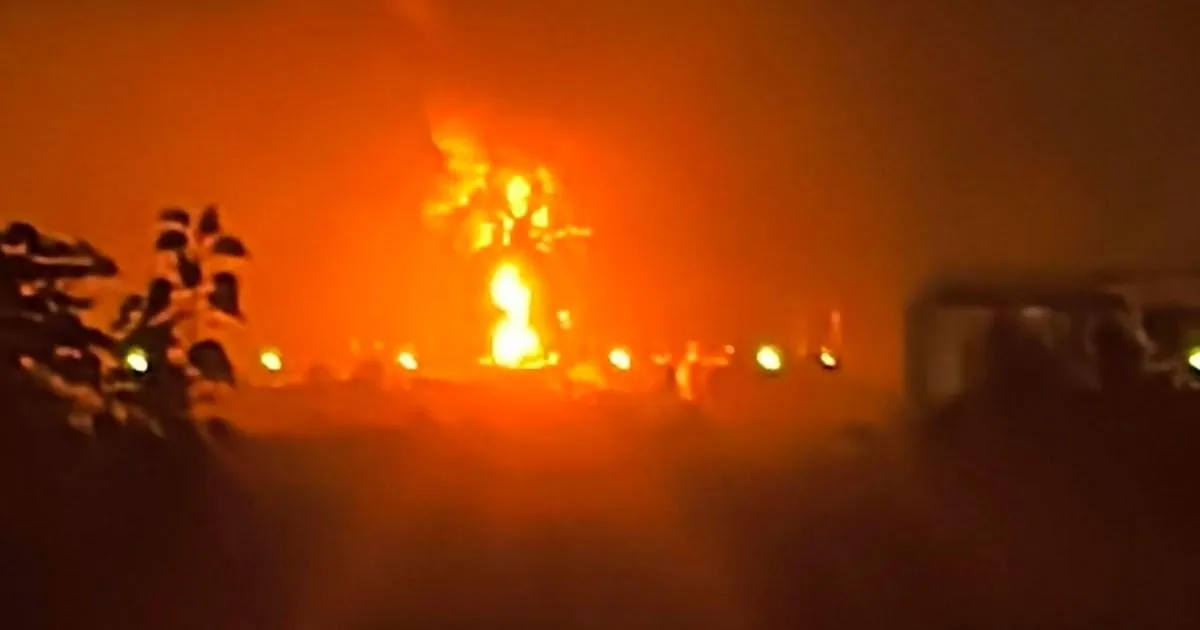
The night sky over southern Russia turned an eerie shade of orange just hours after the world learned that Donald Trump had struck a deal to buy Russian diesel. Ukraine, it seemed, did not intend to let the agreement pass in silence. In a series of massive overnight strikes, Ukrainian drones descended on the Yug Rusi oil-loading terminal near Rostov-on-Don, setting the fuel hub ablaze and sending thick columns of smoke into the morning air. Nearby, the Novoshakhtinsk oil terminal was also hit, and dramatic photographs showed firefighters wrestling with walls of flame as the scale of the attack became clear. For the people living in those towns, the night was a terrifying disruption of any sense of safety. But for Volodymyr Zelensky and his military commanders, the strikes were a deliberate, defiant message: no deal with Moscow that funnels money into Vladimir Putin’s war chest will be treated as normal. The response came directly after reports that the US president had agreed to lift sanctions on Russian diesel, opening the door to the purchase of almost two million tons of Russian fuel. Ukrainian officials were said to have been blindsided by the announcement, and many in Kyiv fear the deal, worth more than £3 billion, could give Russia the financial breath it desperately needs to keep prosecuting its invasion. Instead of calming the situation, Trump’s gambit provoked one of the most dramatic Ukrainian attacks on Russian oil infrastructure in months, transforming what might have been a diplomatic footnote into a blazing confrontation on Russian soil.
The targets were not chosen at random, and Ukraine made clear that its reach extends far beyond contested front lines. Two tankers in the Sea of Azov were attacked, adding to the sense that no part of Russia’s fossil-fuel supply chain could be considered safe. A railway bridge used to transport oil from Rostov-on-Don was also damaged, forcing traffic to halt and threatening to disrupt the movement of fuel and supplies through a key logistical artery. Together, these strikes were designed to squeeze Russia where it hurts most: the economy that sustains Putin’s army. Ukraine has learned over months of brutal fighting that oil is not just a commodity but a weapon, and every refinery damaged, every terminal set ablaze, every tanker disabled is a small subtraction from Moscow’s ability to fund missiles, drones, and artillery. The timing of the strikes was particularly pointed. The agreement between Trump and Putin, according to reports, had emerged partly out of American frustration with Ukraine’s relentless attacks on Russian oil refineries, a tactic that has contributed to soaring fuel prices around the world. Axios reported that a US official warned Zelensky was “misreading the room,” saying that by continuing to hit refineries, he was eroding the goodwill he had built with Trump over the previous six months. But Ukraine’s leadership appears to see things differently. From their perspective, Russia is fighting a war of attrition, and every barrel of Russian oil that reaches the global market is another barrel of blood. The overnight raids were a blunt way of saying that Kyiv will not be asked to sacrifice its own survival so that American consumers can enjoy cheaper diesel.
The political undercurrents here are impossible to ignore. Trump, facing midterm elections next month, is under enormous pressure from voters furious about soaring prices. Diesel costs have hit record levels, hammering American haulage companies, farmers, and everyday families already struggling to make ends meet. In that context, the president’s decision to open the door to Russian diesel can be read as an attempt to cool the economy before voters head to the polls. Trump posted that the deal would release 300,000 tons of diesel immediately “to the American and global marketplace,” followed by 500,000 tons in November and another million tons after that. On paper, those numbers sound substantial. But experts were quick to point out an uncomfortable truth: the United States consumes more than three million tons of diesel every single day. The entire amount Moscow would be allowed to sell would barely cover a single day of American demand, making the deal more symbolic than transformative. Still, the announcement was enough to alarm Ukraine’s allies and raise uncomfortable questions about whether Washington was prioritizing short-term political convenience over long-term principles. For Zelensky, the deal was not just economically dubious but morally indefensible. He branded it “weak” and “unworthy,” using some of his strongest language yet toward the American president. Russia, he argued, is weaker on the front lines than at any other time during the war, and that is precisely why Putin is relying on terror and backroom deals. Any weakening of sanctions against Russia, Zelensky said, without a clear and lasting agreement on de-escalation, is simply a sign of weakness. His words reflected a deep anxiety that the unity of the Western coalition, which had held so firmly in the first years of the war, was beginning to fracture at the highest level.
Amid the geopolitics, the human cost has not paused. Russian strikes on Ukraine overnight killed at least seven civilians, another gruesome reminder that the war’s real burden falls on ordinary people. In Kharkiv, firefighters worked through the aftermath of a Russian attack, dousing flames at a clinic as survivors stood in shock amid the debris. For every dramatic image of an oil terminal burning in Russia, there are quieter scenes of devastation across Ukraine: families burying loved ones, doctors treating the wounded, children learning to distinguish between the sound of a missile and the sound of thunder. Zelensky has spent months trying to maintain a relationship with Trump, and recent weeks had suggested some warmth between the two men. But the latest incident could seriously strain that fragile bond. The Ukrainian president’s frustration is rooted in a simple conviction: Russia has shown no genuine willingness to end the war, and any deal that relieves economic pressure without demanding real concessions simply enables further aggression. In his view, Putin is not looking for peace but for time, and every barrel of oil sold, every sanction lifted, every quiet negotiation held behind closed doors gives the Kremlin more room to regroup, rearm, and continue its assault on Ukrainian cities. The strikes on Russian infrastructure, however risky, are Ukraine’s way of saying that there will be no returning to business as usual while its people are being killed and its cities are under fire.
The backlash to Trump’s move was swift and fierce. Ukrainian former vice prime minister Ivanna Klympush-Tsintsadze drew a stark comparison, saying that dealing with Putin under these circumstances was like funding Osama Bin Laden. She argued that if American citizens were comfortable with their president buying diesel from someone like Bin Laden, then something was profoundly wrong with the United States. Her words were deliberately provocative, designed to shake Americans out of any complacency. She called the deal unacceptable and deeply painful, adding that it goes against the interests of both the United States and the European community. British officials also sought to distance themselves from the arrangement, with a UK government spokesman reaffirming that Britain would continue to maintain pressure on Russia through the toughest sanctions regime ever imposed by the country. The British stance, at least publicly, remains one of steadfast support for Ukraine and a determination to increase the cost of Putin’s aggression. Yet the British response also revealed the awkward position of European allies, who find themselves watching Washington and Moscow negotiate over the heads of the people most affected by the war. The image of Ed Miliband, the British foreign secretary, standing with Zelensky in Ukraine last week was a reminder that Europe’s support for Kyiv remains visible and vocal. But the Trump-Putin deal raises uncomfortable questions about how dependable that support will be if the United States begins to drift toward a more transactional relationship with Moscow.
Ultimately, this moment captures the brutal complexity of a war that has entered its most unpredictable phase. Ukraine’s overnight strikes on Russian oil infrastructure were not just a military operation; they were a political statement, a cry of defiance from a nation that refuses to be treated as a pawn in larger geopolitical games. Zelensky’s anger is understandable. He has watched his country endure devastation, displacement, and death on a scale that most nations cannot imagine, and now he sees the leader of the free world negotiating with a dictator who has shown no genuine interest in peace. For ordinary Ukrainians, the deal feels like a betrayal, a signal that their suffering may be secondary to American election politics and global market pressures. And for ordinary Russians, the fire in the night is a reminder that the war they are told is far away can come home in unexpected ways. There are no easy answers here. Sanctions are blunt instruments, and the global economy is deeply interconnected. But Ukraine’s message is clear: it will not accept a peace that simply freezes the front lines and rewards Russia for its aggression. The strikes on the oil terminals, the tankers, and the railway bridge are all part of a desperate, determined effort to keep the war at the center of the world’s attention, to force every Western leader to understand that any deal that strengthens Putin is a deal made over the bodies of Ukrainian civilians. Whether that message will be heard, or whether the world will choose the quiet comfort of lower fuel prices over the messy demands of justice, remains an open question. But as the flames rose over Rostov-on-Don, one thing was certain: Ukraine is not going to stop fighting, and it expects its partners to keep standing beside it, not to keep striking bargains with its enemy.