
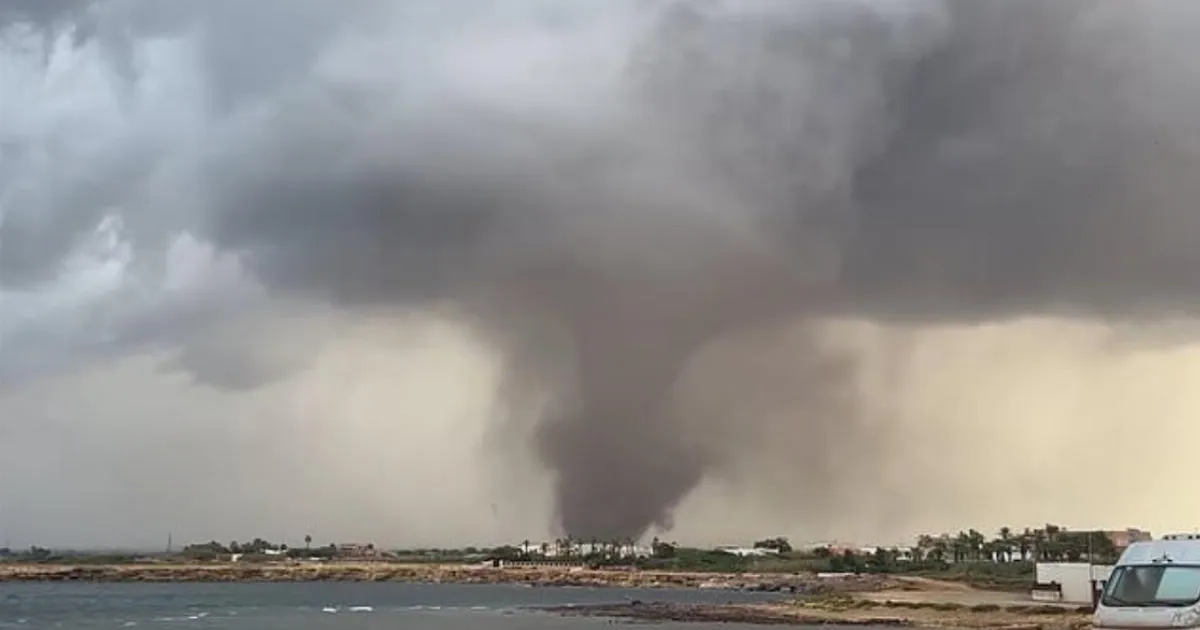
There are moments when nature reminds us, with terrifying clarity, how small we truly are, and this morning in the coastal town of Marsala, Sicily, that reminder arrived not as a distant rumble or a gentle warning, but as a furious, swirling column of wind and water that seemed to rise from the sea with almost no notice. The sky, which had likely begun the day in the soft, hazy quiet of a Mediterranean morning, turned dark and violent as two waterspouts formed over the water, twisting and growing as they made their way toward land. What might have been dismissed as a dramatic weather phenomenon, something to watch from a safe distance, quickly became something far more serious, because these were not harmless funnel clouds dancing on the horizon. They were powerful, destructive tornadoes that struck the southern part of Marsala, in the area between Strasatti and Terrenove, with a ferocity that caught residents completely off guard. Within minutes, the familiar world of quiet streets, schoolyards, and farmland was transformed into a scene of chaos and fear, with debris flying through the air, roofs torn from buildings, and the sound of howling wind mixed with the screams and shouts of people scrambling for shelter. It is one thing to hear about extreme weather on the news, to watch footage of storms in distant places, but it is something else entirely to stand in your own neighborhood and watch a massive, dark funnel descend from the sky, growing larger and more menacing with every second, knowing that there is nowhere to run and nothing you can do but pray that it passes you by.
The waterspout that made landfall moved with a kind of brutal purpose, tearing through the landscape as if it had a personal grudge against everything in its path. One of the most alarming reports came from the Alcide De Gasperi school, where students were inside when the tornado struck. Windows were shattered, sending shards of glass across classrooms, and cabinets were overturned, their contents scattered across the floors as children and teachers huddled together in fear. The thought of that scene is almost too much to bear, because schools are supposed to be places of safety and learning, filled with the laughter and chatter of young people, not places where children have to experience the terror of a natural disaster bearing down on them. The fact that the school was hit while it was occupied makes the entire situation feel even more personal and heartbreaking, and it is a relief that the injuries that have been reported so far are being treated by emergency personnel, although the full extent of what happened is still being assessed. Elsewhere, the tornado left a trail of destruction that looked almost like the aftermath of a bomb, with cars flipped over on the motorway, some of them lying in nearby ditches, their metal frames crumpled and twisted by forces that no human being could possibly resist. The images shared by residents on social media showed two dark waterspouts moving into the city, their massive columns reaching from the clouds to the ground, and they captured the sheer scale of what people were facing in those terrifying moments.
One resident’s account of the experience captures the raw, visceral fear that gripped the community, and it is the kind of testimony that cannot be easily forgotten. Writing on social media, they said, “I’ve never been afraid of dying like I was a few hours ago. This stuff in 2 minutes became 4 times bigger. I’m still shaking, but luckily everything’s ok at my house. It’s hell.” Those words, simple and unadorned, carry the weight of real trauma, because they remind us that behind every statistic, every weather warning, and every news report, there are real people who have looked into the face of something far larger than themselves and felt their own mortality pressing in on them. The fact that this person said they were still shaking, even after the immediate danger had passed, speaks to the kind of fear that stays with you, the kind that lingers in your bones and makes you jump at every sudden sound for days afterward. It is easy to watch videos of tornadoes from the comfort of our own homes and feel a sense of detachment, but this testimony brings us right back to the human reality, to the terror of watching a storm grow four times larger in just two minutes, to the helplessness of knowing that your home, your loved ones, and your entire life are at the mercy of a force that does not care about any of it. The fact that this person was lucky enough to escape without damage to their house does not diminish the psychological impact, because the fear of dying is not something that fades just because you survived.
The damage, however, extended far beyond the school and the overturned cars, reaching into the very fabric of the community and leaving scars that will take time to heal. Farm warehouses, which are so essential to the local economy in this part of Sicily, were badly damaged or completely destroyed, their roofs ripped off and their walls collapsed under the immense pressure of the winds. Uprooted trees lay across roads and fields, their roots exposed to the air, and telephone poles were snapped like twigs, leaving neighborhoods without power and without communication in the aftermath of the storm. The sight of a local warehouse reduced to rubble is a stark reminder that the cost of such disasters is not just measured in broken glass and twisted metal, but in livelihoods, in the hard work of farmers and business owners who suddenly find themselves facing months of recovery and rebuilding. Emergency workers, who must have been overwhelmed by the scale of the destruction, were fielding hundreds of calls as they tried to assess the situation and reach those who needed help the most. In moments like this, first responders become the unsung heroes, rushing into the chaos while everyone else is running away, doing their best to rescue the injured, secure the affected areas, and bring some sense of order to a world that has suddenly been turned upside down. Their efforts are exhausting and dangerous, and they deserve more gratitude than words can express, but they also face the daunting task of trying to help a community that has been shaken to its core.
Regional deputy Cristina Ciminnisi of the 5 Star Movement responded to the disaster with words that echoed the feelings of many, expressing shock and solidarity with those affected. She described the images she was receiving from Marsala and Petrosino as shocking, mentioning destroyed houses, torn roofs, overturned cars, and a school hit while there were children and school staff inside. Her thoughts, she said, were with the children, the families, and all the people involved, and she thanked those who were engaged in first aid and securing the affected areas. It is worth noting that waterspouts and tornadoes are not entirely uncommon in Italy, and the region has seen similar weather events before, but they often do not cause this level of widespread damage. What made this situation so much more dangerous was the heavy storm system that was moving across Sicily, creating the kind of atmospheric instability that allows these violent phenomena to form and intensify. This is not just a matter of bad luck; it is a reminder that weather can be unpredictable and fierce, and that communities living in areas prone to such events must always be prepared for the possibility that a seemingly ordinary day can turn into a battle for survival. The fact that these events are not rare makes it all the more important to understand them, to respect their power, and to invest in measures that can protect people and property from their devastating effects.
As the sun begins to set on this chaotic day in Marsala, the full picture of the damage is still emerging, and the process of recovery has only just begun. There will be time in the coming days to assess the extent of the destruction, to count the costs, and to begin the long work of repairing homes, schools, and businesses, but for now, the priority is simply the safety and well-being of the people who lived through this terrifying ordeal. The children who were in that school will carry the memory of those moments with them, and their parents will struggle with the knowledge that they could not protect them from such a force of nature, even though they were safe in a building that was supposed to shelter them. The residents who watched the waterspouts grow and move toward their homes will replay those images in their minds, and the fear that they felt will not easily fade. And yet, in the midst of all this destruction, there is also a story of resilience, of neighbors helping neighbors, of emergency workers giving everything they have to save lives, and of a community that will come together to rebuild what has been lost. Nature can be cruel and devastating, but human beings have an extraordinary capacity to endure, to support one another, and to find hope even in the darkest of times. As the people of Marsala and Petrosino begin to pick up the pieces, they do so with the knowledge that they are not alone, that their region, their country, and people from far beyond are thinking of them, holding them in their hearts, and wishing them strength for the difficult road ahead.