


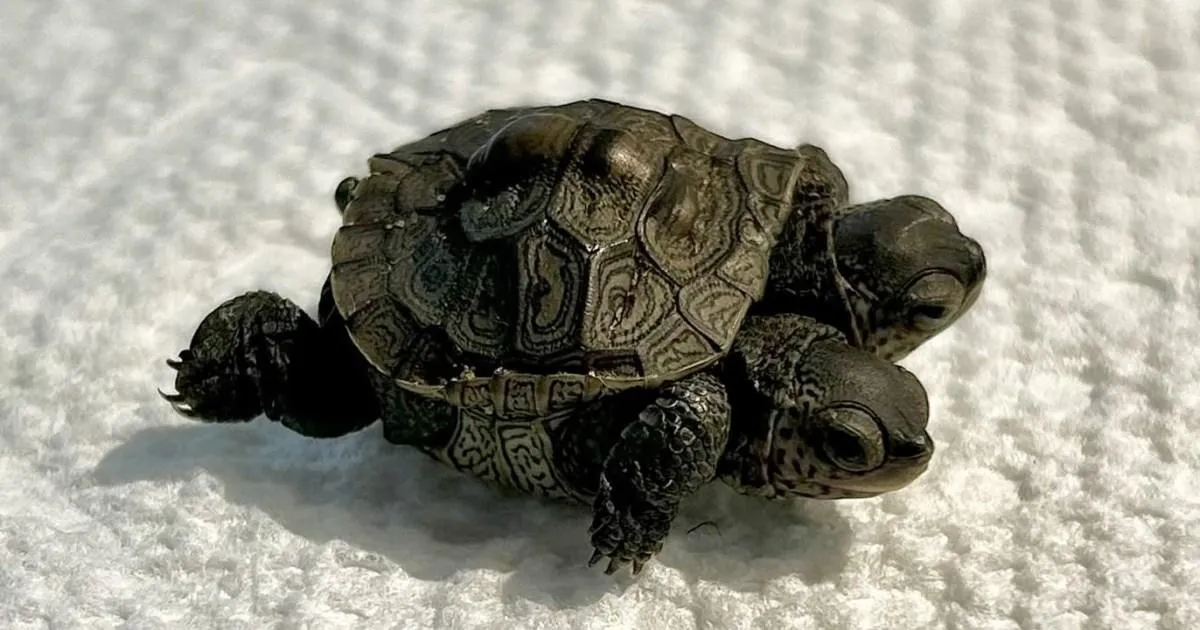
In the quiet dawn of a protected nesting beach in Wellfleet, on the outer arm of Cape Cod, Massachusetts, a discovery was made that stopped wildlife researchers in their tracks. The salt air hung heavy over the sand and marsh grass as staff from the Mass Audubon Wellfleet Bay Wildlife Sanctuary moved carefully through the nesting site, their eyes scanning for signs of new life. What they found was so small it almost escaped notice—a tiny diamondback terrapin hatchling weighing just 5.2 grammes, less than a nickel. But this was no ordinary newborn. Peering out from beneath its delicate shell were two fully formed heads, each with bright, alert eyes and a will of its own. The little reptile was a case of bicephaly, a rare developmental anomaly in which a single body supports two heads, and for the team that first laid eyes on it, the moment was equal parts wonder and concern. Carefully, they gathered the hatchling and transported it to the Cape Wildlife Center in nearby Barnstable, where veterinarians and rehabilitators immediately understood they were in the presence of something extraordinary. Despite its unusual anatomy, the turtle was swimming and eating normally, moving through the water as though it had no idea it was different. For those who held it, the experience was humbling—a reminder that nature’s strangest creations are often also its most fragile, and that caring for such a creature means stepping into an uncertain world where no textbook offers clear answers.
Bicephaly, sometimes called two-headedness, occurs very early in embryonic development when the process of splitting into identical twins begins but fails to complete. Instead of two separate turtles, the embryo develops into a single body with two heads, and sometimes two distinct sets of internal organs. The condition is exceptionally rare in almost every species, and in reptiles it is usually encountered only once in a great while. The Cape Wildlife Center, part of the New England Wildlife Centers network, has treated just two other bicephalic turtles in the past five years, making this hatchling a remarkable outlier even among its own kind. For the staff, every such case is a fresh lesson in anatomy and resilience. “While we’ve encountered this unusual condition before, every case gives us another opportunity to learn more about these fascinating animals’ anatomy and physiology,” they said. The turtle’s two heads are not merely decorative; both are fully functional, with working eyes, mouths, and the ability to eat. That in itself is a small miracle, because many bicephalic animals struggle to coordinate their two brains and may fail to thrive. This little terrapin, however, has so far defied the odds, gliding through the water with surprising grace and showing an appetite that reassures its caretakers. The condition also raises profound questions about identity and individuality: is this one turtle with two heads, or two turtles sharing one body? The staff’s own playful aside—wondering whether to call it “this little one’s (two’s?) appetite”—captures the philosophical puzzle at the heart of their daily work, and it is a question that may never have a simple answer.
Perhaps the most endearing detail to emerge from the center is that the two heads appear to have two distinct personalities. Zak Mertz, CEO of New England Wildlife Centers, observed that the left head seems to have the “bigger personality.” Those familiar with animals that have this condition often describe a kind of tug-of-war between the two brains, each with its own preferences, moods, and reactions. One head might be more curious, the other more cautious; one might reach for food first, the other hang back. In this tiny turtle, such differences are already visible, and they make the creature seem less like a curiosity and more like a character. Watching it swim, one might imagine a silent negotiation between the two sides—each head deciding when to turn, when to surface, when to snap at a bit of food. That the two have found a way to work together well enough to eat and move normally is a testament to the adaptability of life. For the caregivers, these personality differences also add a layer of tenderness to their work. It is hard not to root for a creature that, despite its oddity, is clearly trying to live. The turtle’s small size makes it all the more precious; in human terms, it is a newborn fighting for a chance, and every small success in feeding or swimming feels like a victory. The center’s team has already grown fond of the hatchling, and their careful observations are driven not just by scientific curiosity but by genuine affection for the little animal in their care.
Behind the scenes, the veterinary team is engaged in a careful and patient investigation. For now, the focus is on monitoring the hatchling’s appetite, growth, and behavior, recording every detail in the hope of understanding how its unusual body works. The internal anatomy remains a mystery, and the team knows better than to make assumptions. Depending on how far the embryo divided before development stalled, the turtle could have two complete sets of organs, partially shared organs, or some other arrangement altogether. Some bicephalic animals have two hearts, two stomachs, and two sets of lungs; others share a single heart or digestive tract. The only way to know for sure is to look inside, and as the youngster grows, the team plans to use X-rays and CT scans to map its internal structure. These images will reveal not only how the organs are arranged but also how they are shared between the two sides. Such information is crucial for predicting the turtle’s long-term health and quality of life. It will also contribute to the broader scientific understanding of bicephaly, a condition that has fascinated biologists for centuries. Every case offers a rare window into the developmental processes that normally produce a single, well-organized body—and what happens when that process goes slightly awry. The staff’s cautious optimism is grounded in experience; they have seen other bicephalic turtles survive and even thrive under human care. But they also know that each case is unique, and that the hatchling’s future depends on details they cannot yet see. For now, they are content to take it one day at a time, celebrating each meal and each new sign of growth.
The diamondback terrapin itself is a species worth caring about. Found in coastal salt marshes, tidal creeks, and estuaries from Cape Cod to the Gulf of Mexico, these turtles are well adapted to brackish water and are known for the distinctive diamond-shaped markings on their shells. In Massachusetts, they are considered a threatened species, their populations pressured by habitat loss, boat strikes, and other human activities. Conservation efforts, including the protected nesting site where this hatchling was found, are vital to giving terrapins a fighting chance. The discovery of a two-headed individual at such a site is a reminder that conservation is not just about numbers; it is about the astonishing diversity of individual lives. The question of whether this particular turtle could ever be released into the wild is a difficult one. A bicephalic animal, no matter how healthy it appears in captivity, would face enormous challenges in nature. Coordinating two heads while swimming, foraging, and avoiding predators is a tall order, and even a slight hesitation could prove fatal. For now, the center is focused on giving the hatchling the best possible start in life, while keeping an open mind about what the future holds. Whether it remains in human care or, against all odds, earns a chance at freedom, its story has already drawn attention to the fragile world of terrapins and the dedicated people who work to protect them. It has also reminded us that every hatchling, no matter how unusual, is part of a larger web of life that deserves our respect and compassion.
In the end, the story of this tiny two-headed turtle is about more than a biological anomaly. It is a story about the human instinct to care for the vulnerable, to wonder at the strange, and to find meaning in the smallest creatures. The staff at the Cape Wildlife Center could have simply noted the hatchling and moved on, but instead they chose to invest time, resources, and emotion into understanding it. Their playful note about the little one’s appetite reveals a team that has not lost its sense of humor or its capacity for awe. In a world often dominated by bad news, this small reptile offers a moment of lightness and curiosity. It reminds us that nature is full of surprises, and that even a creature weighing less than a nickel can capture our hearts. The turtle’s two heads may represent a developmental error, but they also represent resilience, adaptability, and the sheer persistence of life. As the team continues to monitor its progress, people around the world will be watching too, hoping that this little terrapin defies the odds. Whether it lives a long life in captivity or surprises everyone by thriving, it has already accomplished something remarkable: it has made us pause, reflect, and care. And in that sense, it is not a freak of nature at all, but a beautiful example of nature’s endless capacity to inspire.