



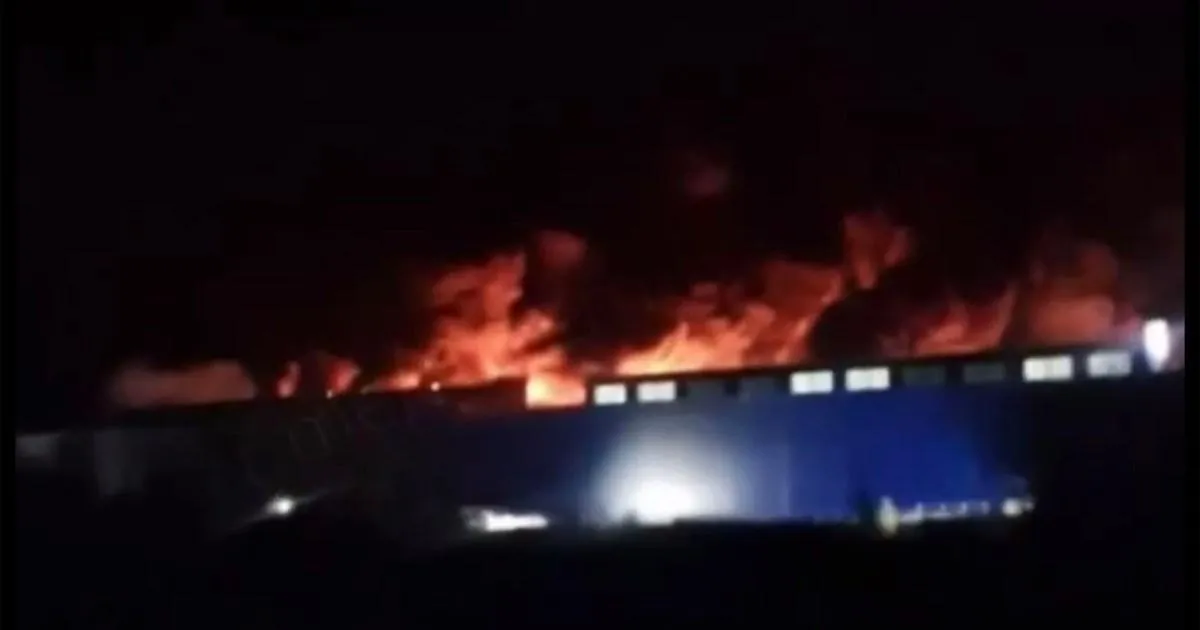
Imagine waking up to the news that the company powering your country’s internet is on fire. That is essentially what happened in Russia this week, when flames tore through one of its most important technological strongholds. Ukrainian drones are believed to have damaged a major data centre owned by Yandex, Russia’s leading artificial intelligence and technology company. The company announced that the attack caused a fire and forced it to fully suspend the centre’s operations, while teams worked to deal with the consequences and restore affected services. For a company often described as “Russia’s Google,” this was not just a technical problem; it was a shock to the digital nervous system of the country. Yandex is not some small startup. It operates Russia’s main search engine, a vast cloud platform, mapping services, taxi-hailing, delivery and countless other digital tools that millions of people use every day. It also runs YandexGPT, one of Russia’s leading generative AI models, a source of national pride and a key part of the country’s technological ambitions. To see a facility like that go up in flames is a vivid reminder that even the most advanced digital infrastructure is vulnerable to physical attack. What makes this strike especially significant is that there were previously no confirmed major Ukrainian drone attacks on Russian data centres. This is a new and dangerous development in a war that has already blurred the lines between military targets and civilian infrastructure. It also comes after a wave of Russian attacks on Ukrainian data centres in recent weeks, suggesting that both sides are now treating the infrastructure of the digital age as a legitimate battleground. The images of the burning facility, with thick smoke rising into the sky, were a powerful symbol of how far this conflict has reached. In a way, it feels like the future has arrived: the wars of the twenty-first century are not just fought with tanks and missiles, but with strikes on the server farms that power our online lives. The attack on Yandex may be a warning, a test, or a first step, but it is unlikely to be the last.
To understand why this attack matters, you need to understand what Yandex actually does behind the scenes. It started as a search engine, but over time it grew into an all-encompassing tech ecosystem, often compared to Google for its dominance and influence. Its flagship AI model, YandexGPT, is a major investment, and the company has poured resources into machine learning, autonomous driving, voice assistants and cloud computing. The data centre that was hit is not just a storage room; it is a vital organ in the body of Russia’s digital economy, keeping online services alive and powering the algorithms that people rely on for everything from finding a restaurant to managing a business. After the attack, Yandex Cloud posted an update saying there were problems with the electricity supply at one data centre “zone” and recommended customers use other zones to avoid disruption. That sounds like routine tech advice, but it reveals a fragile reality: the cloud, which we think of as ethereal and omnipresent, actually lives in concrete buildings filled with servers, cooling systems and cables, all of which can be damaged by a single drone. The company was quick to reassure users that its core consumer services were not affected, and that restoration work was underway. That is good news, but it does not erase the underlying vulnerability. For a company that prides itself on cutting-edge AI, being knocked offline by a wartime strike is both an operational nightmare and a symbolic blow. It also raises uncomfortable questions about data security in a country at war, and about whether Russia’s technology sector can keep functioning if these attacks become routine. The fire reportedly burned for hours, and the sight of such a massive facility being consumed by flames was a stark reminder that the digital world is not as abstract as we like to believe. Every search query, every map route, every AI-generated response depends on physical infrastructure, and in wartime, that infrastructure is a target.
What made the attack even more significant was the fact that Yandex’s data centre was not the only thing on that site. A major military-linked metals company called Sasta was also hit. Sasta may not be a familiar name to most people, but it plays a crucial role in Russia’s military supply chain, producing parts for tactical missiles. It has been sanctioned by Britain and other Western states precisely because of that connection. The close proximity of a cutting-edge technology company and a weapons supplier might seem surprising, but in wartime, industrial zones often mix civilian and military operations in ways that make them attractive targets. For Ukraine, hitting Sasta was a direct strike at Russia’s ability to build and maintain the missiles that have been used to devastate Ukrainian cities. The parts made there are essential to the kind of long-range attacks that have become a nightly terror for millions of people. Whether the damage to Yandex was collateral or intentional is not entirely clear, but either way, the message is unmistakable: Russia’s infrastructure, from its tech sector to its military-industrial complex, is within reach. The attack on Sasta also fits into a broader Ukrainian strategy of striking deep inside Russian territory at the economic and industrial engines of the war effort. Over the past months, Ukraine has targeted oil refineries, ammunition depots, airfields and now data centres, showing that it can hit far beyond the front line. This is a significant shift from the early days of the conflict, when such strikes were rare and often denied. Now they are becoming a regular feature of the war, and each one chips away at the assumption that Russia can wage war from a safe distance. The idea that the Russian heartland is immune to consequences has been shattered, and the combination of technological and military targets in a single strike makes the point even more forcefully.
Beyond the data centre and the metals plant, Ukrainian forces also targeted two major pieces of Russia’s energy infrastructure in a separate series of attacks. One was a large refinery owned by Gazprom in the city of Salavat, located a staggering 870 miles from the Ukrainian border. That distance is a testament to the reach of Ukraine’s drones, and it sends a chill through any sense of security that Russian citizens might have felt. The Salavat refinery is one of the largest oil refining and petrochemical complexes in Russia, and it produces fuel that is essential for both civilian life and the military machine. The other target was the Samara-2 pumping station, one of the largest oil tank farms in Europe. This facility is critical to Putin’s ability to earn dollars through oil exports, and those dollars are the fuel for the war effort. By attacking these sites, Ukraine is trying to squeeze Russia’s economy, reduce its revenue, and complicate its logistics. Oil and gas have always been the financial backbone of the Russian state, and every refinery or pumping station that is forced offline, even temporarily, sends ripples through the entire system. These strikes are not just about physical damage; they are about disrupting the financial flows that keep the war alive. They also carry a symbolic weight, because they demonstrate that Ukraine can reach the very infrastructure that has made Russia powerful on the world stage. Of course, attacking oil facilities carries serious risks, including environmental disasters and the possibility of large fires or explosions. But from a strategic perspective, the logic is brutal and clear: if Russia can bomb Ukraine’s power grid, data centres and cities, Ukraine can respond by hitting the installations that fund and fuel Russia’s war. The attacks on the Gazprom refinery and the Samara-2 pumping station are part of a broader pattern of long-range drone strikes that have become increasingly bold, and they suggest that Ukraine is determined to carry the fight to Russia’s heartland, no matter how many miles away it is. For a country that has been defending itself against relentless bombardment, these strikes are a way of saying that the war cuts both ways.
While Ukraine was striking deep into Russian territory, Russia was continuing its own campaign of destruction inside Ukraine, and the human cost continued to climb. After Wednesday’s Russian strikes, Ukrainian authorities warned that citizens could face up to 11 hours of power outages the next day. This is the grim reality of a war in which energy infrastructure has become a primary target, and ordinary people are left to live in darkness, without heating or running water, while their leaders trade blows. On top of that, a new Russian drone attack on Kyiv killed four people and injured 21 others. These are not just statistics; they are people with names, families and futures, cut down in a city that has already endured so much. The recent Russian attacks on Ukrainian data centres are part of the same strategy, an attempt to destroy Ukraine’s digital infrastructure and isolate its people from the world. Russia has tried to break Ukraine’s communication networks, plunge its cities into darkness, and disrupt its economy. In many ways, the war has turned into a battle of infrastructure, with each side trying to cripple the other’s ability to function. Ukraine’s strikes on Russian soil are a response to this relentless pressure, an attempt to make the Russian public feel some of the fear and pain that Ukrainians experience every day. But there is a deep asymmetry: Ukraine is fighting for its survival, while Russia is fighting from a distance. A drone strike on a Russian refinery is dramatic, but it is not the same as living under the constant threat of missiles and drones, never knowing when the next attack will come. Yet the Ukrainian strikes are significant because they prove that Russia is not invulnerable, and that the war can no longer be contained within Ukraine’s borders. The 11 hours of power outages, the four dead in Kyiv, the 21 injured — all of it is a reminder that the human cost of this conflict continues to mount, and that both sides are locked in a cycle of attack and retaliation with no end in sight. In such a cycle, every act of violence seems to justify another, and the innocent are always the ones who pay the highest price.
Taken together, these events paint a picture of a war that has evolved in ways that few could have predicted. It is no longer just a conflict between soldiers on a front line; it is a war that takes place in server rooms, oil refineries, power grids and civilian neighborhoods. The attack on Yandex’s data centre is particularly significant because it represents a new kind of target, one that is central to modern life and to the future of military technology. Data centres are the backbone of the digital economy, and they are also increasingly important to military operations, from communications to artificial intelligence. By striking such a facility, Ukraine has signaled that it is willing to target the technological infrastructure that Russia relies on, not just its military forces. This raises serious questions about the future of warfare, in which physical drone strikes on data infrastructure may become as common as cyberattacks and missile strikes. It also raises concerns about civilian impact, because data centres support everything from banking to healthcare to social media. The fact that Yandex said its core consumer services were unaffected is good news, but it is not a guarantee that future attacks will be so contained. For Russia, this attack is a wake-up call that the war has come home in ways that many ordinary Russians may not have anticipated. For Ukraine, it is a demonstration of resilience and capability, a way of showing that it can strike back even against the most advanced technology companies in Russia. But the true cost is measured in human lives, from the four people killed in Kyiv to the soldiers and civilians on both sides who have died in a conflict that seems to have no end in sight. As the war continues, the boundaries between military and civilian targets, between physical and digital infrastructure, and between frontline and home front, are likely to become even more blurred. What is clear is that the age of infrastructure warfare has arrived, and the world is watching to see what comes next. In the meantime, people on both sides will keep looking at the sky, wondering where the next drone will strike, and hoping that the digital systems they rely on will keep working for just one more day.