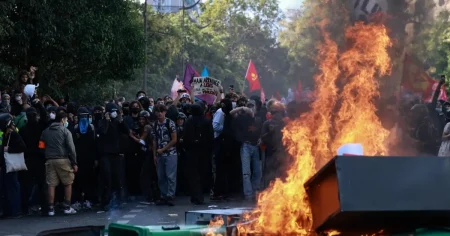


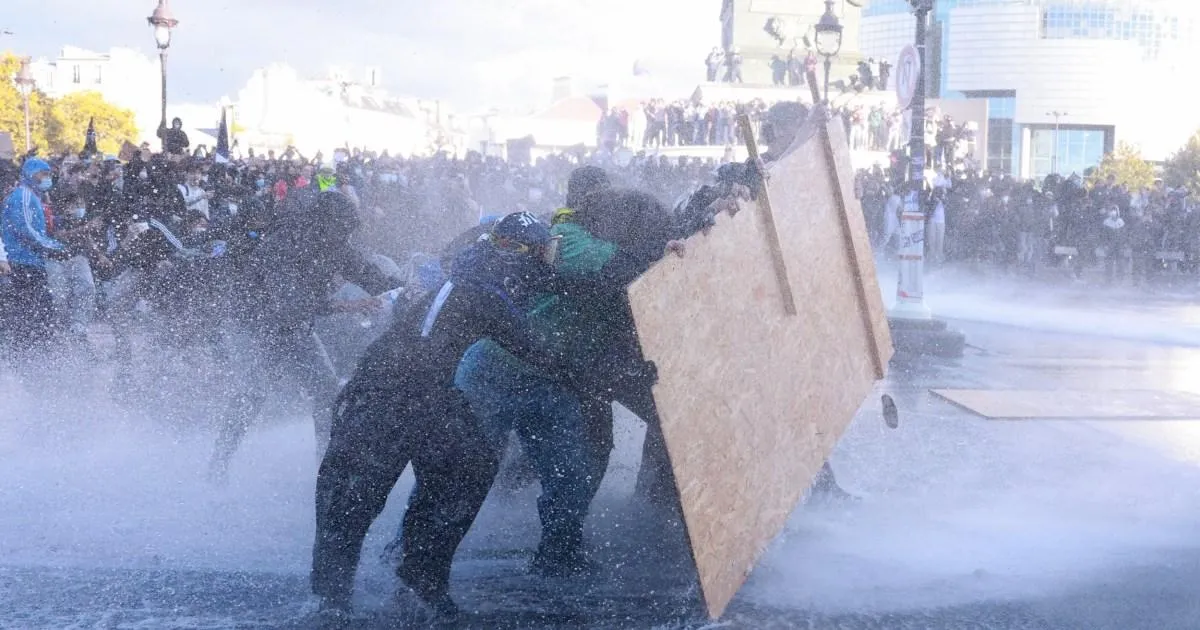
On a resonant autumn afternoon in Paris, the old stones of Bastille Square once again bore witness to the kind of confrontation that has haunted French history for centuries. Riot police charged across the cobbles, batons raised, while water cannons blasted through the air, trying to scatter thousands of schoolchildren who had taken over the square in a mass protest against under-resourced schools. The images are jarring: young faces, some barely out of middle school, standing their ground against lines of uniformed officers; hands in the air; screams swallowed by the roar of engines and the thud of shields. For Jean-Luc Mélenchon, the candidate for La France insoumise in the 2027 presidential election, the meaning was unmistakable. “The Bastille has been retaken,” he declared, his voice carrying the weight of a revolution that began in this very place more than two centuries ago. “Powerful demonstration by the youth who carry their demands in the most beautiful way possible. Immense pride. See you on Tuesday, October 13, at the call of the youth unions and workers.” The comparison to 1789 is not incidental. The Bastille was a medieval fortress and prison, a symbol of King Louis XVI’s absolute power, and its storming on 14 July 1789 ignited the French Revolution. Now, in the twenty-first century, a new generation was invoking the same spirit, not to tear down a prison but to demand something less dramatic yet just as essential: a public education system that does not abandon them before they have even begun.
To understand why teenagers would risk batons and water cannons, it is necessary to look at what they are facing every day in classrooms across France. Underfunding has become a quiet catastrophe, one that eats away at opportunity long before students can articulate it. According to the Organisation for Economic Co-operation and Development, a child born and schooled in a deprived neighbourhood in France has less chance of escaping their socioeconomic background than most other developed nations. That cold statistic translates into overcrowded classrooms, crumbling buildings, missing teachers, and a curriculum that feels less like a ladder and more like a ceiling. For many young people, the protests are not about politics in the abstract; they are about survival, dignity, and the right to imagine a future. One schoolboy told EuroNews that violent outbursts are “normal” if students’ demands are “not heard,” and his words were chilling precisely because they were so reasoned. “All the revolutions in history have served a purpose,” he said. “In 1789, there were a lot of deaths. We don’t want to have deaths, but we could revert to violence as a means of expression. The goal is not to perpetrate violence to hurt people, but it’s to use violence to change the system that harms us.” There is a tragic irony in a teenager having to justify the possibility of violence while the state unleashes water cannons and stun grenades on unarmed adolescents. He is not calling for bloodshed; he is describing what happens when a society refuses to listen to its own children, when every peaceful Avenue seems bricked off, and when the only reply to a plea for books and teachers is a line of riot shields.
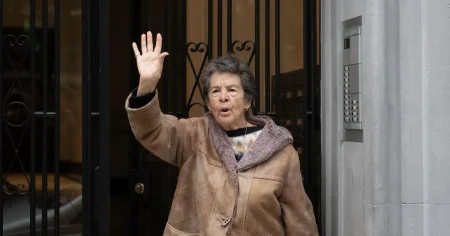
Among those standing with the students is Anouk Vandecasteele, an English teacher at a school in Lille, whose voice trembles with a mixture of anger, fear, and fierce pride. She has joined the growing wave of educators who refuse to let their students face this fight alone. “There is definitely a form of police brutality which has been previously unseen because it has not been directed towards young people before,” she told Metro. “The fact that today they are injuring kids is unacceptable. That’s one of the reasons why we are there.” The injuries she speaks of are not abstract rumours. Earlier this week, at a protest of about 250 people in nearby Lens, a 15-year-old reportedly had his hand “blown off” when a stun grenade thrown by riot police detonated after he picked it up. Anouk has also heard reports of students losing eyes, and of a 14-year-old who lost teeth after their jaw was broken. These are not the wounds of a distant conflict; they are the smashed bodies of children who should have been worrying about homework and friendships. Anouk draws a direct line to previous waves of unrest, such as the gilets jaunes protests, during which many activists were wounded, but something feels different now. “Of course during the gilets jaunes and other strikes many activists have been wounded, but injuring kids is unheard of. It’s a bit scary,” she said. “People who are currently demonstrating and people who are blocking the schools are just kids. They are unarmed; they just want to be heard. It is time for the government to listen to them.” Her words capture the moral heart of the protest: this is not a mob, not a radical fringe, but a generation of young people, many of whom have never participated in activism before, standing in front of the machinery of the state and refusing to be invisible.
The human texture of this movement is what makes it so difficult to reduce to a simple political conflict. Behind every statistical line about school funding is a child with a name, a family, a dream. Behind the phrase “police brutality” is a teacher watching her students return from a protest with shattered limbs and haunted eyes. Anouk’s own resolve is both personal and collective. “I’m ready for anything to make sure that my students have the same opportunities that I had,” she told Metro. “I feel outraged and at the same time I feel like I’m never going to give up and I think that’s how the students feel too. Above all I feel proud.” That pride is not a hollow slogan. It is the pride of seeing young people refuse to accept a destiny written for them by budget cuts and social inequality. It is the pride of an older generation waking up to the realisation that the battle for public education is not just about test scores, but about the kind of society France wants to be. The protestors are not violent revolutionaries thirsting for chaos; they are students who have watched their peers lose sight, lose teeth, lose hands, and still stand. They are teachers who could easily stay home and protect their jobs, but instead choose to step between the batons and the children. They are parents who never imagined they would watch their kids get water-cannoned in the same square where their ancestors rose against tyranny. The revolution being enacted here is not a war; it is an urgent, messy, desperate plea for a better world, made by the people who will inherit the consequences if it goes unheeded.
The deeper issue, however, is one that no stun grenade can resolve: underfunding poses a serious threat to social mobility in France. A child born and schooled in a deprived neighbourhood there has less chance of escaping their socioeconomic background than in most other developed nations, according to the OECD. That sentence is easy to read and easy to forget, but it is worth sitting with for a moment. A seven-year-old in a crowded classroom in a poor suburb is already being marked by an economy that will likely keep them exactly where they started. Their school, their teachers, their facilities, and the expectations placed on them are not neutral; they are the quiet architecture of inequality. When students say the system harms them, they are not exaggerating. They are describing the slow violence of underfunding, which is invisible next to the immediate violence of a baton strike but no less devastating. It narrows their horizons, limits their choices, and tells them, year after year, that they are less valuable than children in wealthier neighbourhoods. The demonstrations are therefore not a rejection of France, but a desperate attempt to make France live up to its promise. The revolution was supposed to have created liberty, equality, and fraternity. Yet when a teenager in a poor district looks around their school, they see little liberty in their choices, little equality in their resources, and little fraternity in the riot gear facing them across the square. The historical echo is painful: just as the Bastille represented the arbitrary power of a king who did not see his people’s suffering, the crumbling, underfunded schools represent a system that has turned away from its youngest citizens.
In the end, the image that lingers is not the chaos but the courage. The Bastille has been retaken, but not by a mob; it has been retaken by children in school jumpers, by teachers in their finery, by ordinary people who believe that a country that abandons its children has no future. The words of Mélenchon — “See you on Tuesday, October 13” — are both a promise and a warning. If the government does not listen, the movement will grow. If it responds with more batons and more stun grenades, it will only confirm what the young protestors already suspect: that their demands are being answered with force because they cannot be answered with reason. The revolution of 1789 was not inevitable; it was the product of decades of neglect, injustice, and silence. No one wants another revolution, least of all the students who say they do not want deaths. But their warning is clear. A society that fails to hear its youth will eventually be changed by them, one way or another. The hope is that France will choose to listen before more hands are blown off, before more eyes are lost, before more jaws are broken in the name of order. The hope is that the adults in power will realise that the best way to honour the legacy of the Bastille is not to block it with riot shields, but to guarantee every child a school that gives them a chance. Until then, the students of France will keep marching, keep shouting, keep occupying squares, and keep reminding everyone that the oldest revolutionary dream is simply this: that the future should not be closed before it begins.