

1.
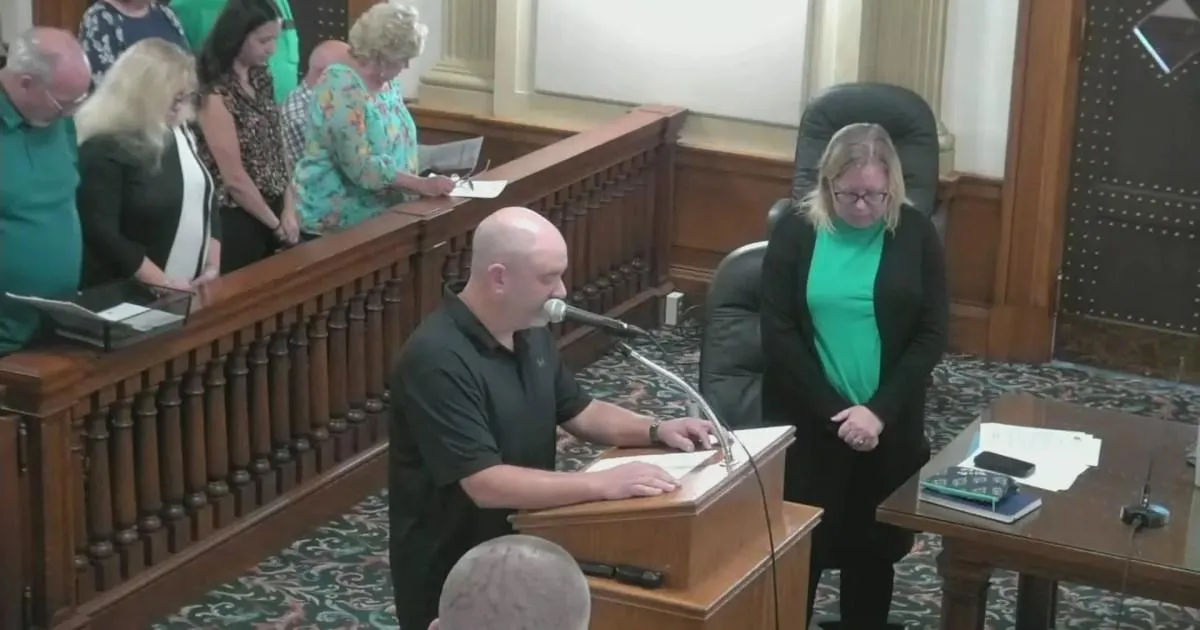
On an otherwise ordinary evening in Ottumwa, Iowa, the fluorescent lights of the city council chamber cast their familiar glow over folding chairs, laminated agendas, and the tired faces of residents who had come to tend to the small business of local government. But the meeting would not remain ordinary for long. Matt Dalbey, a former member of the city council, approached the podium as he had likely done many times before. Yet instead of a moment of silence, a generic invocation, or a prayer to a conventionally understood God, Dalbey opened his remarks by addressing the “dark father” and declaring, with unmistakable clarity, “Hail Satan.” The words hung in the air like a cold front. He went on to call for those present to embrace what he termed the “Luciferian impulse,” urging people to measure one another by their actions rather than by the weight of social convention. The room, which moments earlier had been rustling with papers and quiet chatter, seemed to freeze. Eyes widened. Jaws tightened. Some people shot glances at one another as if to confirm that they had heard correctly. For many in the room, this was not simply a provocative statement—it was an assault on the very moral foundation they believed held their community together. Some turned toward the American flag, perhaps seeking comfort in the familiar words of the Pledge of Allegiance, reciting it with a defiant edge. The scene was a collision of two Americas: one that still sees public space as an extension of its own faith, and another that believes the podium should be open to any philosophy, no matter how unsettling. And in that collision, the small-town council meeting became a microcosm of a much larger national argument about religion, free speech, and who truly belongs at the table of civic life.
2.
The immediate aftermath was as raw as the prayer itself. Pastor Rick Bick of the New Life Center moved quickly, making his way to the podium the moment Dalbey stepped aside. His voice carried both hurt and urgency as he demanded that the council “reverse this curse that was put on our city.” For Bick, the invocation was not an abstract exercise in free expression; it was a spiritual attack, a dark mark on the community that needed to be lifted. “That ‘Hail Satan’ is not welcome here,” he said, his words aimed at the council and at the room at large. He insisted that the prayer had placed a curse on Ottumwa and that something had to be done to stop and reverse it. The mayor, Benjamin Foote, responded in a way that tried to steady the shaking room. He called for thirty seconds of silence—not as an endorsement of Dalbey’s words, but as a pause, a breath. “To reflect on whatever it is we need to reflect on at this time,” he said, offering a phrase so deliberately neutral that it seemed to acknowledge every fractured perspective in the room. The silence that followed was probably not peaceful. It was likely filled with the internal noise of people trying to process what they had just witnessed. The meeting eventually continued, but the emotional temperature had changed. It was no longer just a council meeting; it was a scene of moral and existential unease. Then council member Cara Galloway, who had voted against the policy that allowed such invocations in the first place, calmly reminded everyone that this moment had been foreseen. She spoke of the council’s duty to remain neutral, even when that neutrality hurt. But the damage was already visible in the faces of those who had come expecting routine business and instead left feeling wounded, angry, or deeply disoriented.
3.
At the center of this storm was a small policy change, passed in January, that opened the floor to “prayers or statements from any faith or philosophy” at the start of council meetings. On its surface, the policy appeared generous—even admirable. In a diverse society, why should one faith get exclusive access to the public microphone? Why not allow a Muslim imam, a Jewish rabbi, a Buddhist teacher, or a humanist to offer words of reflection? The policy was likely intended to signal inclusivity, an attempt to recognize that Ottumwa, like many American towns, is not a monolith. But Cara Galloway saw the problem before it unfolded. As the only council member to vote against the measure, she warned that the policy would inevitably lead to controversies like the one that had just thrown the meeting into chaos. After Dalbey’s prayer, she repeated that warning with a kind of “I told you so” sadness rather than triumph. She said that the council had opened itself up for others to object or respond to invocations, and that those elected to local office needed to remember their role as neutral arbiters of public life. She even referenced the possibility that someone from the Church of Satan—or someone offering a prayer about Satan—might one day stand at that very podium, and that under the policy, they would have to be allowed to do so. Her foresight was not a prediction; it was a constitutional reality. In a country with a First Amendment that protects both religious expression and freedom from established religion, you cannot simply pick the prayers you like. Public institutions must endure the discomfort of viewpoints that offend. The policy’s failure was not that it went too far, but that it exposed just how difficult true neutrality can be. The council wanted to set the rules for who could speak, but the rules ended up setting the terms for everyone’s discomfort.
4.
Matt Dalbey, for his part, did not seem surprised by the reaction. He defended his decision by explaining that he is a member of the Satanic Temple of Iowa, an organization that, despite its name, does not worship a literal Satan or believe in a supernatural Lucifer. Instead, the Satanic Temple describes itself as non-theistic, a movement that promotes ideas like individual freedom, personal autonomy, and the importance of challenging arbitrary authority. To Dalbey, the prayer was not an act of devil worship but a philosophical statement—a deliberately provocative way to make a point about equality, about the right of all people to participate in civic rituals, and about the need to break the assumption that public prayer should always align with majority religious beliefs. When he called for the embrace of the “Luciferian impulse,” he was speaking in the language of pride and rebellion, not evil. In his worldview, the very word “Lucifer” has been unfairly demonized by centuries of religious tradition that wanted to control human thought. For him, the impulse toward knowledge, enlightenment, and self-determination was something to celebrate, not fear. And while his choice of words was certainly designed to unsettle, it was also grounded in a serious critique: Why should a Christian pastor be allowed to open a city council meeting with a prayer, but a Satanist cannot? Why should one set of beliefs be treated as normal and another as an outrage? His supporters, though likely few in that room, would argue that the outrage itself proves his point. The hostility, the cries of “curse,” the urgent demand to “reverse” his words—all of it demonstrated exactly the kind of arbitrary authority he was speaking against. Whether one sees him as a provocateur or a principled speaker, Dalbey succeeded in forcing the community to confront a question it would rather have ignored: Is tolerance only for those with whom we feel comfortable?
5.
The fallout from that one prayer spread far beyond the council chamber. In the days that followed, the story was picked up by national outlets, and social media did what social media does best: it amplified the outrage, simplified the facts, and turned a complicated local moment into a culture-war battlefield. For many people watching from afar, Ottumwa became a symbol of a country on the edge—where even a routine city council meeting could become a clash of civilizations. But for the people who actually live there, the moment was more intimate and more painful. Pastor Bick was not some far-off televangelist; he was a neighbor, a spiritual leader who felt a deep responsibility to protect his flock. The council members were not political celebrities; they were volunteers, accidental peacemakers who had to figure out how to restore a sense of order to a room that had been shaken to its core. The residents who stared in disbelief were not “the other side”; they were people who had simply come to talk about zoning, street repairs, public safety, and taxes. They did not expect to be forced into a philosophical debate about the nature of evil. And yet there they were, suddenly having to decide what kind of community they wanted to be. Some probably left that meeting feeling violated, believing that their city had been disrespected. Others may have left with a more complicated feeling, recognizing that while they did not like what they heard, they were not sure the city had the right to stop it. The meeting itself resumed, but the tension remained under the surface. It was in the way people avoided eye contact. It was in the way the usual friendly conversations before the next agenda item felt strained. It was in the realization that the social fabric of a small town is not just woven through shared values, but through the uneasy acceptance that not everyone shares those values.
6.
In the end, the Ottumwa city council meeting offers a lesson about democracy that is both essential and deeply uncomfortable: protecting free speech often means protecting speech we despise. The policy that allowed Matt Dalbey to deliver his Satanic prayer was not a loophole. It was a reflection of a country built on the principle that the government should not endorse any particular religion, and that the public square must be open to everyone—the faithful, the skeptical, the unconventional, and even the offensive. This is not an easy principle to accept, especially for people who genuinely believe that their community is grounded in faith and that inviting God into public meetings is a sacred tradition. But the alternative, as council member Cara Galloway noted, is to make judgment calls about whose beliefs are legitimate and whose are not. And once the government starts making those distinctions, everyone becomes vulnerable. The mayor’s thirty seconds of silence was perhaps the wisest response of the evening, because it allowed each person to stay inside their own truth. For the pastor, it was a moment to pray against a curse. For Dalbey, it was a moment of pride in his speech. For others, it was an awkward silence full of unresolved questions. That moment did not resolve anything, but it held the room together long enough for the meeting to continue. And maybe that is the best we can hope for in a society that contains multitudes—not agreement, but enough space for disagreement without everything falling apart. Ottumwa will move forward. The council will vote on budgets and streetlights and public safety. The wounds from that evening will slowly heal, though they may never fully disappear. And somewhere, someone will remember that a city council meeting in Iowa once stopped, not because of violence or scandal, but because a man stood at a microphone and said two words that forced an entire community to wonder what it truly believes. That is the strange, uncomfortable, and extraordinary power of public speech in a democracy.