
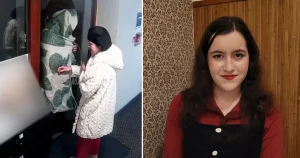

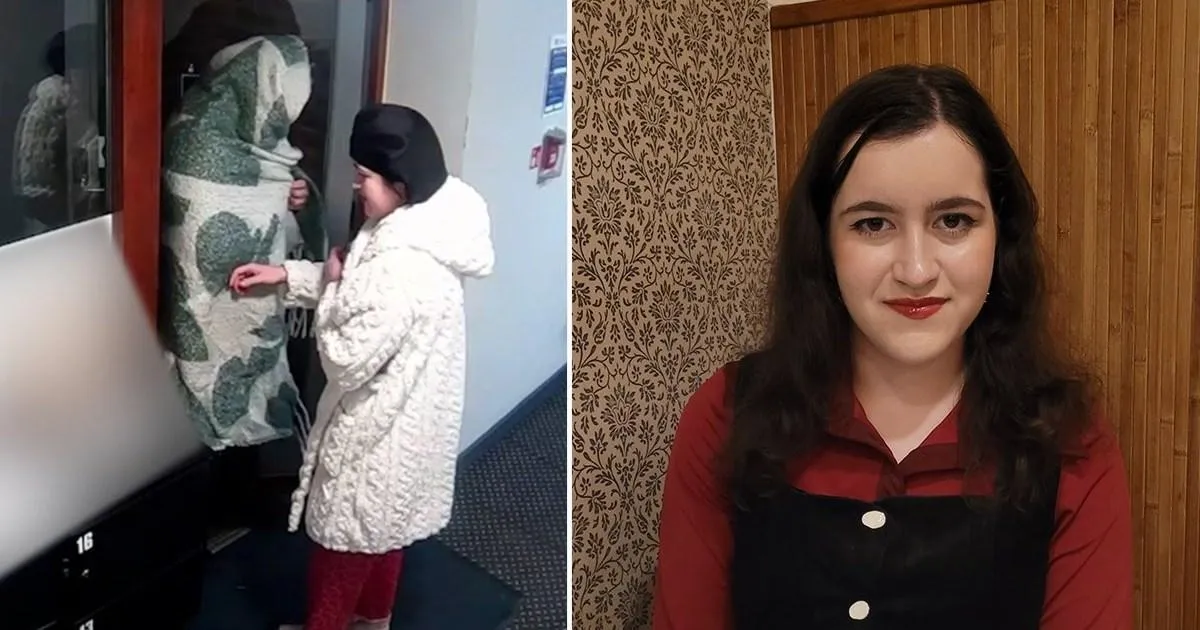
The university corridor was quiet, the kind of ordinary setting where terrible things are not supposed to happen. But in the early hours of February 4, something unthinkable unfolded behind the door of a student room in Preston. Carla Georgescu, a 19-year-old psychology student, opened her door to the man she had grown up calling family. Nathan Owens, 34, her stepfather, had driven more than 100 miles through the night from Hartlepool to reach her University of Lancashire accommodation. The journey itself was strange, but what happened next was beyond comprehension. CCTV footage shown to jurors at Preston Crown Court captures the moment he arrived: he wraps himself in a blanket, knocks on the door of her student halls, and waits. Carla, trusting him, lets him in. He pauses for a brief moment and glances up at the camera, almost as if he knows what is about to happen and wants to mark it, before following her into her room. Over the following 90 minutes, prosecutors say, Owens subjected Carla to a sexually motivated attack that included strangulation and ended in her death. The prosecution told the court that her murder was the culmination of weeks, months, and perhaps years of a one-sided sexual obsession. They described how this trusted stepfather had allowed his feelings for Carla to curdle into something dark and dangerous, and how that obsession finally exploded into deadly violence. Owens now denies murder, intentional strangulation, and causing grievous bodily harm with intent. The trial, which continues, has opened a window into a chilling story of hidden obsession, betrayal, and the murder of a young woman on the threshold of adulthood.
The background to this tragedy, as outlined by the prosecution, paints a deeply disturbing picture of a man consumed by a fixation he could no longer control. Nicholas Lumley KC, prosecuting, told the jury that Owens had a “wholly improper and dangerously entrenched sexual obsession” with his stepdaughter. This was not a fleeting moment of madness, the court heard, but something that had been growing for a long time. In the months before Carla’s death, Owens had secretly taken photographs of her without her knowledge. He had also altered innocent selfies she had shared, turning them into sexual images. He filmed himself having sex with her dolls and toys, including a life-sized effigy dressed in her nightie. The “only possible reason” for such behaviour, according to the prosecution, was his long-standing and deeply troubling sexual fixation with Carla. The court also heard that a fit of jealousy may have been the immediate trigger for his fateful drive to Preston. Carla had plans to fly to Romania the next day, and she had also arranged to meet a man she had been talking to online. Owens appears to have learned of these plans and, prosecutors believe, was overwhelmed by jealousy and possessiveness. His actions on that night, the prosecution argued, were “hardly surprising” given the extent of his obsession. What makes this even more heartbreaking is that Carla likely never knew the danger she was in. To her, Owens was her stepfather, someone she believed she could trust, someone she would open the door to in the middle of the night without suspicion. That trust was horrifically betrayed, and the young woman who should have been celebrating her 20th birthday days later instead became the victim of a violent, sexually motivated murder.
The details of the attack itself are harrowing. Once Owens was inside Carla’s room, the prosecution says, he subjected her to some form of grievous sexual activity that included strangulation. The attack lasted about 90 minutes, and by the end of it, Carla was dead. A post-mortem examination revealed the full extent of the violence she endured. She had suffered two heavy blows to her head, slash marks on her cheek, and cuts and bruises around her mouth and nose. Her hands were covered in blood, evidence of her desperate attempts to defend herself against the man who was supposed to protect her. The court heard that sex toys and Owens’ DNA were found at the scene, leaving little doubt about the nature of the assault. After the attack, CCTV footage shows Owens leaving the accommodation building while shielding himself with an umbrella. He was wearing a face mask and, disturbingly, Carla’s trainers, and he carried two bags as he walked away. Prosecutors believe those bags contained Carla’s phone and laptop, which he later removed and dumped somewhere along the drive back to Hartlepool. The image of him calmly covering his face, taking her belongings, and walking out into the street is one of calculated cruelty. In a matter of hours, he had transformed from the stepfather who had driven through the night to see his daughter into a man trying to erase every trace of what he had done. But he could not erase what was left behind in that small student room: a young woman’s life cut short, a grieving family, and a crime scene that would lead police directly to his door.
The aftermath of the murder is almost as chilling as the act itself. After allegedly killing Carla, Owens returned to Hartlepool, where witnesses described him as being his “normal self.” He went for a walk, visited an Asda supermarket, and went about his day as if nothing had happened. Meanwhile, Carla’s body lay slumped against a wardrobe in her room, a belt tied around her neck. She had been discovered only after her mother became worried when Carla did not respond to calls or texts. The mother, Janina, had no idea that her partner had driven to Preston that night. When police arrived at Carla’s accommodation and found her body, it was on what would have been her 20th birthday. The grief-stricken mother was initially told that Carla had been found hanged, and it was only when she contacted the hospital mortuary that she learned Owens had visited her daughter’s accommodation. Owens later claimed that Carla had asked him to bring her incontinence pants and help her tidy her room. But prosecutors say this was a lie, an attempt to “cover his tracks” and create an innocent reason for his presence. The court heard that in the weeks before her death, Carla was fit and well, with no such health issues. The suggestion that she needed incontinence pants was dismissed as a fabrication designed to mislead investigators. The image of Owens calmly shopping and walking while Carla’s body lay undiscovered is one that haunts the imagination. It speaks to a chilling ability to compartmentalise violence, to move through the world with a mask of normalcy while having committed an act of unspeakable cruelty against the daughter of the woman he loved.
Beyond the legal proceedings, this is a story about a young woman whose life was stolen by someone she trusted. Carla was a second-year psychology student, someone with friends, dreams, and a future. She was on the cusp of her 20th birthday, a time that should have been filled with celebration and hope. Instead, her life ended in violence at the hands of a man who had inserted himself into her family and then corrupted that relationship with obsession. The betrayal is layered: he was not a stranger lurking in the dark, but a stepfather who should have been a protector. He exploited the access and trust that came with that role, watching her, photographing her without consent, and building a secret world of sexual fixation that ultimately exploded into murder. For her mother, the pain must be unimaginable. Not only has she lost her daughter, but she has also learned that the man she shared her life with was responsible for that loss. Every memory of Carla, every family photo, every moment Owens spent in their home is now stained with the knowledge of what he was hiding. The court heard how Carla’s body was found on her birthday, a detail so tragic it brings tears to the eyes. Instead of bringing her cake and gifts, her family was brought the news of her death. Instead of watching her graduate from university, they will attend a trial. The human dimension of this case cannot be overstated: Carla was not just a victim in a criminal trial, but a daughter, a student, a young woman who deserved to live her life free from fear and violence.
As the trial continues, the prosecution will need to prove that Owens deliberately murdered Carla and intended to cause her serious harm. He denies murder, intentional strangulation, and grievous bodily harm with intent, meaning the jury will have to decide whether the evidence supports a narrative of premeditated sexual violence or something less severe. But for those who have heard the details, the picture is deeply damning. This was not a sudden loss of control; it was the endpoint of a long and dangerous obsession. The case also raises broader, uncomfortable questions about how such fixations can remain hidden, especially within families. How can a man be seen as a loving stepfather while secretly harbouring such dark desires? What signs were missed, and what could have been done to protect Carla? It also serves as a reminder of the vulnerability of young people away from home for the first time. University accommodation is meant to be a safe space, a place of learning and independence. Carla opened her door to her stepfather because she had no reason to fear him. That trust was exploited in the most brutal way imaginable. While no sentence can bring Carla back, the trial is a chance for justice to be done. It is a chance for her family to hear the full truth about what happened, and for the public to witness the consequences of unchecked obsession. Most importantly, it is a moment to remember Carla Georgescu not as a headline, but as a human being whose life was filled with promise, and whose death demands that her story be told with the gravity and compassion it deserves.