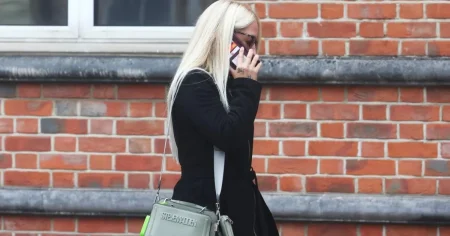



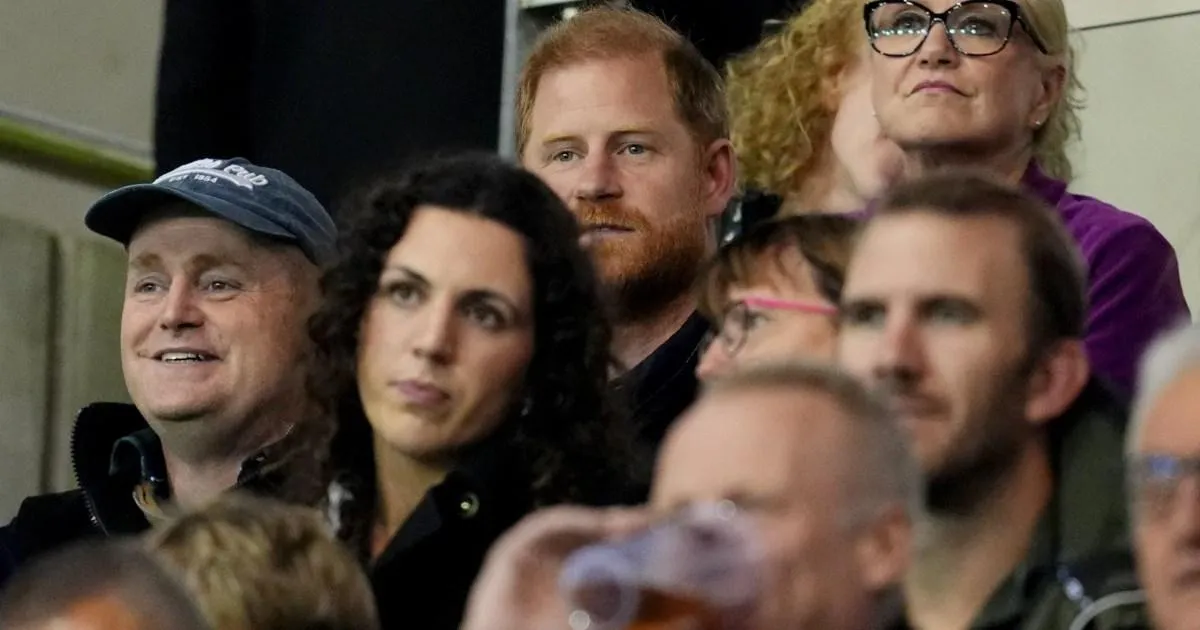
On a cool autumn evening in Leicester, the floodlights at Mattioli Woods Welford Road Stadium burned bright over a familiar English ritual: rugby fans in club colours, plastic cups of beer, the low rumble of anticipation before kick-off. Into this crowd walked Prince Harry, the Duke of Sussex, dressed not as a royal guest but as a fan—blue jeans, a dark coat, a pint in his hand. He took his seat in the stands, perhaps hoping for a quiet evening of sport, a chance to lose himself in the game he loves. But the cameras found him almost immediately, and so did a segment of the crowd. A video shared by Prem Rugby on X captured the moment, and the sound of booing rang out. TNT commentator Nick Mullins, spotting the duke on screen, tried to frame it positively: “A face in the crowd, Prince Harry, back home and enjoying some rugby again.” Then he paused and conceded, “There were some boos there.” The awkwardness was palpable. For anyone who remembered the Prince Harry of a decade earlier—the beloved redhead who hugged wounded veterans, posed with schoolchildren, and served as patron of the Rugby Football Union—the sound was jarring. This was not a hostile stadium; many fans applauded and cheered. But the boos were loud enough to be heard on television, loud enough to become part of the story, loud enough to make the evening feel less like a homecoming and more like a referendum. Harry, to his credit, seemed unbothered. He lifted his pint, settled into his seat, and fixed his eyes on the pitch, as if to say: I am here for the rugby, nothing else. The match was a Gallagher Premiership fixture between Leicester Tigers and Gloucester, two sides with fiercely loyal followings. Harry, 42, had chosen a populist setting, not a VIP box, and that choice said something about the man he has become. A decade ago, his presence would have been met with a standing ovation. Now, the atmosphere was more complicated, a strange cocktail of nostalgia, resentment, and curiosity. Some fans wanted to show support; others wanted to show displeasure. In the end, both happened, and the moment became a tiny, telling snapshot of a fractured relationship between a prince and the public. But Harry has always been stubborn. He didn’t flinch. He didn’t leave. He simply watched, waiting for the game to begin, and in that small act of defiance, there was something quietly human.
The rugby itself provided the kind of drama that made the booing feel secondary. Leicester Tigers, playing at home, faced a Gloucester side determined to spoil the party. The match swung one way and then the other, with tries, penalties, and desperate defence. Harry, who knows the game inside out, was utterly absorbed. Photographs from the evening show him with his hands in his hair, then clapping, then leaning forward as Gloucester piled on pressure. When Leicester finally secured a 38-31 victory, he exploded with joy, punching the air and high-fiving a friend sitting next to him. It was a genuine, unscripted moment of sporting happiness, and it reminded everyone why he used to be so popular. He is not a cold, distant royal; he is a man who feels things intensely, whether that is grief, anger, or delight at a last-minute win. The victory meant nothing to his public life, but it meant everything to him in that moment. This was also a significant occasion beyond the result: it was Harry’s first solo appearance in Britain since he and Meghan returned to the UK with their children, Archie and Lilibet, in August. For months, the family had been living quietly in the Cotswolds, with the children starting school in Oxfordshire, but this was Harry stepping back into the public eye alone. He seemed nervous at first, perhaps aware of the mixed reception, but by the final whistle he was just another rugby fan, glowing with the joy of a home win. The father-of-two may have lost the unconditional adoration he once enjoyed, but he has not lost his love for the game. If anything, that love seemed deeper now, more precious, because it offered a rare escape from the constant scrutiny of his life. For ninety minutes, he wasn’t a headline or a hashtag; he was just a man with a pint, living in the moment.
To fully understand why a chorus of boos at a rugby match matters, you have to look back at the extraordinary transformation of Harry’s public standing over the past decade. In the mid-2010s, he was arguably the most popular royal in Britain, a former soldier who had served in Afghanistan, founded the Invictus Games, and championed mental health awareness. As patron of the Rugby Football Union, he was a fixture at Twickenham, and the rugby community adored him. He seemed destined for a lifetime of public service, beloved by tabloids and fans alike. Then came January 2020, when he and Meghan announced they were stepping back as senior royals, a decision quickly dubbed “Megxit.” The couple said they wanted to become financially independent and escape the intense media scrutiny that had made Meghan’s life miserable. But the move was seen by many as a rejection of the Royal Family and, by extension, of Britain itself. The couple relocated to North America, initially to Canada and then to California, where they struck lucrative deals with Netflix and Spotify, built a new life, and began to speak openly about their experiences inside the palace. Every interview, every documentary, every court case seemed to widen the gap. The goodwill that Harry had accumulated over thirty-five years of royal life evaporated in a remarkably short time, replaced by a more polarised view: to some, he was a brave truth-teller; to others, a privileged hypocrite. Last night’s booing was not an isolated incident; it was the accumulated weight of six years of estrangement, expressed in a few seconds of sound. The fact that it happened at a rugby ground, the very place where he once felt most at home, only made it more poignant. Sport has a way of cutting through the noise, but even sport could not escape the long shadow of the Sussex saga.
The estrangement did not happen overnight, and it was deepened by a series of explosive public moments. In March 2021, the Sussexes sat down with Oprah Winfrey in a televised interview that shook the monarchy. Meghan spoke about feeling suicidal and isolated, and the couple alleged that a senior royal had raised concerns about the colour of their unborn son’s skin. The late Queen issued a carefully worded statement, noting that “recollections may vary.” The interview made headlines around the world, but it also hardened attitudes among those who felt the couple were airing private family grievances in public for profit. Then, in January 2023, Harry published “Spare,” a memoir that was intimate, angry, and often astonishing. He wrote about his use of recreational drugs, his grief over his mother, Princess Diana, and a physical altercation with his brother, Prince William, in 2019 over Meghan. William’s representatives strongly denied that any violence had occurred, but the damage was done. The book sold millions of copies, but it turned Harry into a deeply controversial figure in Britain. On top of all this, Harry was fighting a legal battle over the security he and his family received when visiting the UK. In May 2025, he lost an appeal against a decision to downgrade his protection, and shortly afterwards he told the BBC that he could not see a world in which he would bring his wife and children back to Britain. It was a bleak statement, full of frustration and hurt. And yet, only a few months later, he was back, sitting in a rugby stadium with a pint in his hand, as if trying to reclaim a piece of his old life. The contradictions are impossible to ignore. He says he doesn’t feel safe, yet he returns. He says he wants privacy, yet he sits in the most visible seat in the house. But perhaps that is the nature of exile and homecoming: you want to come back, and you also want to be seen coming back.
So how did Harry end up back in the stands at Welford Road? The answer lies in a quiet, surprising family move. Over the summer, the Sussexes—Harry, 42, Meghan, 45, and their two children—left their lavish home in Montecito, California, and relocated to the Cotswolds, a picture-postcard region of rolling hills and honey-coloured villages. Archie, seven, and Lilibet, five, were enrolled in schools in Oxfordshire for the autumn term. It was a decision that caught everyone off guard, including the media, and it suggested that Harry and Meghan were willing to give Britain another chance, or at least to give their children a taste of British life. The couple reportedly began paying for their own private security, while the Home Office initiated a review of whether their publicly funded protection should be reinstated. It was an awkward situation, to say the least. Harry had spent years arguing that he could not safely return without state protection, and now he was back, living on British soil, funding his own guards. The irony was not lost on his critics. But there was also something undeniably human about the decision: a son wanting to be closer to his father, a brother perhaps wanting to heal a rift, parents wanting their children to know the country of their birth. Harry’s appearance at the rugby match was a tentative step, a test of the water. He came alone, without Meghan, without a visible security entourage, just a seat in the stands and a pint. The boos were a reminder that the past is never far behind, but his decision to stay, to watch, to cheer, was a quiet signal that he is not willing to give up on Britain entirely. It may not have been a triumphant return, but it was a return nonetheless, and sometimes that is the bravest first step.
What should we make of the booing? It would be easy to say that Harry got what he deserved, or that the crowd was cruel, but the truth is more nuanced. Rugby crowds are notoriously loud and tribal; they boo referees, opposition players, and sometimes even the big screen when it shows a celebrity. Some of the boos may have been playful or performative, part of the rough-and-tumble of matchday atmosphere. Others were clearly sincere, a public expression of the anger and disappointment that many Britons feel towards the Duke of Sussex. But the moment also revealed something about Harry’s enduring appeal. For every person who booed, there was another who clapped, cheered, or simply wanted to watch the game. Harry himself seemed to embody that complexity: a man who is both privileged and wounded, both royal and rebel, both desperate for privacy and drawn to the spotlight. He is 42 years old, a father, a husband, a son, and a brother, carrying the weight of a very public family drama. Last night, he chose to do something ordinary: go to a rugby match, have a beer, and cheer for the home team. That should not be controversial. It is, in many ways, the most normal thing he has done in years. The boos may linger in the headlines, but so will the image of him high-fiving a friend as Leicester sealed their victory. If he continues to show up, to be himself, to embrace the messy reality of public life in Britain, there is a chance that the relationship can be rebuilt. It will not happen overnight, and it will not happen without more awkward moments. But as the old rugby saying goes, the game is never over until the final whistle. For Harry, the whistle has not yet blown. And if the last few years have taught us anything, it’s that he is not the kind of man to walk off the pitch while there is still time on the clock.