
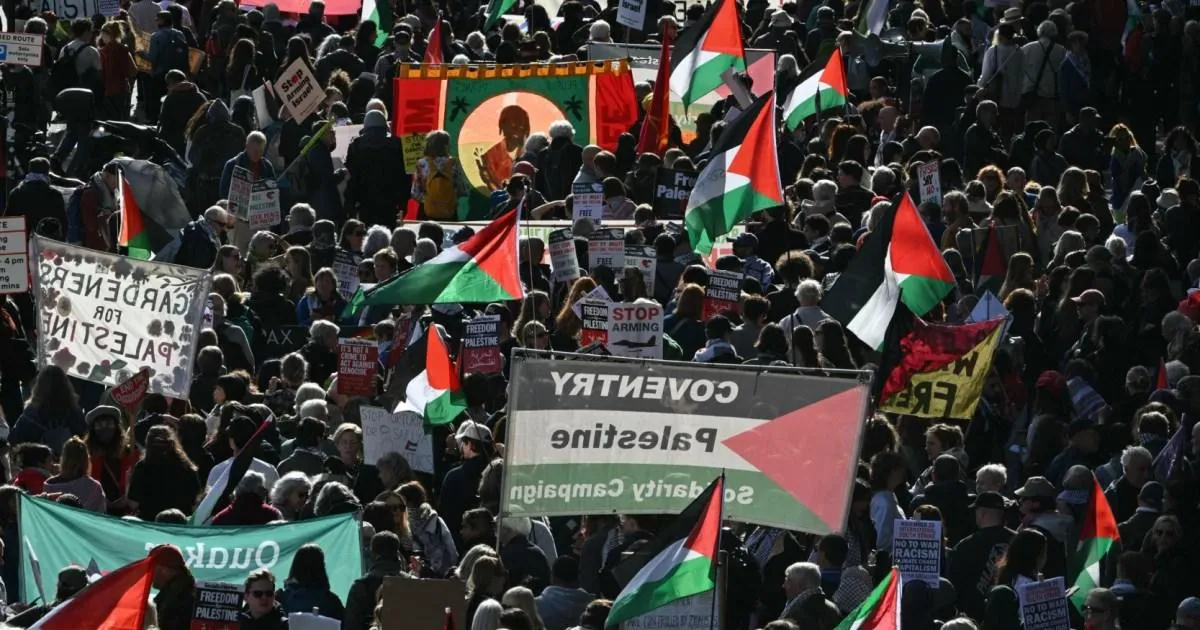
On a grey, restless London afternoon, the city found itself holding its breath. Thousands of demonstrators, many wearing keffiyehs and carrying Palestinian flags, gathered along the Embankment for the National March for Palestine. The Metropolitan Police had expected as many as 10,000 marchers, and the route, from the Embankment to Whitehall, was lined with officers and the low-voltage hum of anticipation. There were families with children on shoulders, students with Palestinian flags tied around their necks, older activists who had marched for decades, and first-time protesters who felt they could no longer stay silent. The Thames ran alongside them, indifferent and grey, while the sound of drums and overlapping chants bounced off the stone buildings. It was not a single voice but a chorus of demands: an end to the bombing, an end to occupation, a recognition of Palestinian humanity. Yet the atmosphere was not simply solemn. It had a jagged edge. The police presence was heavy, and the language of the day was coloured by emergency and crisis. For many marchers, this protest was a symptom of a deeper moral difficulty: the feeling that across the world, especially in Gaza, civilian suffering was being met with official excuses rather than action. Against such a backdrop, even a peaceful march in a safe city carried an immense emotional weight. The people who gathered were not statistics. They were neighbours, teachers, healthcare workers, faith leaders, and young people trying to make sense of a conflict that had entered their hearts and their social feeds. The Embankment itself had seen many protests before, but this one felt generationally significant, a moment where people had decided they could not look away. As the march began to move, the first hints of tension emerged. The route was long, the crowd was dense, and along the edges of the procession, police officers and protesters were locked in quiet, watchful standoffs. Everyone understood that the day might unfold in ways nobody had planned.
At Whitehall, where generations of protest have reached their natural meeting point, the mood grew more volatile. A small pro-Israel counter-demonstration stood nearby, and as the marchers passed, cries of “shame on you” cut through the air. It was a phrase charged with raw moral certainty, directed at people who supported military action or who seemed, in the marchers’ eyes, to be standing on the wrong side of a painful history. The counter-demonstrators were vastly outnumbered, and the experience of standing under that wave of collective disapproval was surely difficult. Some held their flags high and tried to look calm. Others shouted back. In such moments, the city became a collision of two communities, each carrying its own narratives of fear, grief, and identity. Police officers stood between the two groups, their faces unreadable, their bodies forming a thin line between peace and disorder. At certain moments, scuffles broke out between officers and groups of demonstrators. The details were confused: shoving, pushing, commands shouted through loudspeakers, and the sudden chaos of a crowd pressing forward. In a protest of this size, small incidents can quickly grow, and the police, who had come prepared to manage a large and emotional event, were forced into a series of difficult interventions. For those in the midst of it, the experience was disorienting. One moment a protester might be chanting with friends, the next they were being pulled away by officers, their arms held tightly, their face a mask of shock. The scuffles were not, on their own, a full-scale confrontation, but they exposed the fragile boundary between lawful demonstration and public disorder. At the edge of the rally, people who had seen the clashes tried to calm others, while some walked away in tears. The presence of the counter-demonstration had intensified an already charged day, and the anger that had been directed at distant governments found a closer target. The police, meanwhile, had to balance their duty to protect free speech with their responsibility to prevent disorder. It was a thankless position, and both protesters and officers felt the strain. By the time the main rally began, the focus had shifted back to the speeches and the solidarity that had brought people there, but the memory of those scattered confrontations lingered in the air.
Then came the arrests, and with them, a deeper knot of controversy. Police confirmed that several arrests had been made after what they described as damage to a memorial commemorating the Battle of Britain. The memorial stands as a tribute to the airmen who fought in one of the most defining moments of the Second World War, and it occupies an almost sacred place in the public imagination. It is not a forgotten relic. It is visited by schoolchildren, decorated with poppies on Remembrance Sunday, and cared for by people who see it as an act of gratitude. The idea that it might have been damaged by pro-Palestinian demonstrators immediately generated shock and outrage. For many, the damage was a betrayal of the protest’s moral claims. No matter how deep the anger over Gaza, they argued, a war memorial is not a legitimate target. For others, the accusation was murkier, a fragment of a chaotic day in which the line between accidental damage and deliberate vandalism was not immediately clear. The police were still investigating, and the arrests did not automatically prove that a protester had set out to desecrate the site. But the image of a memorial damaged in the middle of a march for human rights was profoundly unsettling. It gave critics of the protest a powerful symbol: a movement that spoke of justice but could not protect the memory of those who had died defending their country. It also put the demonstrators on the defensive, forcing them to answer for the actions of a few in an otherwise largely peaceful crowd. Humanly speaking, the moment was a loss for everyone. For veterans and relatives of veterans, the memorial is not stone but memory. To see it harmed, even scratched or smudged, is to feel history being erased. For protesters, the incident undermined their message and handed political opponents an easy weapon. The grief and anger that had filled the streets suddenly had to compete with a quieter, more complicated emotion: embarrassment. Some demonstrators distanced themselves from the damage, while others tried to understand how a march focused on civilian life could have ended in a confrontation with the dead. The answer may never be entirely clear. What was clear, in the aftermath of the arrests, was that the day’s moral landscape had become far more difficult to navigate.
Alongside the memorial allegations, police announced that further arrests had been made on suspicion of supporting Palestine Action, an organisation they described as proscribed. In British law, proscription carries serious consequences. It is not a casual label. It places a group outside the boundaries of lawful activity, and it means that even expressions of support can become the subject of criminal investigation. For the police, the arrest was a straightforward application of that law. For many protesters, however, it was a reminder of the narrow line they were walking. The legislation that governs proscription is broad, and its use in the context of a mass march can feel, to activists, like a chilling effect. They come to protest not as lawyers but as citizens, carrying signs that say “end the war” or “stop the arms trade,” and they do not always know which phrases or symbols might put them at legal risk. The arrest of a protester for alleged support of a proscribed group thus carries a troubling human dimension. It transforms someone from a participant in a public rally into a suspect, with all the anxiety and isolation that follows. They may spend hours in a police station, separated from the community that had surrounded them, wondering how a day of solidarity turned into a personal legal emergency. Onlookers watching the arrests unfold experienced a painful sense of recognition. The person being handcuffed might have been a neighbour, a colleague, a parent. The distance between holding a cardboard sign and being held in a police van turned out to be terrifyingly short. At the same time, the police are not simply agents of repression. They are responsible for enforcing laws that Parliament has passed, and they must take action when they believe an offence has occurred. Their officers were working long shifts, facing a large and sometimes hostile crowd, and trying to ensure that the protest did not spiral into violence. The arrests were, from their perspective, a necessary way of holding people accountable. But in the broader political context, they deepened the sense among many demonstrators that their legitimate concerns were being treated as a security problem. The government, they argued, was more interested in policing protest than in addressing the conditions that made protest inevitable. The result was a festival of mutual suspicion, in which every chant, every banner, and every memorial became a possible flashpoint. And at the centre of it all stood ordinary people, trying to make themselves heard, suddenly aware of how much their presence might cost them.
To understand the intensity of the day, one has to look beyond the rally itself and into the long, unbroken history of pain that drew people to the Embankment. The war in Gaza had already lasted for many months, and every week brought fresh images of devastation. In the homes of those who marched, the suffering was not an abstraction. It was visible on their screens at breakfast, in their conversations at work, in the faces of friends who had lost family. They came to London because they felt powerless, but also because collective action offered a small, fragile antidote to despair. A march is not a policy. It does not stop a bomb or open a border. But for the people who take part, it is a moment of shared humanity, a way of saying that the world is watching. That was the deeper purpose of the National March for Palestine. It was not merely a demonstration against a government or a conflict; it was an act of solidarity with people whose voices had been muted by war. The banners and chants were addressed as much to the public conscience as to the politicians. The march was also an act of memory. Participants carried photographs of people who had been killed, names on T-shirts, stories written on placards. They were not just marching for an idea. They were marching for real people whose lives had been swallowed by war. But the march was also happening in a country torn by its own divisions. The conflict in the Middle East had become entangled with domestic debates about identity, free speech, and the meaning of British values. Some attendees felt that any criticism of Israeli policy was being unfairly equated with antisemitism. Others felt that the phrase “pro-Palestine” itself had become a stigma, a label that could cost them friendships or employment. In that atmosphere, every encounter with a counter-protester or a police officer carried an extra weight. The city itself, with its war memorials and its parliamentary buildings, seemed to remind everyone that history is not neutral. The same streets that had seen protests against the Iraq War, against apartheid, against nuclear weapons, were again being used as a stage for moral witness. But with each new conflict, the questions became harder. When does a legitimate demand for justice become a threat? When does solidarity become offense? And who gets to decide where the line falls? The march did not answer those questions. It simply made them impossible to ignore.
By the time the crowds began to disperse, London felt heavier than it had in the morning. The arrests had turned a day of protest into a subject of national argument. On social media, supporters of the march condemned the response of the authorities, while critics condemned the demonstrators. The war memorial, once again, became a symbol of competing narratives. For some, it stood for the sanctity of historical memory. For others, it was a stone reminder of how quickly a moral cause can be tarnished by careless anger. The human truth, as always, was more complicated. The people who had marched were not a monolith. They carried different histories, different reasons, and different breaking points. Some had come as a peaceful gesture of conscience. Others had come looking for confrontation. In any crowd of thousands, the line between witness and rage can blur. The police had made their choices and made their arrests. The protesters would go home and face the consequences of those choices, whether in courtrooms or in the quieter courts of public opinion. But the deeper questions raised by the day remained unanswered. How should a society weigh the pain of a distant war against the need to protect its own monuments? How should it protect the right to protest while ensuring that protest does not tip into destruction? And how should it hear the voices of people who feel, with every fibre of their being, that the world has failed them? There were no easy solutions on that grey afternoon. There was only the long walk back along the Embankment, the silence of a river that had seen centuries of human struggle, and the knowledge that the next march, the next rally, the next argument was already being planned. In the end, the day was not a victory for any side. It was a mirror, reflecting a society uncomfortable with the images it saw. The memorial would be cleaned or repaired. The arrests would take their legal course. But the memory of the march, in all its human complexity, would remain. It was a story of grief and anger, of solidarity and mistake, of people who believed they were doing right and people who believed they had witnessed wrong. And that was perhaps the most honest place to leave it: not with a neat conclusion, but with the uneasy, unresolved task of living with each other.