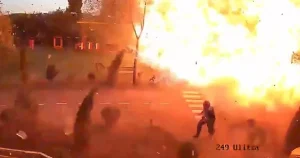

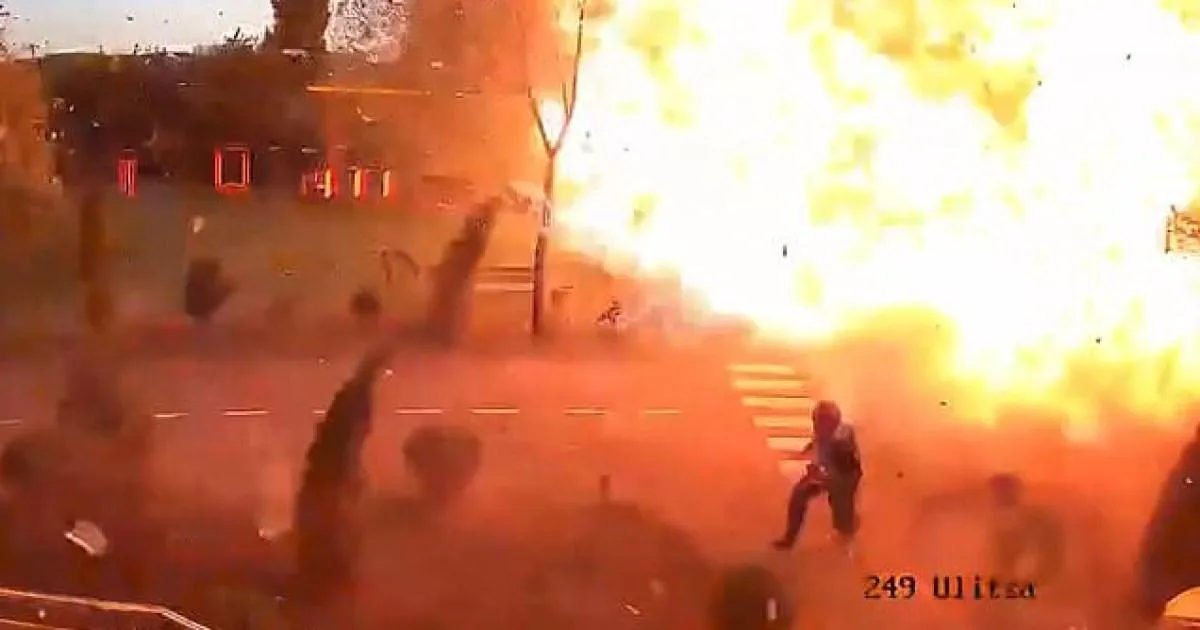
**1. The CCTV footage is the kind that makes you hold your breath, even when you already know the ending. It captures a man walking along a quiet street beside a children’s playground, his gaze fixed on his phone, his body relaxed in the illusion of safety. The day appears ordinary—cold, grey, perhaps one of those short afternoons before winter closes in. The playground equipment stands empty, swings motionless, a slide waiting for children who are not there. The man checks his phone, unaware that an unseen predator is travelling through the air above him. Then, in a moment that seems to come straight from a nightmare, he stops. He has heard something. The sound of the approaching Russian drone must have been faint at first, a mechanical buzz woven into the wind, but enough to break the spell of the screen. He looks up, and in his posture you can read the full, terrifying arc from confusion to recognition to panic. He sprints for cover with the raw, desperate speed of a man who understands that the next second may be his last. The drone impacts where he had been standing a heartbeat earlier. A ball of fire erupts, debris scatters, smoke curls into the grey sky. He survives. The footage leaves you with a strange, sickening mixture of relief and dread, because it shows how thin the line is between life and death in a war that claims to respect no one. Every minute detail is mundane: the way he tucks his elbows, the slight hunch of his shoulders, the way people walk when they think the world is safe. The camera angle might have come from a shop or apartment block, a mundane piece of urban infrastructure repurposed as a witness to horror. In less than ten seconds, the routine becomes a matter of life and death. The explosion is sudden and violent, a blooming orange fireball that turns the spot into a blast zone. It is hard to watch, yet impossible to look away, because it could be anyone—you, a partner, a neighbour, a friend—caught in the same moment of inattention. His sprint is not heroic in the Hollywood sense; it is instinctive, animal, a body fighting for survival before thought has caught up. And then, after the dust settles, there is the strange aftermath: the man, alive, perhaps shaken, perhaps bleeding from minor shrapnel, stumbling to his feet. How does anyone process that? How does one return to ordinary life after stepping out of the path of death by the width of a breath? The footage does not tell us. It only leaves us with the image of a playground and a man running, and the knowledge that in Ukraine this has become a normal part of wartime reality.
2. This man’s near-miss is not an isolated accident. It is a glimpse of a deliberate and chilling strategy. Ukrainian officials say they have obtained Russian documents outlining plans to target civilian infrastructure and population centres as winter sets in. The documents, according to Kyiv, describe a campaign meant to break the country’s will by making it impossible to live safely in any city, town, or village. President Volodymyr Zelenskyy described the strategy in stark terms, recounting what the documents allegedly reveal: that Russian forces have permission to strike infrastructure, logistics, roads, schools, hospitals, and residential areas across Ukraine. “They allow them to attack infrastructure, logistics, and especially to attack in the cities, in the villages, everywhere, roads, schools, hospitals,” he said. The goal, he added, is simple and brutal: “To pressure people to leave the capital, leave different cities: this is the goal of the operation.” For those who have stayed, this means a winter of fear, cold, and uncertainty. The video of the man at the playground becomes a kind of evidence: not just a lucky escape, but a demonstration of how Russia’s war machine now sees ordinary civilians as legitimate prey. There is no front line here, no military base or munitions depot. There is only a sidewalk, a phone, and a man trying to live his life. The timing is not accidental. Historically, winter has been a weapon in conflicts, and Ukraine has faced this before. In previous years, Russia bombarded energy grids, leaving millions without heat and light in freezing temperatures. Now, with colder months approaching, Ukrainian officials fear a repeat—but with a new dimension of terror. The CCTV footage shows not just a drone strike but a calculated psychological assault: every public space, even a children’s playground, becomes a potential death trap. The Russians, according to the documents, do not distinguish between military and civilian. They want cities emptied, villages abandoned, the country ungovernable. This is why a man checking his phone is not a random target but a strategic one. Every civilian death is intended to send a message: nowhere is safe, no one is safe.
3. If the drone footage captures the terror of one individual, the glide bomb attack on Zaporizhzhia captures the collective catastrophe that has become routine. Ukrainian officials reported that a strike on the city killed at least fifteen people, including three children. Rescuers searched through rubble for hours, pulling bodies from the wreckage of what had been someone’s home. The phrase “glide bomb” may sound technical, but on the ground it means a powerful, accurately guided weapon that can level a building without warning. Unlike the drone that missed by seconds, many do not hear the bomb coming. There is no time to run, no instinctive sprint for cover. One moment a house is quiet, filled with ordinary sounds—a kettle boiling, a television murmuring, children doing homework—and the next it is a pile of broken concrete. Hospitals treated the wounded, including the elderly and very young. Doctors worked through the night in conditions that have become depressingly familiar: trauma surgery, shrapnel wounds, burn injuries, post-traumatic collapse. The attack on Zaporizhzhia is not a piece of military calculus; it is an act of violence against everyday life. The children killed were not soldiers. They were probably playing, or sleeping, or sitting at a table, just like children everywhere. Their deaths are the real face of the Russian strategy Zelenskyy described. When he says the goal is to make people flee, he means that this textbook horror is designed to create waves of refugees, crush morale, and force Ukrainians to abandon their homes before the snow falls. One can imagine the chaos: people digging with bare hands, screaming names, the sound of sirens competing with cries for help. In such moments, the abstract political battle over documents and strategy dissolves into the most personal sorrow imaginable. A lost child, a broken family, a city scarred by senseless destruction. The international community offers condolences, but in Zaporizhzhia there is no time to mourn. The next attack may be coming. Every siren is a reminder that civilians are not collateral damage; they are the target.
4. For Ukrainians, this is the reality of daily life in the third winter of full-scale war. The CCTV video and the Zaporizhzhia bombing are not separate stories; they are chapters in the same ongoing assault. The idea of a “playground” has become darkly ironic: in a country where drones and bombs decide the shape of the day, there is no safe place for children. Schools have been destroyed or transformed into shelters. Hospitals, themselves attacked, have been forced to treat the wounded in basements. Roads that connect villages to cities are shelled, making it impossible for families to flee or for supplies to reach them. The winter adds another layer of cruelty. As temperatures drop below freezing, Russia’s targeting of energy infrastructure means that even surviving a bomb attack can be followed by the slow torture of living without heat, water, or electricity. Ukrainian engineers work around the clock to repair the grid, but the attacks repeat, each time drawing the same blood. The strategy is to wear down the population, to replace hope with exhaustion and then with despair. Talking to people in cities near the front, one hears a mixture of defiance and weariness. They have learned to sleep in underground stations, to keep bags packed, to say goodbye to loved ones as if it might be the last time. Yet they also refuse to leave. This is their home. The man at the playground, after his luck ran out or perhaps held, will likely go home to an apartment with broken windows, put a kettle on, and listen to the air-raid siren as if it were just another street noise. There is a terrible ordinariness to the horror. That is what the Russian strategy relies upon, and that is what the footage exposes. The human mind is not designed to live in a state of constant alert, yet here every parent must decide whether to let a child ride a bike or walk to school, every teacher must practice duck-and-cover drills, every patient in a hospital bed wonders if the building will still be standing in the morning. This is not wartime heroics; it is wartime survival. And the fact that so many people continue to wake, work, cook, love, and hope in the middle of it all is a quiet act of resistance that no bomb can erase.
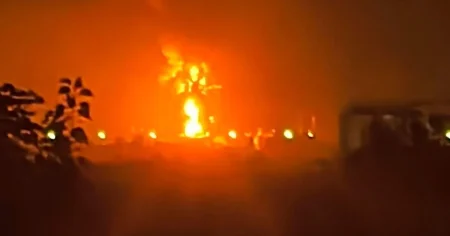
5. The only answer from Kyiv has been defiance. In the wake of the attacks, Zelenskyy has not retreated into calls for calm; he has escalated in kind. As the world’s attention briefly shifted to the latest diplomatic manoeuvrings, Ukrainian forces launched a strike on a major Russian oil hub, a direct hit against the infrastructure that fuels the war machine. The operation was a message: Ukraine can take the fight beyond its borders, and it will not accept a settlement dictated by fear. Zelenskyy’s public language has grown sharper, too. When a potential deal between Donald Trump and Vladimir Putin was floated, supposedly to pause the fighting and freeze the lines of control, Zelenskyy dismissed it as “weak” and “unworthy.” For a country bleeding daily, any peace that legitimises the occupation of its territory and leaves civilians under the shadow of future drone attacks is not peace at all. The words resonated with ordinary Ukrainians, many of whom feel they are being asked to make impossible choices: negotiate with an enemy that sends glide bombs into residential streets, or continue fighting while the bombs keep falling. The diplomatic calm of foreign capitals feels far removed from the CCTV video, but it is not. The deals and decisions being made in powerful boardrooms will determine whether more playgrounds become blast zones, whether more schoolchildren become statistics, whether more families have to choose between freezing and fleeing. Zelenskyy’s strike on Russian oil infrastructure, controversial as it may be, argues that the best protection is to make the aggressor feel some of the same pain. The strategy may be debated by analysts, but for a man who has just looked up at a descending drone, the abstraction of diplomacy matters only in the split second before the explosion. He does not care about power balances or negotiating positions; he cares about whether the next morning comes, whether the air is quiet, whether the children can leave the basement. Yet the two are connected, and the leaders of the free world are being called upon to remember that every so-called political compromise is written in the flesh of people who had nothing to do with starting this war and everything to lose in continuing it.
6. What does it mean to witness a man escape death by seconds? In a war filled with unspeakable tragedies, such small miracles can feel like rare mercies. But they also carry a burden. For every person who runs fast enough, there is another who does not. For every ball of fire that misses its human target, there is a building in Zaporizhzhia where a ball of fire does not miss. The CCTV footage should not be used to comfort us with the idea that fate is kind; it should remind us that fate is random, and that randomness has a politics. The drone was sent by someone. The glide bomb was released on someone’s command. The documents describing the targeting of civilian infrastructure were written, approved, and executed. There are individual human beings responsible for the fact that walking by a playground has become an act of lethal risk. And yet, in the midst of this, there is something remarkable about the man’s escape. It is not just luck; it is the instinct to live, the refusal to accept death, the stubborn animal hope that carries us through the worst of what humanity can do to itself. That same stubbornness is visible across Ukraine. It is in the engineers repairing power lines under fire, in the teachers holding lessons in metro stations, in the parents who still take their children to playgrounds when the sirens fall silent for a few hours. The Ukrainian strategy, if it can be called that, is not merely military. It is the decision to go on living, in the fullest and most defiant sense, in the face of a policy designed to make life impossible. The world may not know how this war will end, or when. But it knows now, from a few seconds of security footage, what is at stake. A man walks by a playground, checks his phone, hears the sound of death coming, and runs. He survives. We must hope that Ukraine, too, will keep running—until the day when no one has to look up at the sky in fear.