


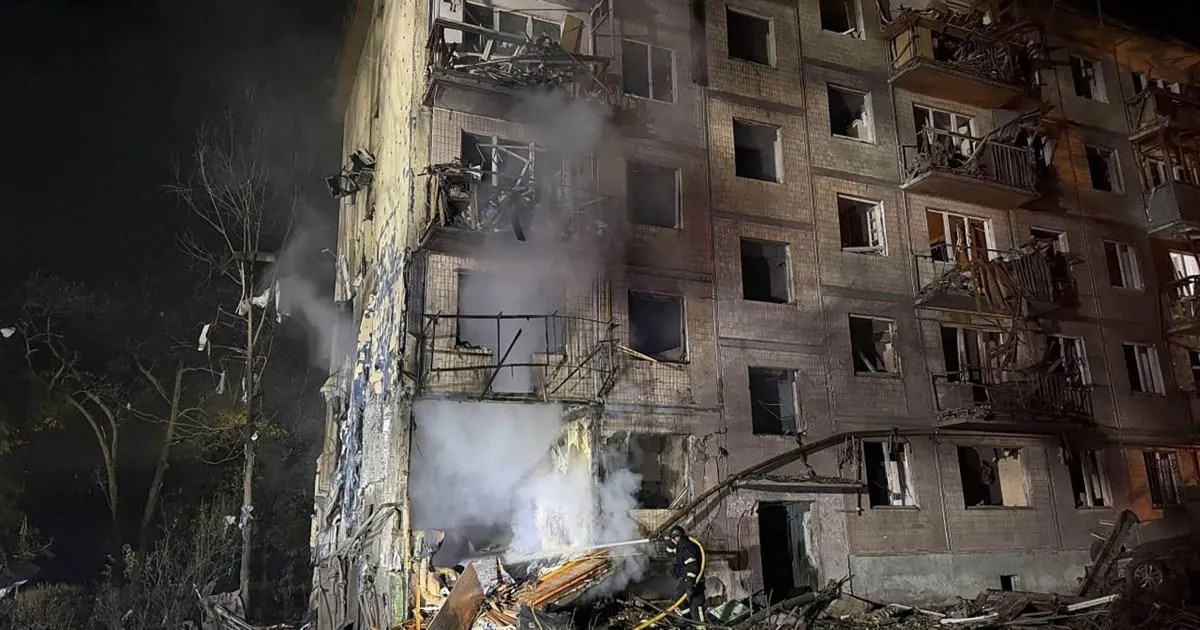
The early hours of this morning brought a harrowing reminder of the brutal reality of the ongoing conflict in Ukraine, as a barrage of Russian ballistic missiles tore through the relative silence of the night in Kyiv. The sirens began their mournful wail at approximately 1:30 a.m., prompting desperate, split-second scrambles for cover. For many, however, time simply ran out. Mayor Vitali Klitschko reported a series of deafening explosions across the capital, and the grim aftermath was soon captured in raw, heartbreaking images: streets littered with debris, the skeletal remains of fire-gutted cars, and the sight of wounded citizens waiting for help that arrived amidst the smoke and chaos.
The devastation was widespread, affecting seven districts and claiming at least nine lives, with 28 others—including four young children—suffering injuries. President Volodymyr Zelensky, who took to social media to document the carnage, highlighted the deliberate nature of the strikes, noting that the missiles had once again targeted ordinary residential neighborhoods. The toll on civilian infrastructure was immense, with 18 homes, a school, and the Lithuanian embassy sustaining significant damage. In the Solomyanskyi district, a six-story building became a furnace, trapping residents inside and turning a place of rest into a scene of unspeakable tragedy.
Behind the immediate destruction lies a deepening systemic crisis: Ukraine’s air defense capabilities are reaching a breaking point. President Zelensky issued a stark warning that after years of relentless bombardment, the nation’s supply of Patriot interceptors—the only reliable defense against high-speed ballistic missiles—is dangerously low. He emphasized that Moscow is acutely aware of this vulnerability, fueling a summer of intensified aerial assaults. For the Ukrainian people, the absence of these defensive tools is not merely a strategic setback; it is a daily, lethal gamble where the lack of hardware is directly correlated to the number of lives lost.
The geopolitical tension surrounding these defenses has become a central friction point in the international response. Ukraine has formally requested that the United States grant a license to allow for the domestic production of these vital interceptors. However, the path to approval remains fraught with hesitation. During recent discussions, President Donald Trump expressed a cautious stance, citing concerns over the proliferation of highly sensitive military technology. While the U.S. acknowledges the severity of the situation, the reluctance to share such proprietary defensive capabilities leaves Ukraine in a precarious position, waiting on external supplies that are currently falling short of the necessity.
This latest strike follows a terrifying pattern of escalation, coming only days after a previous attack claimed the lives of nine people, including six members of the same family. Adding to the international volatility, the recent incursion of a Russian cruise missile into Polish airspace has further heightened fears of the conflict spilling beyond Ukraine’s borders. The object, which left a massive, nine-meter-wide crater in a rural field, serves as a chilling reminder that the regional security architecture is under immense strain, and the margin for error is shrinking by the day.
As the smoke clears in Kyiv and rescue workers continue to sift through the rubble, the human cost remains the most poignant aspect of this tragedy. Every explosion echoes the desperate, unmet need for security that has defined the lives of millions for half a decade. For the families mourning in the Solomyanskyi district or those tending to wounded children, the debates in Washington and the technical details of defense contracts are distant compared to the immediate, visceral grief of the morning. The war continues to extract a relentless price from the civilian population, leaving a nation to grapple with the haunting question of how much more they can endure as their defenses slowly fade.