

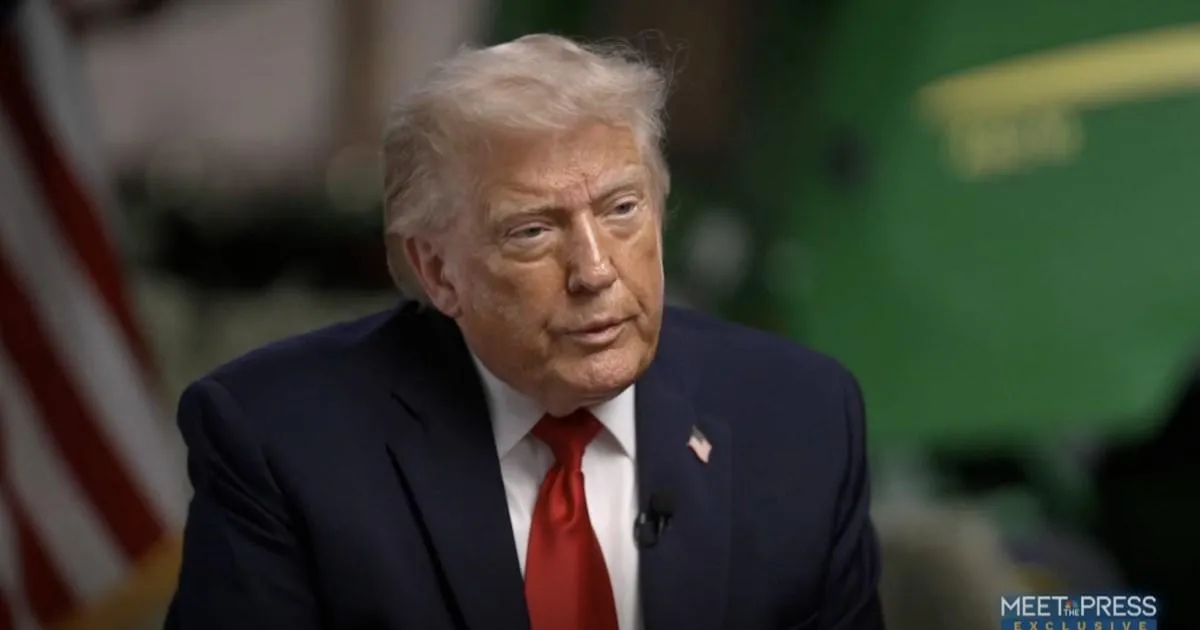
In an unexpected series of statements, Donald Trump has outlined a complex vision for the future of U.S.-Iran relations, signaling that he believes a formal agreement is finally within reach. During a candid conversation, the former president suggested that even if a diplomatic breakthrough is reached, the American military presence in the region would not immediately conclude. Instead, he underscored that U.S. forces would remain on the ground until the mission is finalized, specifically focusing on the neutralization of Iran’s enriched uranium stockpile. Trump’s tone shifted between diplomatic optimism and military pragmatism, insisting that while both nations are on the verge of a deal, he remains committed to ensuring that the threat of nuclear proliferation is comprehensively dismantled.
The core of this potential agreement appears to be a strict conditionality regarding nuclear capability. Trump highlighted that he is personally pushing for a clause that would go beyond simply banning development; it would explicitly prohibit Iran from acquiring or purchasing nuclear assets in any form. Interestingly, he offered a unique assessment of Iran’s current leadership, describing them as “very smart” and “very rational.” He even drew an unprompted comparison between the current supreme leader, Mojtaba Khamenei, and his father, Ali. This public nod is particularly striking given that the younger Khamenei has remained largely out of the public eye since the onset of the conflict, yet Trump clearly views him as the key figure needed to bring this geopolitical standoff to a close.
The logistics of the disarmament process, as envisioned by Trump, would involve a collaborative effort. He suggested that if a friendly deal is struck, the United States would assist in the physical removal or destruction of nuclear materials, utilizing American equipment to do so either on-site or at a designated facility. However, this carrot-and-stick approach has a sharp edge: Trump warned that should the diplomatic path fail, he is fully prepared to take what he described as “harsh” military action. This underscores his attempt to leverage the threat of total destruction to force a diplomatic resolution that he feels has been missed by his predecessors, whom he frequently blames for allowing the situation to reach this breaking point in the first place.
Technological superiority remains a significant pillar of Trump’s strategy. During the interview, he emphasized the U.S. military’s unprecedented ability to monitor Iranian nuclear activity from orbit. With a characteristic flair for hyperbole, he insisted that their surveillance capabilities are so advanced that they could identify individuals on the ground with extreme precision. This assertion serves a dual purpose: it warns the Iranian leadership that any attempt to skirt the terms of a deal would be immediately detected, and it reassures domestic audiences that the United States is operating with a level of oversight that renders deception impossible. By painting a picture of total visibility, he aims to discourage any lingering attempts at clandestine development.
The geopolitical landscape remains incredibly fragile, however, as evidenced by ongoing skirmishes in the broader region. While negotiations are teased as being “very close,” the reality on the ground is marred by active conflict. The U.S. military has recently reported successful interceptions of Iranian drones and missiles near the Strait of Hormuz, alongside targeted strikes against coastal radar installations. These actions highlight the volatile environment in which these talks are taking place. Simultaneously, the ceasefire between Israel and Lebanon is showing significant signs of fatigue, with projectile exchanges and retaliatory airstrikes threatening to pull the region back into a state of full-scale warfare, complicating an already delicate diplomatic choreography.
As pressure mounts for a final resolution, Trump acknowledged the psychological difficulty for the Iranian side to concede after years of operating under their own set of rules. He suggested that the current Iranian leadership is struggling to process their precarious situation, which he described as being “virtually decapitated” in terms of their strategic position. While he hinted at the possibility of unfreezing certain assets should they demonstrate a change in behavior, the path forward remains shrouded in uncertainty. Ultimately, the success of this strategy hinges on whether Trump can balance the iron-fisted demands of security with the necessary diplomatic concessions to bring an end to a conflict that has defined decades of international relations.