


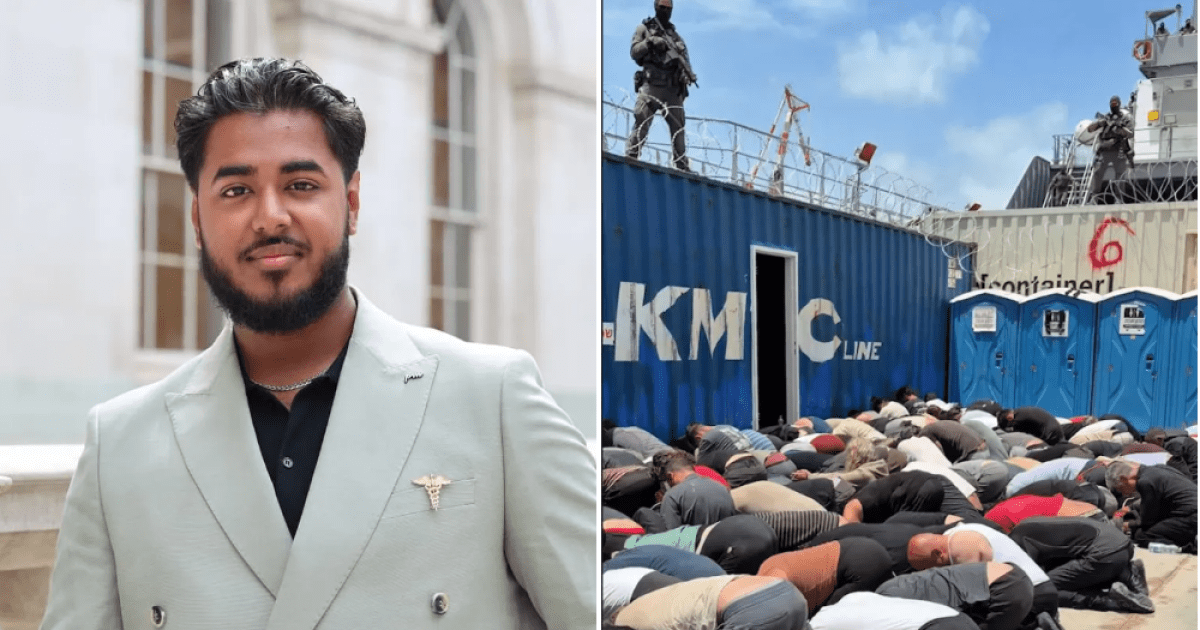
For Hasnain, a student at King’s College London, the decision to join the Global Sumud Flotilla was not a whim of radicalism, but a natural progression of his longstanding commitment to humanitarian activism. Having previously served on the land crew for similar missions, he felt compelled to move from the sidelines to the front lines, joining hundreds of volunteers aiming to bridge the gap between global indifference and the desperate needs of the people of Gaza. After undergoing rigorous maritime safety training in Greece, Hasnain and his fellow activists set sail from Turkey in May, fully aware that their journey was fraught with peril. They were not combatants; they were civilians carrying baby formula, food, and basic necessities, bound together by the belief that a peaceful, visible act of solidarity could offer a glimmer of hope to a population under siege.
The journey turned into a harrowing ordeal on the fourth day at sea, when the peaceful horizon was broken by the approach of Israeli military vessels. What began as a simple humanitarian mission quickly devolved into a terrifying encounter with state-sanctioned force. Despite the flotilla consisting of nearly 400 unarmed civilians, the military responded with overwhelming aggression. Hasnain vividly recoils at the memory of the speedboats surrounding them, the blaring threats to shoot, and the chaotic violence that followed. In an instant, the water was filled with the sound of gunfire and the screams of those wounded. Hasnain himself was injured by flying shrapnel, while a companion suffered a gunshot wound to the face—a brutal reminder of the stark contrast between their cargo of aid and the weaponry aimed at them.
The immediate aftermath of the interception was a descent into a nightmare of abduction and captivity. Dragged from his vessel onto a military speedboat, Hasnain recalls the frantic, desperate moments of trying to maintain his grip while buffeted by cold, violent seas. He was held captive in a cramped, unsanitary warship, surrounded by dozens of others in a suffocating room that smelled of human waste. Despite the degrading conditions, Hasnain describes a fierce, internal determination not to let despair take root. He clung to the perspective that their suffering, however acute, remained an infinitesimal fraction of the systemic trauma endured by the Palestinians they had set out to help—a reminder that helped him maintain his resolve even as the situation deteriorated into physical torture.
Upon being moved to a prison in the Gaza Strip, the treatment did not improve; it worsened into systematic cruelty. Hasnain details being subjected to kicks, punches, and elbows to his ribs, face, and knees by prison staff. He describes the dehumanizing experience of being forced to kneel with his hands tied behind his back—a position he was forced to hold for hours, leaving permanent physical reminders on his wrists. This reality was captured in official videos released by Israeli authorities, confirming the grim circumstances of his detention. For four long days, he existed in a state of suspended humanity, stripped of dignity and subjected to the whim of his captors, until he was eventually forced to sign deportation papers to return to the United Kingdom.
Returning home brought a sharp, painful realization of the privilege inherent in his support system, a reality he describes as a double-edged sword. While his family and friends could ensure his safety and recovery, the people of Gaza remain trapped, lacking any such escape or protection. Yet, Hasnain remains firm in his conviction that the sacrifice was not in vain. He points to the fact that, despite the military intervention, some of the aid packages were eventually released into the sea and reached the waiting hands of those in Gaza. For him, the mission was a success, not just in terms of the sustenance delivered, but in the profound, unbreakable sense of community forged among those who were willing to risk everything for a shared moral cause.
Looking back, Hasnain rejects any notion of regret for his involvement in the flotilla. He views the exhaustion, the violence, and the trauma as the necessary price of a life lived in accordance with his conscience. While official Israeli authorities maintain that their actions were conducted in accordance with the law and deny reports of mistreatment, Hasnain’s testimony serves as a stark, human account of the collision between humanitarian intent and military power. He remains grateful for the experience—not for the cruelty he endured, but for the rare, beautiful solidarity he found among his peers, and he continues to hold tight to the belief that silence in the face of suffering is the only true failure.