



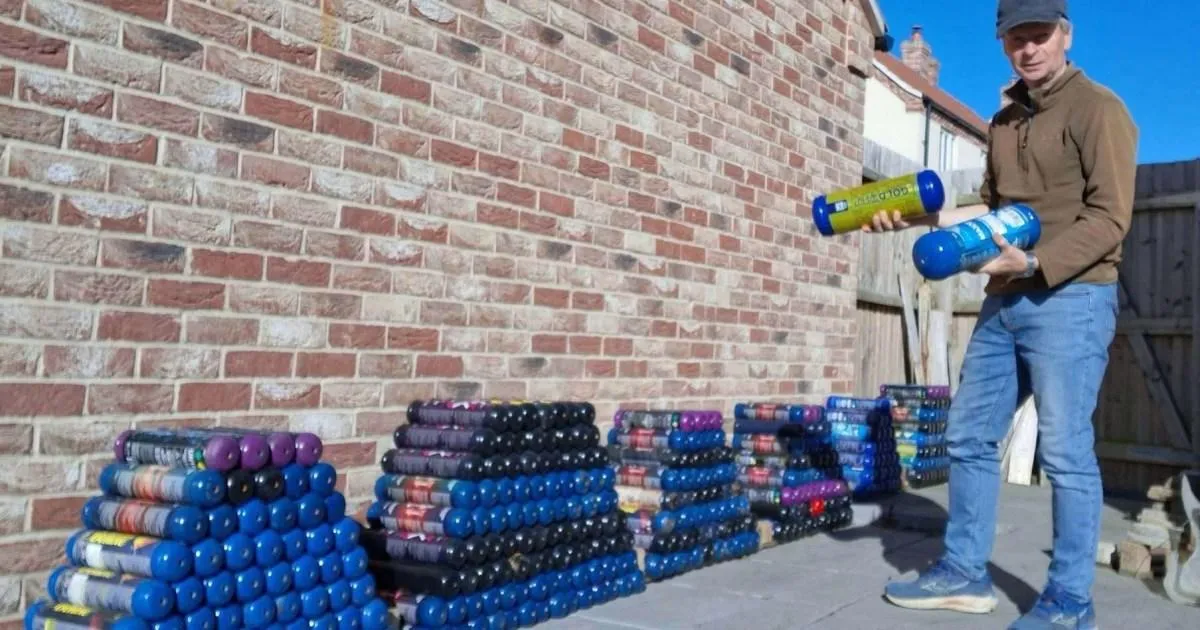
In the quiet corners of Fenland, Norfolk, a retired teacher named Tim Chapman has unwittingly become the front line of an environmental and public safety battle. Over the past 18 months, Tim has taken to the streets, lanes, and parks of his local community with a mission that has grown far beyond a simple neighborhood cleanup. He has spent his retirement collecting discarded nitrous oxide canisters—the metallic remains of a growing recreational drug culture—and the scale of his findings is staggering. To date, Tim has single-handedly recovered 3,500 of these containers. Weighing in at roughly five tonnes of cold, discarded steel, his haul is a physical testament to a problem he describes as an “obnoxious tide” that refuses to ebb.
The visual blight of these canisters is only the surface of the issue. Tim describes scenes in places like Wisbech Park, where mornings often reveal a carpet of metallic waste left beneath public benches, frequently accompanied by vapes and other refuse. For Tim, this isn’t just about the aesthetics of a messy town, though the impact on local pride and tourism is clear; it is an affront to the community he calls home. As an avid cyclist, he first noticed the trend in countryside lay-bys and junctions, where the canisters were tossed aside with disregard for the environment or the law. What began as a feeling of being “fed up” with the lack of care for his surroundings has morphed into an exhausting, persistent obligation that he fears he cannot stop, despite his desire to retire from the task.
The legal landscape surrounding these canisters shifted in 2023 when nitrous oxide was reclassified as a Class C drug under the Misuse of Drugs Act 1971, following a surge in its recreational use during the pandemic. While the gas has legitimate commercial roles—such as in baking and catering—its misuse now carries significant penalties, including potential prison time for supply or heavy fines for possession. Despite these stricter regulations, Tim has observed a troubling trend: the litter has not diminished. Instead, he sees it evolving from the occasional stray canister to entire boxes dumped carelessly along the roadsides. This escalation suggests that the law has yet to translate into a tangible reduction in the public dumping that continues to plague his region.
The danger, however, extends far beyond simple littering. Tim is deeply concerned about the prevalence of users inhaling the gas while operating vehicles, a reckless behavior that has tragically led to accidents, life-altering injuries, and fatalities across the country. There is also an environmental toll which Tim describes as “appalling,” noting that nitrous oxide is a potent greenhouse gas, significantly more damaging than carbon dioxide. The user experience is short-lived, making drug-induced driving difficult for police to detect, creating a dangerous and elusive cycle. Tim argues that the current approach is not working and suggests more systemic solutions, such as a mandatory licensing scheme for buyers or a substantial deposit system on each canister to discourage the casual, mass-consumption habits that lead to such widespread waste.
A critical part of Tim’s advocacy involves educating a public that largely remains unaware of what these canisters are or why they represent such a specific hazard. Many well-meaning neighbors, mistaking them for harmless beverage containers, have tried to help by tossing them into public trash bins. Tim warns that this is actually a major safety risk. When these canisters enter the standard waste stream, they become ticking time bombs for waste management facilities. If they find their way into incinerators, they can explode with enough force to cause millions of pounds in infrastructure damage. His advice remains consistent: if people wish to help, the cans should be left safely on the ground near a collection point, rather than hidden inside a bin where they can cause carnage.
Ultimately, Tim’s story is one of communal concern versus the uphill struggle of an individual trying to hold back a rising tide. He feels forced to continue his work, not because he enjoys the labor, but because he sees the systemic failure of oversight and the lack of awareness in his town. His 3,500-canister haul is a silent siren, calling for both better enforcement of the law and more innovative solutions to keep the gas out of the wrong hands and the steel out of the earth. Until policy catches up to the reality on our roadsides, Tim remains an unlikely, weary sentinel, doing his best to keep his corner of Norfolk clean, safe, and, hopefully, noticed by those with the power to change things.