

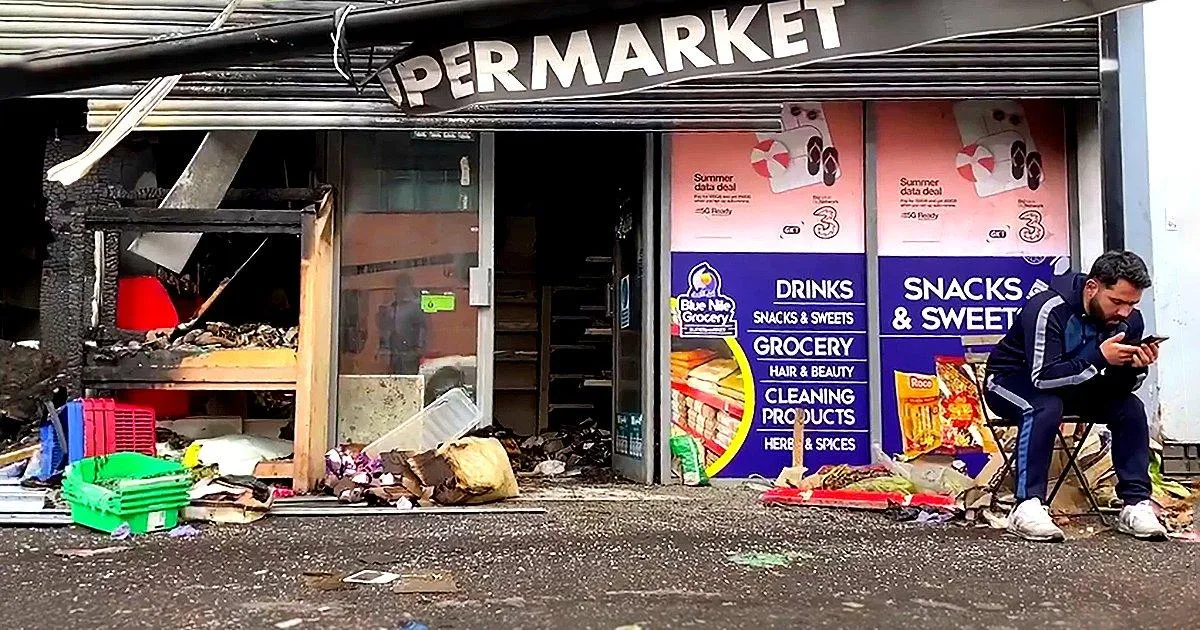
The recent scenes unfolding on the streets of Belfast serve as a heartbreaking reminder of the fragility of community peace. Once again, The Sham supermarket on the Donegall Road has been reduced to a shell of charred debris and broken metal. This wasn’t just a random act of destruction for those who rely on the store; it felt like a targeted assault on a business that had already weathered an agonizing storm only months prior. Seeing the shop’s mangled gates and gutted interior this week echoed the same sense of violation felt during the 2024 anti-immigration protests, leaving locals to look on with a weary, familiar sense of grief. It is difficult not to think of Jamal Ghabes, the shop’s former butcher, who once spoke so poignantly about losing his sense of safety here and his desire to find sanctuary elsewhere.
The tragedy of this situation lies in how quickly long-standing stability can unravel. The violence, which saw cars set ablaze and homes targeted, was ignited by a brutal knife attack in North Belfast that left a man named Stephen Ogilvie with serious injuries. While a 30-year-old man has since been arrested and charged in connection with this crime—an act that has understandably shaken the neighborhood—the public response spiraled into a dangerous cycle of collective blame and destruction. Instead of a community coming together to manage the fallout of a horrific local incident, the city found itself witnessing police Land Rovers under siege and public transport, like a Glider bus, being incinerated by those venting their rage through indiscriminate fire.
Human stories, often buried beneath the headlines of arrests and riots, are where the true cost of this instability is felt. Take, for instance, Jamie Corry, a resident of Lendrick Street who has called his home his own for over a decade. His account of standing by helplessly as his car—and eventually his home—was consumed by flames is piercingly painful. Standing amongst the wreckage on Wednesday morning, he described his property as being “destroyed, top to bottom.” For Jamie, this was not a political event; it was a devastating personal invasion. His experience personalizes the terror felt by many residents who were forced to watch from the sidelines while the very streets they walk upon were reclaimed by fear and uncontrollable heat.
When a store like The Sham is hit repeatedly, it signals a deeper, more troubling erosion of social cohesion. This business provided a vital service, offering a wide array of goods and specialized Middle Eastern foods, serving as a point of connection for a diverse neighborhood. By deliberately targeting this property, the rioters were not attacking an abstract concept; they were stripping away the livelihoods of those trying to trade, provide, and integrate. The fact that the interior was a complete loss in 2024, only to suffer further damage during this latest round of unrest, highlights a relentless cycle of persecution that makes it nearly impossible for any community member to feel at home or secure in their future.
The wider unrest currently stretching across Northern Ireland and parts of the UK is a symptom of a deeply fractured environment where fear dictates action. When people stop seeing their neighbors as individuals and begin reacting through the lens of group resentment, tragedy becomes inevitable. The fires in Belfast are not just consuming property; they are scorching the social fabric that holds society together. Every bus set on fire, every residential home threatened, and every small business firebombed creates ripples of trauma that will take years, if not longer, to heal. It leaves the rest of us asking how we can find our way back to a space where disagreements are resolved through empathy rather than through the ignition of a petrol bomb.
Ultimately, behind the chaotic footage and the grim statistics of the week, there remains a need for a profound return to humanity. As parents now grapple with how to explain these riots to their children, and as long-term residents like Jamie try to salvage what they can from the ash, the focus must shift to what remains of our shared values. No single act of violence, however horrific, justifies the widespread destruction of a community’s heart. Peace in Belfast requires a collective choice to stop the cycle of retaliation, choosing instead to protect the neighbors who have been here all along, rather than tearing down the foundations upon which a diverse and functioning society must stand.