
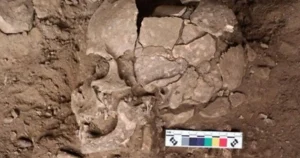

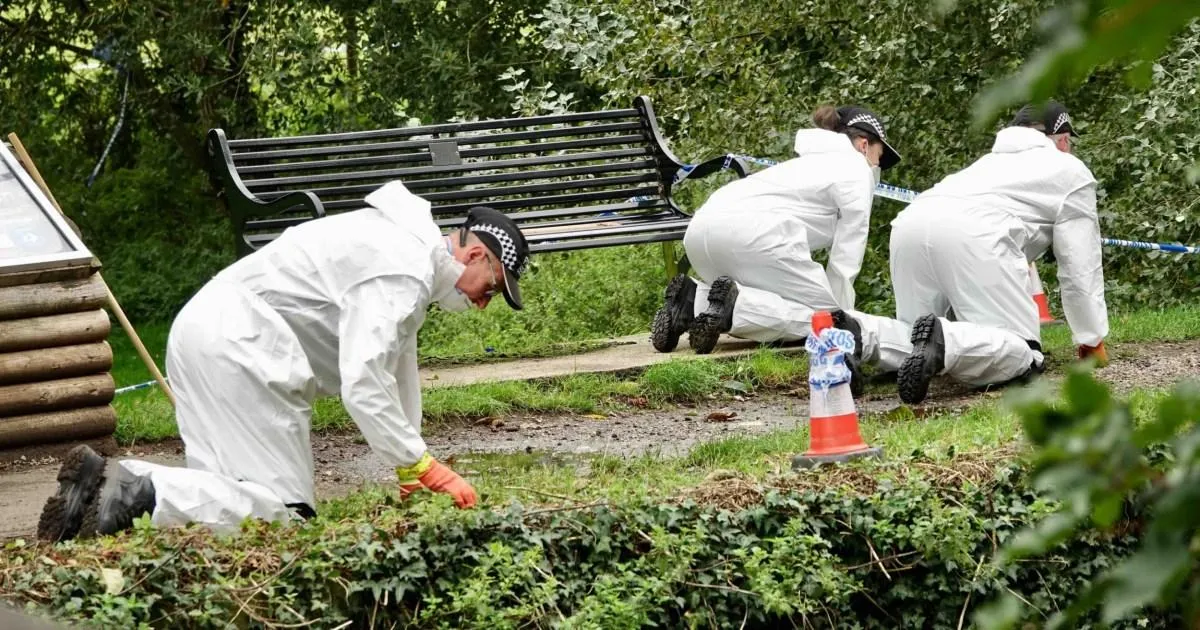
For over four years, a chilling mystery has haunted the banks of the River Stour in Suffolk, centering on a man whose identity remains as elusive as his final moments were brutal. It began on an ordinary August day in 2020 when a dog walker, Julie Dunn-Beechin, noticed something unsettling in the water. Her instincts told her that the black bin bags bobbing in the river didn’t belong there, a suspicion that eventually led authorities to a gruesome discovery: mummified human remains. What followed was a complex police operation that unearthed skull fragments, limbs, and bones, piecing together a story of a life stolen and a body hidden with a calculated, cold-blooded efficiency that has baffled investigators to this day.
The victim, now formally referred to as “The Croft Man,” has become a tragic symbol of a cold case that refuses to be solved. Despite a relentless forensic pursuit, his name remains unknown, and his face never appeared on any missing persons bulletin in the UK or abroad. Through the use of radiocarbon dating, experts have suggested a timeline that places his birth prior to the 1950s, indicating that he was likely in his sixties or seventies when his life was violently cut short between 2008 and 2012. For many years, he was someone’s son, perhaps a friend or a neighbor, yet he currently sits in a forensic limbo, existing only as a set of biological markers and a grim, unanswered question.
Senior Coroner Nigel Parsley recently delivered a formal conclusion that brought the somber reality of the case into sharp relief. After reviewing the evidence, he ruled that the Croft Man was undoubtedly the victim of an unlawful, violent assault, characterizing his death as a tragedy of profound proportions. The coroner’s words were a poignant reminder that behind the “mummified remains” and the forensic reports, there was a human being who spent decades walking the earth, only to end up in a waterway, discarded like refuse. The deliberate nature of the dismemberment—specifically the removal of his hands and the catastrophic damage to his skull—points to a strategic, malicious attempt by someone to ensure that he would never be identified.
The investigative process has unveiled a series of disturbing details regarding how the killer sought to “erase” the victim. A pathologist, Dr. Ginni Fitzpatrick-Swallow, testified that the extent of the damage to the skull went far beyond what would be necessary for simple dismemberment, suggesting a level of rage or a desperate, pathological need to destroy the man’s identity. Inside the bags found in the river, police recovered not only human remains but also heavy objects like bricks and rocks, as well as remnants of cleaning products, likely used in a futile attempt to mask the scent of decomposition or dissolve physical evidence. This wasn’t a crime of passion, but an act of concealment that required the perpetrator to have a chilling level of technical composure.
Police investigators have shared their belief that the perpetrator likely possessed a grim “skill in butchery,” evidence of which was found in the surgical precision of the dismemberment. Though DNA analysis confirmed the man was a white, northern European male with light hair and blue or green eyes, the lack of a database match makes the pursuit of justice feel like a race against an ever-widening gap of time. Superintendent Mike Brown noted that the body had likely been stored for years before being discarded, implying that the killer lived alongside this secret for a long time, potentially someone who feared drawing police attention and waited for the perfect moment—or the perfect amount of desperation—to dispose of the remains.
As the case of the Croft Man remains open, the human tragedy weighs heavily on those involved in the investigation. The coroner’s lament—that there are loved ones out there somewhere, likely still wondering why their brother, father, or friend simply stopped showing up—serves as the most painful aspect of the entire affair. Every bag pulled from the river and every forensic test run has been a search for justice, yet the silence of the victim is absolute. He remains a man without a country, a name, or a history, a spectral figure whose anonymity is the final, cruel victory of a killer who has, so far, managed to remain just as hidden as the victim they took such pains to discard.