


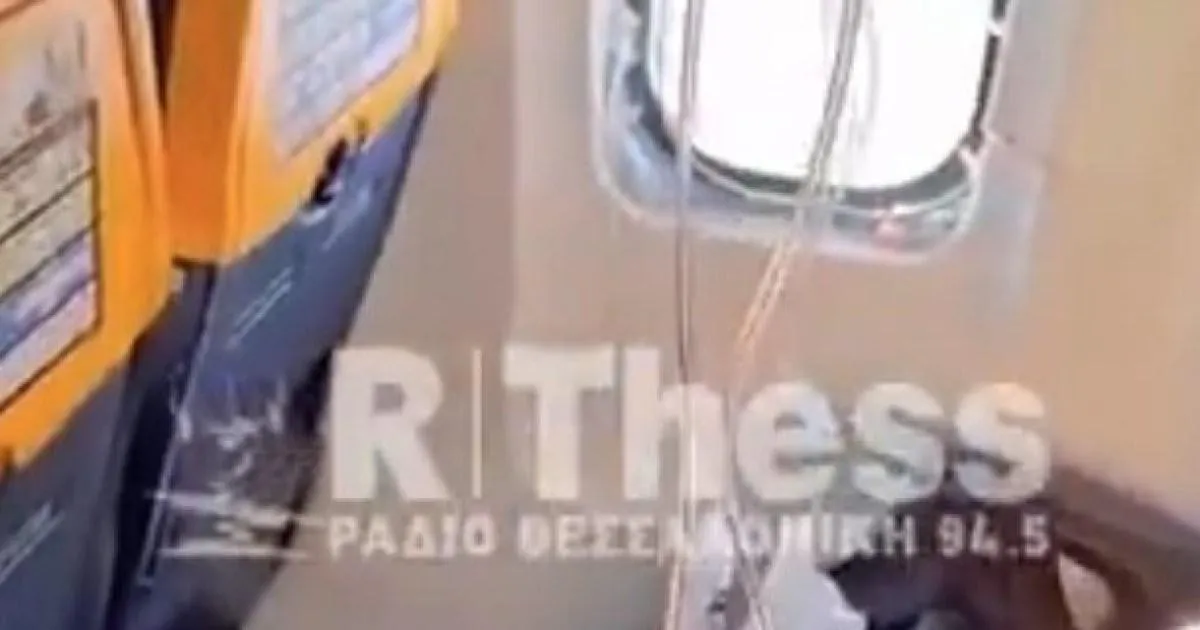
The terrifying ordeal of a 61-year-old traveler aboard a Ryanair flight last Friday serves as a sobering reminder of how quickly a routine journey can turn into a life-threatening crisis. During a trip from Thessaloniki, Greece, to Memmingen, Germany, the serenity of the cabin was shattered when the plane’s engine suffered a catastrophic failure. The resulting pressure shift and mechanical breakdown caused the passenger window adjacent to the man’s seat to instantly dislodge, exposing him to the violent, freezing slipstream of the outside atmosphere. In an instant, a standard commute became a battle for survival as the extreme pressure difference threatened to pull him from his seat.
What followed was a harrowing act of instinct and devotion that undoubtedly saved the man’s life. As the cabin began to lose its integrity, it was the man’s wife who stepped in, clutching onto her husband’s legs with every ounce of strength she possessed. While the aircraft buffeted in the air, she held firm, preventing him from being swept into the void outside. It is impossible to imagine the sheer terror they must have felt during those moments, as the roar of the rushing wind replaced the mundane sounds of in-flight conversation and the stability of the cabin was compromised under the immense forces of physics.
The technical implications of the failure were jarring. While the Boeing 737-8AS is a workhorse of the sky, this specific incident demonstrated how vulnerable even well-maintained machinery can be. When the engine failed, the resulting kinetic impact affected the window’s integrity, leading to a depressurization event that is the stuff of every traveler’s worst nightmare. The crew, faced with an unprecedented emergency, acted swiftly to turn the aircraft around, heading back to the safety of the Thessaloniki terminal while the couple grappled with the physical reality of the altitude and the icy, abrasive winds screaming through the aperture.
Upon landing, the gravity of the incident was plain to see. The man did not escape unscathed; he required immediate medical intervention after arriving back on the ground. Beyond the acute psychological shock of staring death in the face, he suffered friction burns caused by the brutal conditions just outside the fuselage. It is a testament to his resilience, and the heroic quick thinking of his wife, that the outcome was not a tragedy of even greater proportions. He was stabilized by medical teams who treated him for his injuries, marking the end of a terrifying chapter that began as a simple holiday flight.
In the aftermath, Ryanair confirmed the details of the return, emphasizing that the plane touched down under standard protocols to ensure no further harm came to those on board. The airline moved to minimize the disruption by arranging a replacement aircraft, allowing the remaining passengers to continue their journey to Memmingen. While the logistical response was swift, for those involved in the incident, the experience has likely left an indelible mark. Such events force us to look past our screens and our magazines, acknowledging that we are suspended thousands of feet in the air, relying entirely on the engineering integrity of the vessel and the grace of those seated beside us.
Ultimately, this incident highlights the vulnerability of the modern traveler and the profound human impact of mechanical failure. It serves as a stark reminder of the fragile balance between technology and nature, and the vital importance of human intervention when systems collapse. While investigations into the engine failure and window integrity will continue, the story remains, at its heart, one of a couple’s survival. It is an account of a wife who refused to let go, proving that in the face of the most extreme, unexpected, and terrifying circumstances, the bonds of human care remain our most powerful shield against the unpredictable dangers of the world.