

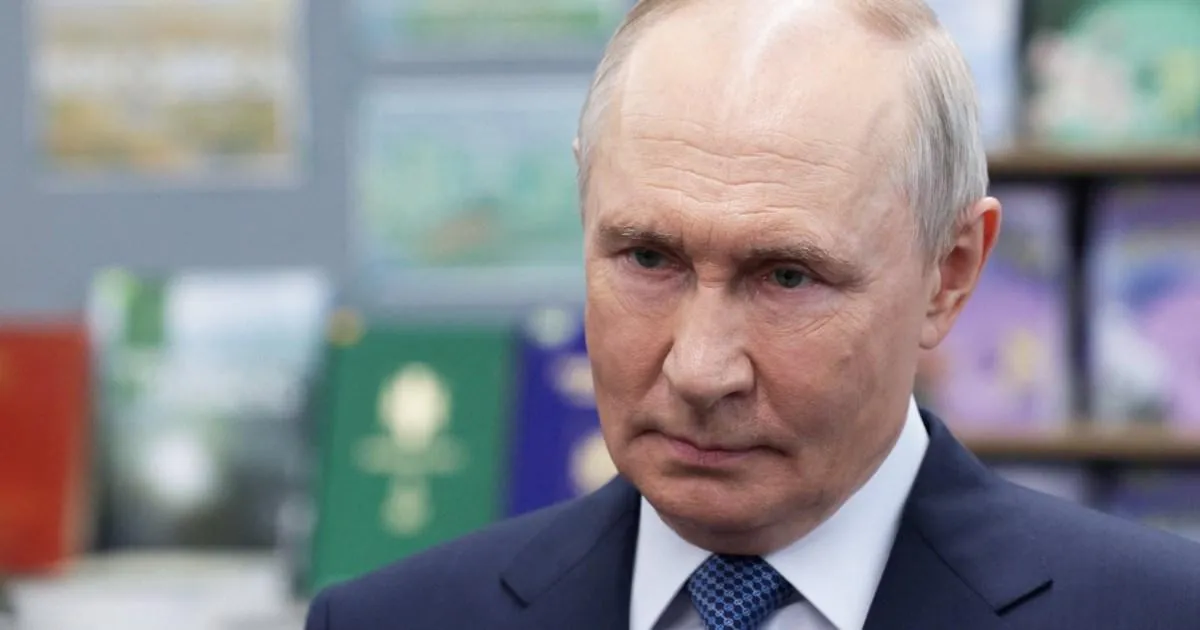
Vladimir Putin’s recent trip to Novosibirsk, Russia’s third-largest city, served as a stark reminder of the extreme lengths to which the Russian state goes to insulate its leader from the public. As the President arrived for his first visit to the Siberian hub since 2018, the atmosphere on the ground was far from a welcoming celebration. Instead, residents living along the motorcade’s path—specifically on Bolshevistskaya Street—were issued rigid, almost stifling security mandates. They were explicitly instructed to remain indoors, keep away from their windows, and relocate their vehicles away from the roadside. The authorities were blunt: following these directives was the only way to avoid “unpleasant situations,” a thinly veiled threat that underscored the profound tension currently defining Putin’s domestic movements.
The surreal nature of these demands, such as the prohibition against using electronic or optical devices while the motorcade passed, highlights the deep-seated apprehension currently gripping the Kremlin. It is a far cry from the image of the stoic, approachable statesman the government usually attempts to project. While the official itinerary included stops at scientific facilities, like the Siberian Circular Photon Source, and meetings with academics and students, the reality of the visit felt more like a military operation than a diplomatic tour. This contrast between the intellectual veneer of his public events and the heavy-handed logistical containment of the local population suggests a leadership increasingly defined by fear rather than engagement.
This Siberian visit is part of a broader, more frequent travel schedule Putin has adopted recently, marking a shift away from the months he spent hunkered down in Moscow. Following the early stages of the war, where he remained largely isolated amid perceived security threats, the President has made appearances in cities like Kazan, Irkutsk, Omsk, and Ulan-Ude. However, these excursions do not signal a return to normalcy. Instead, they occur against a backdrop of intensified internal defensive maneuvers, most notably the placement of air defense systems—specifically the Pantsir anti-aircraft missile and gun units—directly adjacent to critical energy infrastructure in Moscow. The sight of these weapons, often caged in protective metal, is a testament to the reality that even the capital is no longer seen as untouchable by the reach of Ukrainian drone strikes.
The vulnerability of these military assets, which were once touted as the pinnacle of Russian engineering, is now a point of scrutiny. The fact that the Kremlin has been forced to relocate front-line defense hardware to protect its own oil refineries suggests that the technological superiority Russia once claimed is, at best, outdated and, at worst, insufficient to combat modern aerial threats. The irony of protecting the center of power with hardware intended for the front lines of a distant war is not lost on observers. It serves as a visual metaphor for a state that is consuming its own resources to maintain an illusion of stability while its actual strategic position grows increasingly precarious.
Beyond the physical security measures, reports continue to surface detailing an evolving, almost suffocating paranoia within the President’s inner circle. Analysts suggest that Putin’s operational behavior has shifted significantly, with the leader frequently working from fortified bunkers and abandoning his favored palaces out of a suspicion that they have become targets—potentially even from those within his own regime. The friction between Putin and long-time figures like Security Council Secretary Sergei Shoigu adds another layer to this internal instability. The recent arrest of Shoigu’s former deputy on massive corruption charges is widely viewed as a tactical move by the Kremlin to systematically dismantle the influence of powerful figures who might threaten the status quo.
Ultimately, this state of heightened alert paints a portrait of a leader who is simultaneously everywhere and nowhere. By turning Russian cities into locked-down zones where even looking out a window is treated as a security risk, the regime inadvertently broadcasts its own vulnerability. Whether these measures are intended to prevent genuine external threats or to suppress potential internal dissent, they have created an environment where the distance between the Kremlin and the Russian people has never felt wider. In his attempts to secure his life and his position, Vladimir Putin has fostered a climate of suspicion that defines his current era: a period where every motorcade, public appearance, and bureaucratic shake-up is framed by the overwhelming need to survive in an increasingly volatile political landscape.