


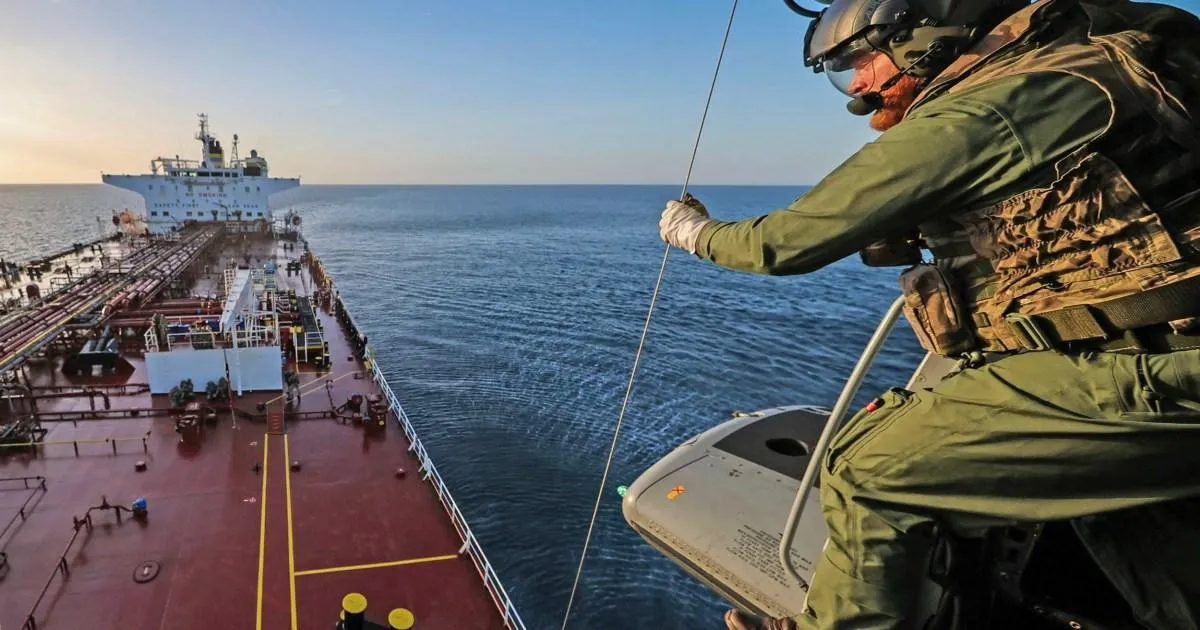
In a bold move that marks a significant escalation in the ongoing geopolitical tug-of-war, Sir Keir Starmer has officially authorized the interception of a Russian-linked oil tanker, the SMYRTOS, within the English Channel. The vessel, which departed from the Baltic oil hub of Ust-Luga earlier this month, was successfully boarded and seized by the Royal Navy in a mission supported by the RAF’s Maritime Air Group, HMS Sutherland, and HMS Ledbury. Now anchored off the south coast of England under strict observation, the ship represents a direct challenge to the “shadow fleet” that Russia utilizes to bypass international sanctions. By grounding this vessel, the UK government has signaled a transition toward a more assertive policy, aiming to dismantle the illicit trade networks that continue to fund Moscow’s activities despite worldwide condemnation.
The official British response has been characterized by a sense of resolute, strategic purpose. Prime Minister Starmer, flanked by Defence Secretary Dan Jarvis, has framed the seizure as a necessary intervention to uphold international law and national security. During a recent interview, Cabinet member Lisa Nandy emphasized that this decisive action is the result of a clear mandate from the Prime Minister to be “on the front foot” when dealing with the threats posed by Russia. By targeting these ships, the UK is attempting to squeeze the economic lifeblood of the Russian war machine, explicitly demonstrating that the “shadow fleet”—which is estimated to transport 75% of Russia’s sanctioned oil—is no longer free to navigate these waters with impunity.
However, the Kremlin’s reaction has been as chilling as it is aggressive. Dmitry Rogozin, a prominent senator and former Russian envoy to NATO, responded to the interception with a threat that sounds plucked from the pages of a spy novel. He has openly advocated for the mining of Russia’s own tanker fleet, suggesting that these vessels should be rigged with explosives to be detonated if they are ever boarded or steered toward a foreign port. Rogozin’s rhetoric, which includes the callous suggestion that “environmental consequences” and oil spills are acceptable collateral damage if they deter British oversight, highlights a dangerous shift in how global maritime disputes are being framed. It is a grim reminder that in the eyes of some Russian hardliners, any cost—even an ecological disaster—is secondary to their strategic defiance.
The conflict has also reignited a war of words rooted deep in history. Rogozin accused the United Kingdom of reverting to the “piracy” of the 16th and 18th centuries, comparing the modern Royal Navy to the state-sponsored privateers of the British Empire. By invoking the memory of the Crown’s historic use of sea raiders to dismantle Spanish trade and consolidate power, he is attempting to paint Britain as a neo-colonial aggressor rather than a modern nation state enforcing international sanctions. This framing seeks to cloak Russia’s illicit activities in a sense of national victimhood, suggesting that the current British operations are merely “the well-forgotten old” tactics of an imperial power refusing to let go of its past glory.
Despite the inflammatory rhetoric, the reality on the ground remains a complex game of maritime cat-and-mouse. The UK Ministry of Defence has made it clear that while it has already sanctioned over 500 of the approximately 700 vessels identified in Russia’s shadow fleet, the effort to monitor and interdict these ships is an immense logistical challenge. Each operation requires significant resources, including advanced surveillance aircraft and naval destroyers, to ensure the safety of the Channel and the integrity of trade routes. The success of today’s operation is being touted as a “significant blow” to the Kremlin’s logistical network, but it also underscores how thin the line is between enforcing sanctions and triggering a much broader, more volatile confrontation at sea.
As the SMYRTOS sits anchored in English waters under the watchful eyes of the military, the international community watches on with bated breath. This incident serves as a stark reminder that the war in Ukraine is not merely contained to land battlefields; it is bleeding into the open oceans, where energy security and sanctions enforcement are colliding. Whether these high-stakes intercepts will force Russia to abandon its shadow fleet tactics remains to be seen, but for now, Sir Keir Starmer’s government has made its stance clear: the UK will not stand by as sanctioned oil flows through its maritime backyard. The coming weeks will be critical in determining whether this pressure leads to a quiet compliance or a dangerous escalation in the foggy waters of the English Channel.