

-
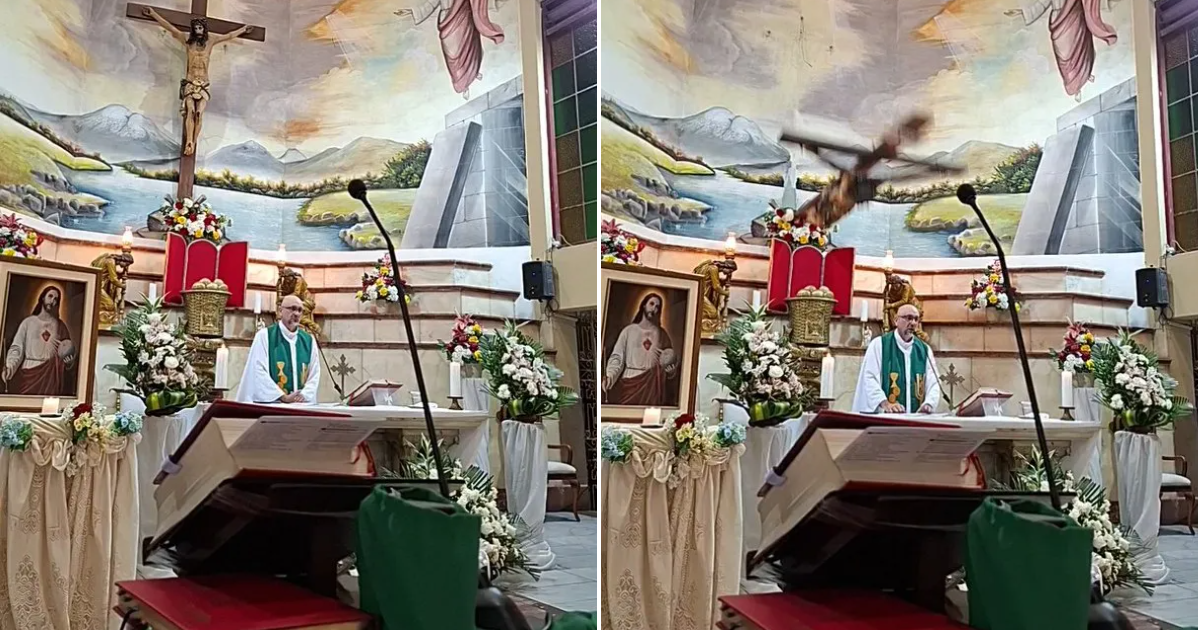
It was meant to be an ordinary evening of worship, a moment of quiet devotion shared between a priest and his congregation in the bustling port city of Guayaquil, Ecuador. Father Patricio Alfredo Sánchez, a devoted parish priest of the Perpetuo Socorro Church, had just begun celebrating the Catholic Holy Mass, a sacred ritual repeated countless times in churches around the world. As was becoming increasingly common in the digital age, he had also chosen to share the service with a wider audience, switching on a Facebook livestream so that those unable to attend in person could still feel part of the community. For the first half hour, everything unfolded gently and peacefully. Parishioners prayed, listened, and responded to the familiar rhythms of the liturgy. There was no hint of the horror that was about to unfold. Then, about twenty-seven minutes into the live broadcast, the unthinkable happened. A massive altar cross, fixed to the wall above the sanctuary, suddenly broke free. In a sickening, thunderous crash, the heavy crucifix plummeted down and struck Father Sánchez with devastating force. The serene atmosphere was instantly shattered. The livestream captured the chaos and raw panic that followed, with church officials screaming and rushing toward the altar as the priest lay motionless on the altar table. The cross, a towering symbol of faith and sacrifice, had become the instrument of a sudden and incomprehensible tragedy.
-
The cruel irony of the moment did not go unnoticed by those who had watched the broadcast or who later learned of the events. Only minutes before the cross fell, Father Sánchez had delivered his homily, the reflective sermon that forms the heart of the Mass. His topic, as it happened, was death. Speaking to the faithful gathered before him, he spoke with a gentle and contemplative tone about the certainty of mortality. “Dear brothers, one day, all of us who are here are going to die,” he told the congregation, according to local news outlet TN. It was a familiar Catholic theme, a reminder that earthly life is temporary and that what truly matters is how one chooses to spend the time given. He went on to offer comfort and guidance, distinguishing between merely passing through hours and living with meaning. “Sometimes the time we have used on other things does not have as much meaning as the time we use in God,” he said. He then added, with evident sincerity, “That quality time we give to God, to our brothers and sisters, to our family, is the best time spent.” Those words, so calm and thoughtful, would become his final public message. In retrospect, they seemed almost prophetic. He had prepared his congregation for the idea of death, perhaps never imagining that he himself was standing so close to it. The poignancy of his last sermon now echoes far beyond the walls of the little church, a reminder that none of us truly knows the hour or the moment.
-
In the immediate aftermath of the accident, the atmosphere around the Perpetuo Socorro Church shifted from spiritual serenity to stunned sorrow. The livestream, which had been a window into a peaceful act of worship, was suddenly showing a scene of desperate confusion. Church officials could be heard screaming as they rushed to the aid of their beloved pastor. The church doors were quickly shut, sealing off the sanctuary from the outside world while forensic teams arrived to do their solemn work. There was a particularly heart-wrenching detail: according to churchgoers who spoke to local media, a wedding was scheduled to be held at the church later that same day, following the conclusion of the Mass. Joy and celebration had been planned to follow the liturgy, but instead there was grief, shock, and the harsh finality of a body being prepared for removal. The Roman Catholic Archdiocese of Guayaquil later confirmed Father Sánchez’s death in an emotional Instagram post, offering the faithful a glimpse of their belief in the afterlife. The post announced that Father Sánchez Molinari, “who served as parish priest of the Perpetual Help church in the Central Vicariate, has gone to the Father’s House to enjoy His presence and glory.” The Archdiocese expressed its solidarity, affection, and love to the Redemptorist family, as well as to the priest’s relatives and friends, and asked that all join in prayer for the eternal rest of his soul. Yet, even as they mourned, questions remained. The Archdiocese did not confirm whether Father Sánchez had died instantly or had been alive for some time after being struck. Equally troubling, the cause of the cross falling remained entirely unclear, and police had not launched an official investigation.
-
As news of the tragedy spread, many who knew Father Sánchez or who followed his ministry paused to reflect on the kind of man he was. He belonged to the Congregation of the Most Holy Redeemer, a religious order known for its deep commitment to pastoral care, evangelization, and service to the poor. In his role as parish priest of Perpetuo Socorro, he was not merely a ceremonial leader but a shepherd to his flock, a familiar and comforting presence who walked alongside his parishioners through the joys and sorrows of their lives. He baptized their children, married them, heard their confessions, and offered guidance when they were lost. He was the kind of priest who livestreamed Mass not because he sought attention but because he genuinely wanted to reach as many souls as possible, understanding that for many elderly, sick, or housebound members of his community, the online broadcast was a lifeline of faith. His final homily about the meaning of time was not abstract theological speculation; it was the conviction of a man who had spent his life trying to make his own time meaningful through service. That is perhaps why his death has struck such a deep chord, not only in Guayaquil but far beyond. It feels unbearably cruel that a life devoted to bringing people closer to God should end so suddenly and violently, beneath a symbol that was supposed to represent love, redemption, and hope. And yet, for those who share his faith, there is also a strange comfort in knowing that he died exceptionally well, in the middle of the Mass, doing exactly what he had been called to do.
-
Beyond the immediate grief, the tragedy invites deeper reflection on the fragility of human existence and the mysterious ways in which faith and sorrow often intertwine. Father Sánchez’s death is a stark reminder that no moment is guaranteed, that even the most sacred spaces can become scenes of sudden loss. Churches are supposed to be places of safety, sanctuaries from the dangers of the world, yet here was a man struck down during an act of worship. The altar cross itself, a fixture that generations of parishioners had looked upon without fear, had become a lethal object. It forces us to confront the unsettling truth that tragedy can arrive from anywhere, at any time, wearing the most unexpected face. But there is also something deeply poignant about the message Father Sánchez left behind. In his last words to his congregation, he had encouraged them to think about how they spend their time, to prioritize what truly matters, to give their best hours to God, to their families, to one another. He was, in a sense, offering them a blueprint for a life well lived, one rooted not in possessions or accomplishments but in love and presence. The fact that his own life was cut short so abruptly only amplifies the power of that message. It is as if his death, sudden and shocking as it was, became a final sermon more memorable than any he had ever preached. His last homily on death was not just a rehearsed meditation; it was a lived prophecy, and now it speaks to all of us with newfound urgency.
-
In the days that followed, the congregation of Perpetuo Socorro Church and the wider Catholic community in Guayaquil had to find a way to move forward. The church may have reopened, but the presence of Father Sánchez is profoundly missed. The planned wedding, once imagined as a moment of happiness and new beginnings, will forever be associated with the shadow of tragedy, though perhaps the couple and their families will also experience a deeper understanding of the preciousness of life and love. The Redemptorist community has lost a brother, the faithful have lost a pastor, and the world has lost a voice of compassion. While the unanswered question of why the cross fell continues to hang in the air, and while forensic teams and church authorities work behind closed doors to determine what went wrong, the ultimate meaning of this event may lie not in the cause but in the consequence. Father Patricio Sánchez touched a nerve in his final moments because he reminded us, perhaps without intending to, that death is not an abstraction. It is real, it is near, and it can come without warning. And yet, because of his own faith, he had spent his life preparing for that very moment. He had believed, wholeheartedly, that death was not the end but a passage into the loving presence of God. His suffering is over, and in the belief of his church, he has indeed gone to the Father’s House. For those left behind, the challenge is to honor his memory by taking his final words to heart, by spending their time on what truly matters, and by holding their loved ones a little closer. In the end, a giant cross may have silenced his voice, but it cannot silence the message he left echoing in the hearts of those who heard him.