

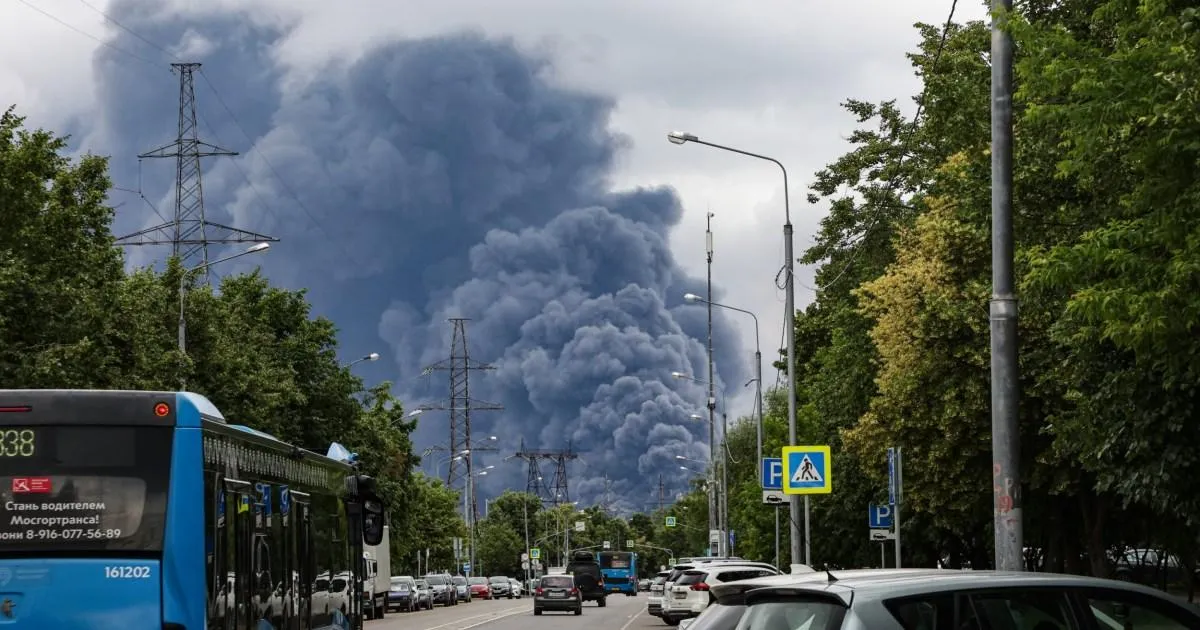
The recent drone assault on Moscow serves as a stark turning point in the ongoing conflict, bringing the reality of war directly to the doorstep of the Russian political elite. As thick, ominous plumes of black smoke choked the capital and a grim “oil rain” fell over the city’s streets, it became clear that Moscow’s defensive capabilities were not the impenetrable shield the Kremlin had long boasted of. This massive strike on a key oil refinery was not just a tactical victory for Ukraine; it was a psychological blow that pierced the veneer of control Vladimir Putin has carefully cultivated. In a desperate attempt to shore up his defenses, the Russian president was forced to redeploy a Pantsir anti-aircraft missile system directly adjacent to the refinery, a telltale sign that the capital’s security is no longer as assured as the state propaganda machine would like its citizens to believe.
To the casual observer, the sighting of a Pantsir system caged in metal armor—a design usually reserved for the chaotic front lines—is deeply telling. It underscores a shift in military priorities: the very equipment meant to protect the nation’s soldiers in the field is being yanked back to protect the crown jewel of Russia’s economy and its geopolitical power center. This maneuver suggests that Russia’s vaunted air defense systems are struggling to keep pace with the evolving ingenuity of Ukrainian drone technology. The once-feared air defense umbrella now appears increasingly outdated, forcing the Russian military to trade frontline protection for the safety of its own back garden, a decision that speaks volumes about the vulnerability of Moscow today.
Yet, the physical security of the refinery is merely one layer of a much larger, more suffocating atmosphere of dread currently permeating the Kremlin. Reports from those within Putin’s inner circle highlight a leader consumed by deepening paranoia, a man who has increasingly retreated into the subterranean safety of bunkers rather than the public view. The audacity of the strikes seems to have fractured his sense of security, compelling him to abandon his most opulent palaces—homes that now feel more like potential bullseyes than sanctuaries. When the leader of a superpower starts to view his own villas as death traps, it illustrates the profound isolation and fear that now define his daily life.
This climate of suspicion is not directed solely at foreign adversaries; it is equally focused on the people behind the closed doors of power. Putin’s relationship with his top brass has curdled into a toxic dynamic of mistrust, with figures like Security Council Secretary Sergei Shoigu reportedly under a microscope. The systematic dismantling of Shoigu’s allies—exemplified by the high-profile arrest of his deputy over massive bribery allegations—suggests a regime purging its own ranks to preempt any potential threat. Having witnessed the shock of the Wagner rebellion in 2023, the Kremlin is now haunted by the prospect of internal betrayal, leading to a tightening of security, increased screenings, and a frantic reassessment of loyalty among the ruling class.
The lifestyle of the president himself has been drastically reshaped by this siege mentality. Once a figure who wielded his presence like a weapon, Putin has largely retreated, avoiding his favorite retreats in Novo Ogaryovo and his secluded Valdai palace. Even the private sanctity of his family life—shared with his partner Alina Kabaeva and their young sons—is reportedly shrouded in the same secrecy that defines his political maneuvers. By hiding his children under assumed surnames and drastically slashing his public appearances, the Russian leader has signaled that his survival is now his only true objective. He is living a life defined by restricted movement and constant, heightened surveillance, a prisoner of the very conflict he initiated.
Ultimately, the image of a cage-enclosed missile system standing guard near a refinery in the heart of Moscow is the perfect metaphor for the current state of the Russian administration. It is a government trapped in a mindset of defensive contraction, desperately trying to keep the fires of a failing war from scorching the seats of power. As drones circle closer and his own associates become subjects of suspicion, Vladimir Putin finds himself less like the iron-fisted ruler of the past and more like a man watching his carefully constructed walls begin to crumble. The war, which once seemed to exist safely on a distant map for the people of Moscow, has arrived, and it has brought with it a profound, irreversible shift in the security of the Kremlin.