

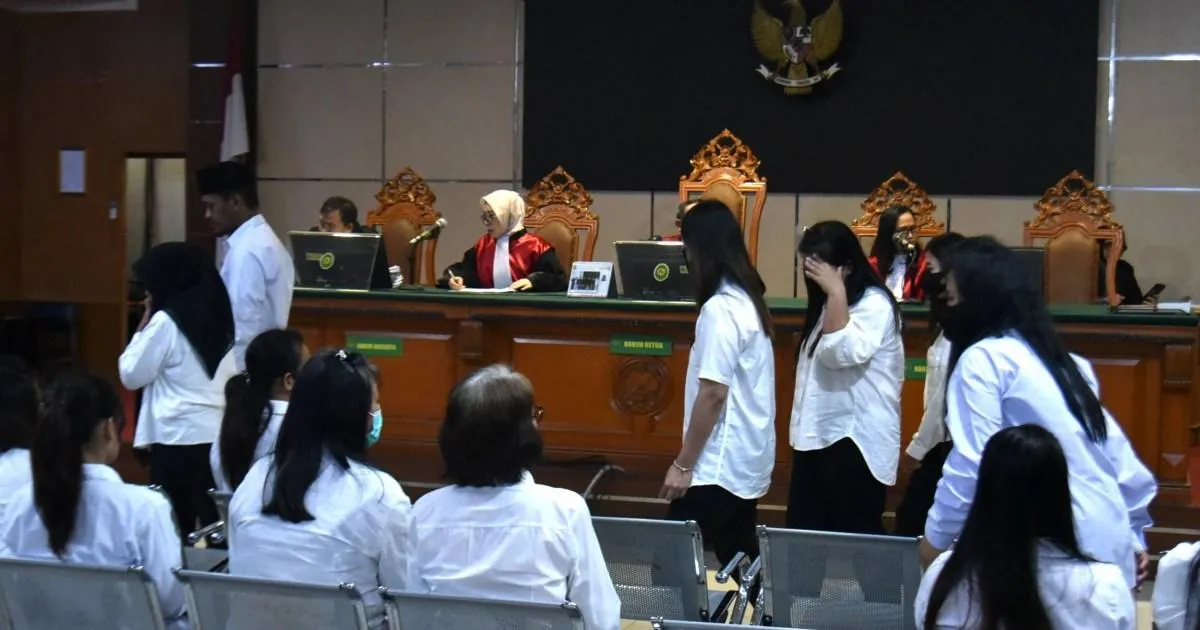
The recent conclusion of a major criminal trial in West Java, Indonesia, has shed light on a harrowing human trafficking operation that spanned borders and exploited the most vulnerable. Nineteen individuals—one man and eighteen women—were sentenced to prison terms ranging from three to seven years for their roles in a sophisticated ring that trafficked 34 infants. The group’s modus operandi involved sourcing babies, sometimes through coercive or deceptive means, and systematically forging official documents to make the children appear as though they were being legally adopted. While the defendants faced varying degrees of culpability, the court’s decision underscores the severity of commodifying human life for profit.
At the center of this grim enterprise was 70-year-old Lie Siu Luan, who acted as the primary architect of the syndicate. Prosecutors revealed that Lie facilitated the sale of babies to buyers in Singapore, with each child valued at no less than 18,000 Singapore dollars. Leveraging a network of brokers, document forgers, and caregivers, Lie orchestrated a scheme that prioritized financial gain over the rights and safety of the children. During the proceedings, Lie attempted to deflect responsibility by claiming she was misled by her overseas associates and maintained that she believed she was merely helping families navigate the adoption process, a defense that ultimately failed to hold weight in the eyes of the court.
The trail of evidence leading to this discovery began with a desperate father, Dani Hidayat, whose newborn was abducted in April 2025. Hidayat had connected with a woman online through a Facebook adoption group—a platform that increasingly serves as a dangerous hunting ground for traffickers. The woman, identified as Astri Fitrinika, had manipulated him with promises of adoption, only to vanish once she secured the baby. When payments she had promised failed to materialize, Hidayat turned to the police. His persistence proved pivotal; upon seizing Fitrinika’s phone, authorities uncovered a vast, hidden network of transactions and documentation, revealing that his child was only one of dozens caught in the web.
Despite the mounting evidence, the courtroom atmosphere was thick with justifications and denial. Many of the defendants maintained the stance that they were unaware of the illegality of their actions, framing their involvement as a altruistic effort to unite children with families in need. The lawyers representing document forger Lai Siu Ha argued that her actions were clerical rather than criminal in nature, attempting to minimize her culpability as a mere employee following instructions. However, the judge’s sentencing suggests a firm rejection of these narratives, as the court recognized the structural danger of their teamwork, regardless of the individual roles held by the brokers, caregivers, or paperwork handlers.
The emotional toll of the proceedings was palpable, particularly as verdicts were delivered. For figures like Fitrinika, the reality of her actions—and the consequences of her choices—seemed to finally take hold during the emotional sentencing session. While some of the convicted parties are already signaling their intent to appeal, claiming dissatisfaction with their sentences, others have chosen to accept the court’s ruling as a final resolution. The legal team for the ringleader, Lie, noted their client’s acknowledgment of her sentence, suggesting that a sense of remorse played a role in the judge opting for a seven-year term rather than the ten years requested by prosecutors.
As the legal proceedings draw to a close, the focus for the Indonesian Ministry of Social Affairs now shifts to the long-term welfare of the rescued children. Eight of these babies remain under state care in a West Java orphanage, where they are undergoing assessments to determine their legal status and the best path forward for their future. The government is tasked with the incredibly sensitive mission of identifying whether these children can be safely reunited with their biological families or if alternative, state-monitored protective care is necessary. This case serves as a sober reminder of the shadow world of illegal adoption, where human empathy is weaponized to tear families apart for the sake of monetary gain.