


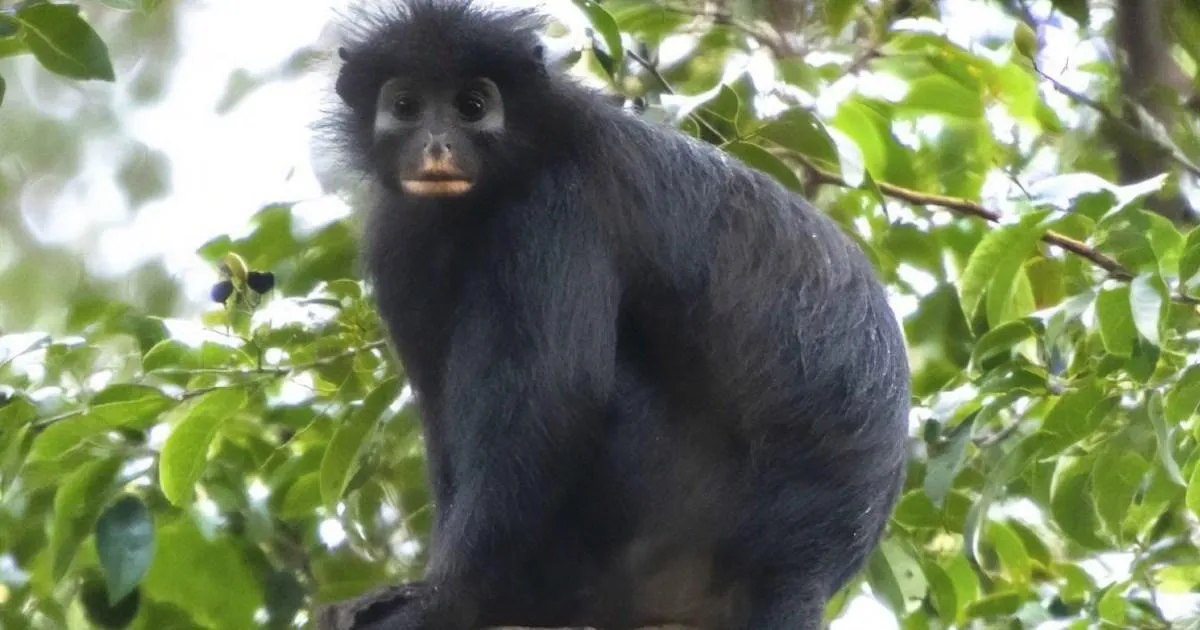
Deep in the lush, mysterious rainforests of the Democratic Republic of Congo, nature has just unveiled a secret it has guarded for millions of years. Scientists have officially confirmed the existence of a brand-new monkey species, known to locals as the “Likweli.” With its sleek black fur, dramatic cape-like shoulders, and a uniquely striking patch of orange-cream color around its mouth and nose, the primate is a visual marvel. This discovery is a rare scientific event, marking only the fifth new monkey species identified in Africa in the last 75 years—a humbling reminder that even in our modern, mapped world, the wild still holds incredible mysteries waiting to be found.
The journey to this discovery began in 2008 when researchers caught a blurry, fleeting glimpse of something unusual in the dense canopy. For over a decade, it remained a phantom—an undocumented shadow in the trees despite years of intense exploration. It wasn’t until 2018, when the team finally secured a clear image of the animal, that the scientific community realized they were looking at something truly special. Subsequent genetic, anatomical, and acoustic testing confirmed the hunch: this monkey represents a distinct evolutionary lineage that branched off from its closest relatives between four and five million years ago.
For Junior Amboko, a PhD student at Florida Atlantic University and a key member of the international research team, this discovery is far more than just a line in a journal article. Having grown up in the region, Amboko described the experience as deeply personal and exhilarating. He was involved in every stage of the project—from that initial haunting photograph to the long months of field training and data analysis. It was a proud moment for him when the scientific community accepted his proposed name for the species: Colobus congoensis. By choosing this name, he ensured the monkey would forever be a symbol of his homeland’s rich, often overlooked biological heritage.
The Colobus congoensis is a creature of striking aesthetics. Beyond its glossy coat and long, sweeping tail, its “mask-like” facial features give it an almost noble, inquisitive expression. Between 2018 and 2022, researchers put in the hard work to document 114 sightings, mapping out a range that covers approximately 1,700 square kilometers. While the sight of this elusive monkey bringing a splash of bright color to the dark Congo forest is cause for celebration, the reality of its existence is bittersweet. The very isolation that allowed it to evolve away from human contact for millions of years has now made it incredibly vulnerable to the pressures of the modern world.
Unfortunately, the celebration of this new entry in the history books is tempered by an urgent call to action. Scientists are already petitioning for the Colobus congoensis to be classified as “endangered” on the IUCN Red List. With such a restricted range, a small population, and the escalating threats of habitat loss and hunting, the monkey’s survival is far from certain. Experts warn that the species is, quite literally, at risk the moment it becomes known to the world. It serves as a stark metaphor for the state of our planet: we are finding new life just as quickly as we are losing the environments that sustain it.
Despite the shadow of extinction hanging over the Colobus congoensis, its discovery provides a spark of hope and a profound lesson in humility. Dr. John Hart of the Lukuru Wildlife Research Foundation noted that the Congo Basin remains one of the final, great frontiers for mammal discovery, proving that our planet still has wonders hidden in plain sight. Every new species found is a testament to the resilience of nature and the importance of conservation. As we learn more about this remarkable, orange-lipped monkey, we are reminded that our responsibility is not just to study the natural world, but to fiercely protect the hidden corners where these rare, magical creatures still roam.