
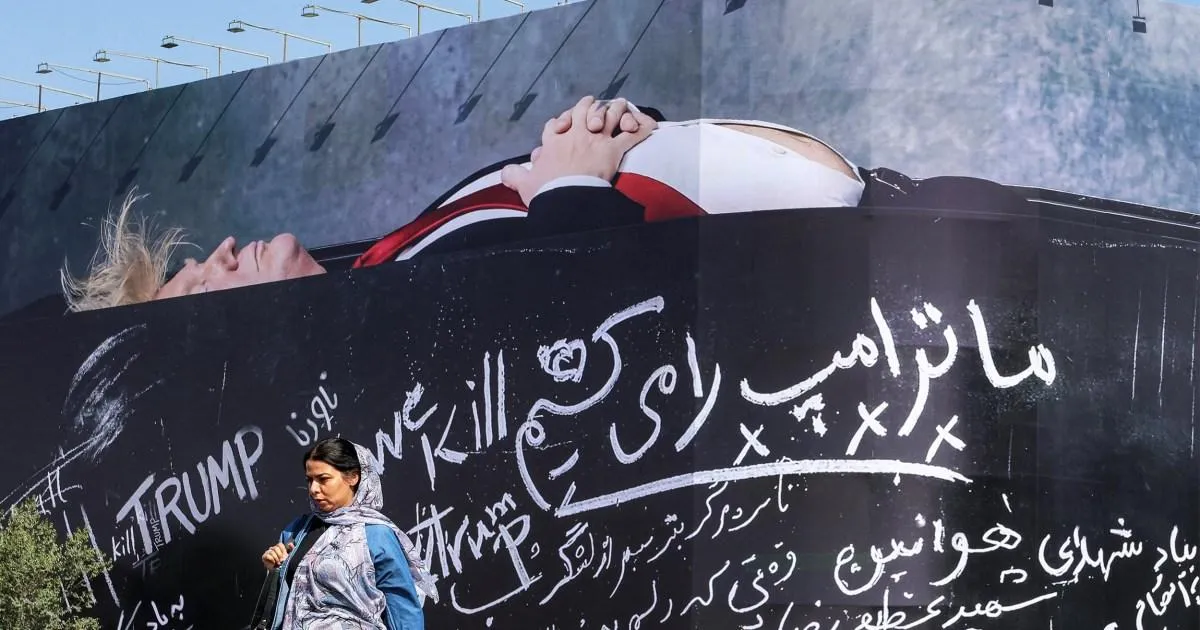
The political atmosphere in Tehran has reached a chilling new level of intensity following the appearance of a provocative, larger-than-life billboard in the heart of the city’s Islamic Revolution Square. The display features a grim depiction of Donald Trump lying in a coffin, his signature hair styled erratically and his hands crossed over his torso, accompanied by the blunt, menacing inscription, “We kill Trump.” This installation, which serves as a stark visual manifestation of the ongoing hostility between Washington and Tehran, follows closely on the heels of the massive funeral for Ayatollah Ali Khamenei. During those commemorative events, the air was thick with the voices of thousands chanting slogans demanding the death of the American president, signaling a profound and dangerous escalation in public sentiment that has now been literally set in stone—or rather, set in vinyl—in the center of the Iranian capital.
The imagery is not merely an isolated act of street art; it acts as a thermometer for the fever-pitch climate currently defining U.S.-Iran relations. President Trump has been vocal about his awareness of the target on his back, publicly acknowledging that he remains the primary focus of Iranian aggression. In remarks to the press, Trump addressed the instability of the current leadership in Tehran while candidly admitting that his own position could be similarly precarious, given the depth of the animosity. He dismissed the Iranian leadership as “scum” and pointed to a forty-seven-year history of hostile conduct as proof that the current standoff is not merely a modern anomaly, but the latest chapter in a long-standing, deep-seated conflict that continues to shape global security concerns.
Tensions have moved far beyond the symbolic realm of billboards and rhetoric, manifesting in tangible, high-stakes military engagements in the Strait of Hormuz. The region, which serves as a vital artery for global commerce, has become the primary theater for this escalating dispute. Recently, the U.S. government has taken a firmer stance, initiating a series of targeted strikes and demanding that Tehran temper its behavior after a disturbing string of attacks on cargo ships traversing the waterway. In response to these provocations, Washington has moved to reimpose a blockade on the Strait, further tightening the metaphorical and literal noose around the Iranian economy and its ability to project power in the region.
The reach of this conflict extends well beyond the borders of Iran and the United States, drawing in neighboring allies caught in the crossfire. Iran has shown little sign of de-escalation, continuing to deploy missile and drone strikes against U.S. partners including Bahrain, Kuwait, and Jordan. This persistent pattern of aggression is forcing the U.S. military to recalibrate its defensive posture, leading to increasingly frequent and unprecedented maneuvers. Reports indicate a significant shift in tactical operations, including the first-ever use of “kamikaze drones” to strike Iranian naval bases, a move that highlights the technological evolution of this proxy war and the desperate speed with which both sides are escalating their methods of engagement.
President Trump has made his strategy clear: if the Islamic Republic does not choose to back down, the consequences will be systemic and paralyzing. He has explicitly warned that future U.S. strikes would not be limited to symbolic targets, but would instead aim to dismantle the foundational infrastructure of the country, specifically targeting power plants and bridges. The threat is aimed at fundamentally weakening the regime’s capacity to function, suggesting that the United States is moving away from measured, incremental pressure and toward a strategy designed to cripple the Iranian state’s ability to conduct its foreign policy ambitions. This rhetoric has turned the Strait of Hormuz from a potential zone of diplomacy into a volatile flashpoint where a single miscalculation could trigger a much broader confrontation.
As the situation continues to unfold, the international community watches with growing unease, wondering if the cycle of provocations can be broken before it descends into a full-scale conflict. The billboard in Tehran is a harrowing symbol of a relationship that has, quite literally, become a matter of life and death, reflecting a deep-seated hatred that has been allowed to fester for decades. With diplomatic talks currently stalled and military assets shifting into place across the Middle East, the future seems increasingly uncertain. Whether this is the brink of a new era of war or a desperate show of strength in a high-stakes game of geopolitical posturing remains to be seen, but as the world remains tuned into these headlines, the reality is that the safety of the region hangs in a balance that feels more fragile with each passing day.