



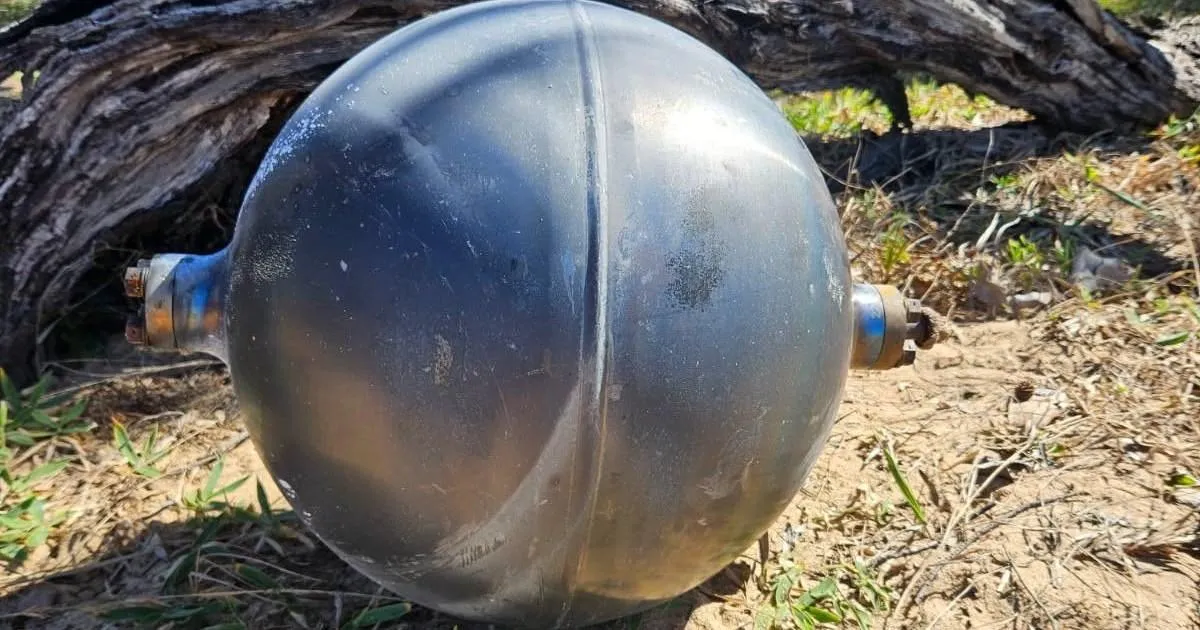
The quiet shores of Forrest Beach, a sleepy community near Ingham in Queensland, Australia, recently became the unlikely epicenter of an international mystery. Over the course of just three days, six mysterious, shiny, chrome-colored spheres washed ashore, sparking a flurry of confusion and genuine fear among the locals. Fisherman Trevor Kyle, who stumbled upon the first orb, initially dismissed it as a simple buoy. However, his nonchalance quickly evaporated as the beach was swarmed by a coalition of hazmat-clad firefighters, space experts, and national emergency personnel. Police soon cordoned off the area with a 160-foot exclusion zone, and as more of these peculiar objects appeared, rumors began to swirl that they might be volatile explosives or toxic hazards.
The anxiety in the air was palpable, with many locals worried that their peaceful seaside getaway had been turned into a dangerous crime scene. Mr. Kyle noted the escalating tension as he watched the arrival of bomb squads and emergency vehicles, describing a scene that felt ripped from a disaster film. For a few days, the people of Forrest Beach were living in uncertainty, unable to walk their familiar sands without the looming threat of the unknown metallic intruders. The presence of the hazardous materials team served as a stark reminder that even in a remote coastal town, the vast, unpredictable nature of our modern world can make landfall in the most unexpected ways.
By Monday, the Australian Space Agency finally calmed the fervor, clarifying that these were not bombs, but rather “space balls”—a humorous, informal term for pressurized fuel tanks used in rocket launches. The agency confirmed that the spheres were likely debris from a foreign rocket body that had recently descended from orbit after completing its service. While the label “space junk” sounds dismissive, it represents a very real part of our orbital reality; currently, approximately 15,800 tonnes of abandoned satellites and rocket parts are crowding the space above our heads. It was this realization—the sheer volume of human-made equipment floating in the abyss—that transformed a local beach scare into a broader conversation about the state of our skies.
Scientists, particularly “space archaeologist” Dr. Alice Gorman, helped demystify why these balls arrived on the beach in such pristine condition despite the violent nature of atmospheric reentry. Many wondered how metal could survive the trek through the Earth’s atmosphere, where temperatures regularly exceed 1,500°C. Dr. Gorman explained that the spheres are constructed from a robust titanium alloy designed specifically to withstand immense heat and high-pressure environments. Because their melting points far exceed the heat generated during their descent, they remain intact, acting as durable time capsules from a past orbit. These vessels, once housing volatile propellants like hydrazine, are engineering marvels that prove just how resilient aerospace materials truly are.
The presence of this debris also highlights Australia’s unique, and sometimes heavy, role in the global space race. Because of its vast, unpopulated geographic footprint, Australia regularly acts as a landing zone for falling satellites and rocket stages. Under the 1967 United Nations Outer Space Treaty, the countries that launch these objects still retain legal ownership of them, even when they crash-land in a local’s backyard or on a public beach. We have seen this happen before, with parts from Elon Musk’s SpaceX missions and Indian launch vehicles turning up along the Australian coast in recent years. As global space programs continue to accelerate, it is becoming clear that humanity’s trash is an increasingly common visitor to our shores.
Ultimately, the confusion at Forrest Beach serves as a modern cautionary tale regarding the remnants of our technological ambition. The Australian Space Agency has issued clear guidelines for anyone who might encounter similar debris in the future: keep your distance, do not attempt to touch or handle the objects due to potential chemical hazards, and contact local authorities immediately. While these silver orbs were harmless on this occasion, they serve as a reminder that the heavens are not as empty as they appear. The next time something glinting washes up on the tide, the world will be watching with a mix of curiosity and caution, forever mindful of the celestial debris that reminds us just how small our planet really is.