

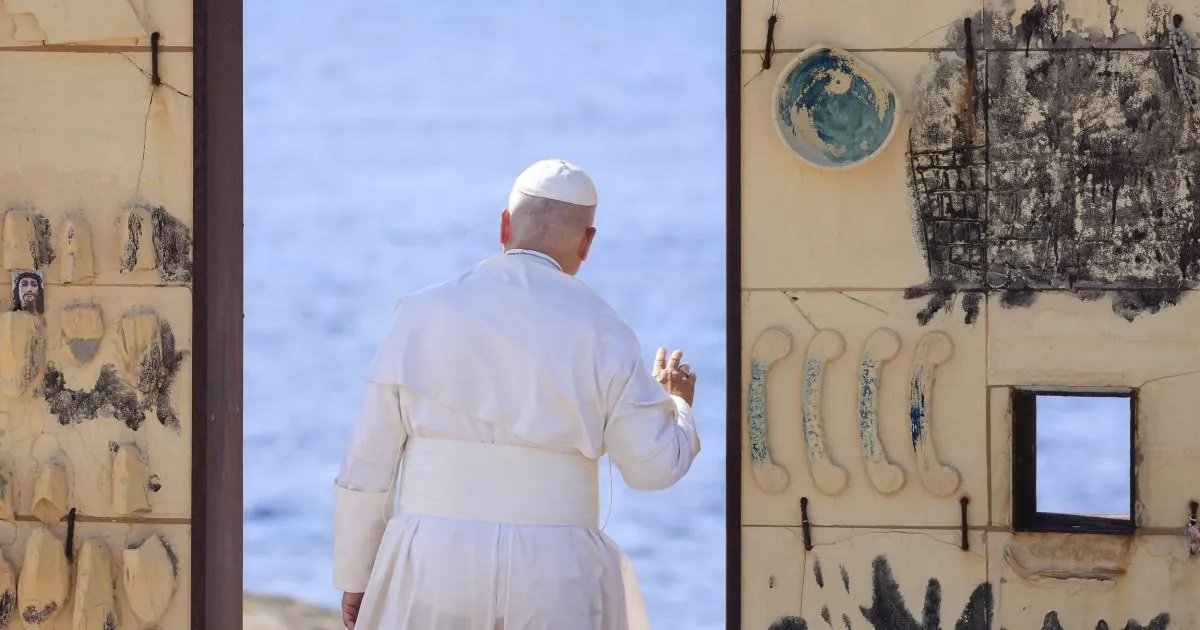
On July 4th, while the United States erupted in celebratory fireworks and patriotic fervor to mark its 250th anniversary, Pope Leo XIV chose a vastly different stage to convey his message. Rather than joining the jubilant crowds, the history-making, U.S.-born pontiff traveled to the jagged, sun-scorched Sicilian island of Lampedusa. This tiny, treeless strip of rock, situated closer to the African coast than the Italian mainland, has become the somber gateway for hundreds of thousands of souls fleeing conflict, climate change, and desperate poverty. By spending the holiday in prayer at a migrant cemetery and presiding over a solemn Mass, Leo sought to shift the world’s focus from national pride to the universal, moral imperative of human dignity.
The imagery of the day was as powerful as the Pope’s words. Standing alone on the windswept jetty where so many perilous journeys reach a tragic or uncertain end, Leo watched the Mediterranean with a look of profound reflection, his vestments whipping in the breeze. He walked among the island’s residents and the survivors who had arrived by boat, recognizing the “miracle of compassion” exhibited by a community that has become the frontline of a human crisis. For Leo, this was not merely a ceremonial visit; it was a physical manifestation of his belief that true morality is found in gestures—gestures that must be backed by a genuine, beating heart.
Pope Leo took this high-profile platform to offer a stern reminder to both his American homeland and the European continent: greatness is not defined by borders, but by the capacity to protect the most vulnerable. He navigated the difficult intersection of politics and faith, reminding the U.S. government—with which he has frequently clashed regarding immigration policies—that the very fabric of America was woven by immigrants. In a heartfelt letter addressed to the American people, he articulated that one cannot claim to uphold the sanctity of life without simultaneously embracing the immigrant. To him, welcoming those seeking a better life is not just a kind act of charity, but a necessary recognition of the inherent dignity that every human being possesses upon birth.
The humanitarian stakes of this message were highlighted by the grim reality facing the Mediterranean. While the number of arrivals has statistically dipped compared to past years, the International Organization for Migration estimates that over 35,000 migrants have gone missing—and likely perished—in these waters since 2014. These are not merely statistics to be debated in halls of power; they are lives lost to waves, indifference, and a lack of cooperative international policy. Standing at “Ground Zero” of the migration debate, the Pope warned that the world cannot afford to hide behind intellectual arguments or ideological walls when human beings are washing up on shores stripped of everything they once owned.
Addressing the leadership of Europe, Leo called for a paradigm shift, moving away from reactive policing toward a comprehensive strategy that prioritizes the “receive, protect, support, and integrate” framework. He spoke of the need to look beyond the immediate crisis to address the root causes of migration, advocating for the stabilization and development of migrants’ home countries so that no individual is ever forced to flee their hearth due to a lack of options. His sermon was a plea for Europe to rise to the occasion and assume its moral responsibility, reminding leaders that before any policy is drafted, there is the fundamental human encounter—the moment one person sees another in total destitution and chooses to act.
Ultimately, Pope Leo’s Fourth of July mission served as a sobering, humanizing counter-narrative to traditional celebrations of independence. He framed the concept of liberty as something that carries a global responsibility, challenging the Trump administration’s deportation efforts and Europe’s guarded borders with a vision of a world that is more than just a collection of sovereign states. By bridging the gap between his own American identity and the desperate plight of those on the shores of Lampedusa, the Pope succeeded in reminding us that our collective history is a shared story of movement and sacrifice. In his view, the only true way to measure the success of a nation is to see how it treats those who have nothing but the hope of starting over.