


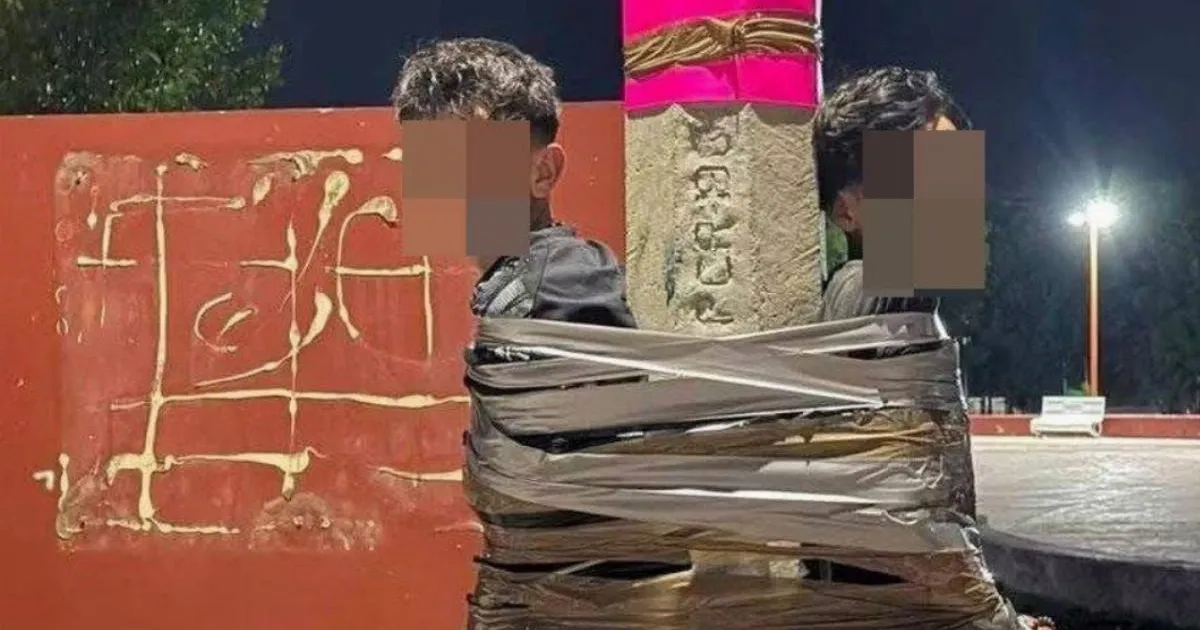
In the region of Lagos de Moreno, Jalisco, a strange and unsettling phenomenon has captured the public’s imagination: the rise of a self-appointed “Batman.” Amidst a notable surge in local petty crime, specifically the brazen theft of motorbikes, a mysterious individual has taken the law into their own hands. Rather than letting incidents vanish into the bureaucratic void of the justice system, this vigilante has been punishing alleged offenders in a public, humiliating, and physically painful manner. Photos circulating online show culprits bound to utility poles with heavy-duty duct tape, their faces marked by humiliating drawings of cat whiskers and moustaches, with the Spanish word “ratero”—meaning “thief”—scrawled across their foreheads.
The optics of these incidents are as bizarre as they are brutal. The vigilante doesn’t just stop at taping them up; they often leave signs written in pink ink detailing the specific crimes the men are accused of committing. It is a spectacle designed to shame, turning busy intersections into makeshift outdoor prisons. Reports indicate that at least one of these individuals was discovered in a battered state, suffering from visible bruises and bloodied skin from their interaction with the captor. While the online community has begun cheering on this “Mexican Batman,” the reality on the streets is far more precarious, as these scenes suggest a breakdown in the social contract that usually governs public behavior.
Local law enforcement, predictably, has taken a much colder view of these theatrical displays. State Security Secretary Juan Pablo Hernández has confirmed that there have been at least five documented cases of this specific brand of vigilante justice. Contrary to what some of the more enthusiastic social media commentators might think, the police are officially classifying these bound men as victims. The state has launched an active investigation to track down the identity of the vigilante, treating the perpetrators of these “arrests” as criminals rather than civic heroes. Authorities have already identified two vehicles believed to be linked to the incidents, though they have yet to name a primary suspect.
This surge in vigilantism does not exist in a vacuum; it is a symptom of a deep-seated frustration with the state of security in Mexico. When citizens feel that the authorities are either unable or unwilling to curb a crime wave, the vacuum is often filled by individuals or groups taking matters into their own hands. The “Batman of Lagos de Moreno” is merely the latest example of this trend. While these public punishments are undeniably extreme, they tap into a reservoir of public anger toward those who steal the basic transport—motorbikes—that many residents rely on for their livelihoods. In the eyes of some locals, the humiliation of the thief serves as a form of rough, immediate justice that the court system allegedly fails to provide.
The broader context of Mexican civil unrest reveals that this incident is part of a growing pattern of private defense groups rising to replace failed institutional protections. In the neighboring state of Michoacán, for example, groups of women have taken up arms, carrying assault rifles and operating homemade tanks to shield their communities from the encroaching violence of the Jalisco New Generation cartel. Where the vigilante in Lagos de Moreno uses duct tape and social shame, the groups in Michoacán use barricades and heavy weaponry. Both narratives, however, share a common root: a desperate, often dangerous attempt by ordinary citizens to impose order in regions where they feel they are being left to fend for themselves against an onslaught of criminality.
Ultimately, the story of the “Mexican Batman” is one of profound societal tension. It raises uncomfortable questions about what happens to a community when the rule of law begins to atrophy. While it is easy to view these events as a strange news curiosity or a comic-book-inspired stunt, the reality is a story of victims turning into perpetrators, and a community caught between crime and lawless retribution. As the police continue their search for the mysterious figure behind the tape, the residents of Lagos de Moreno remain in a state of unease, watching to see whether their “hero” will strike again or if the reach of the state will finally be enough to restore traditional order to their streets.