



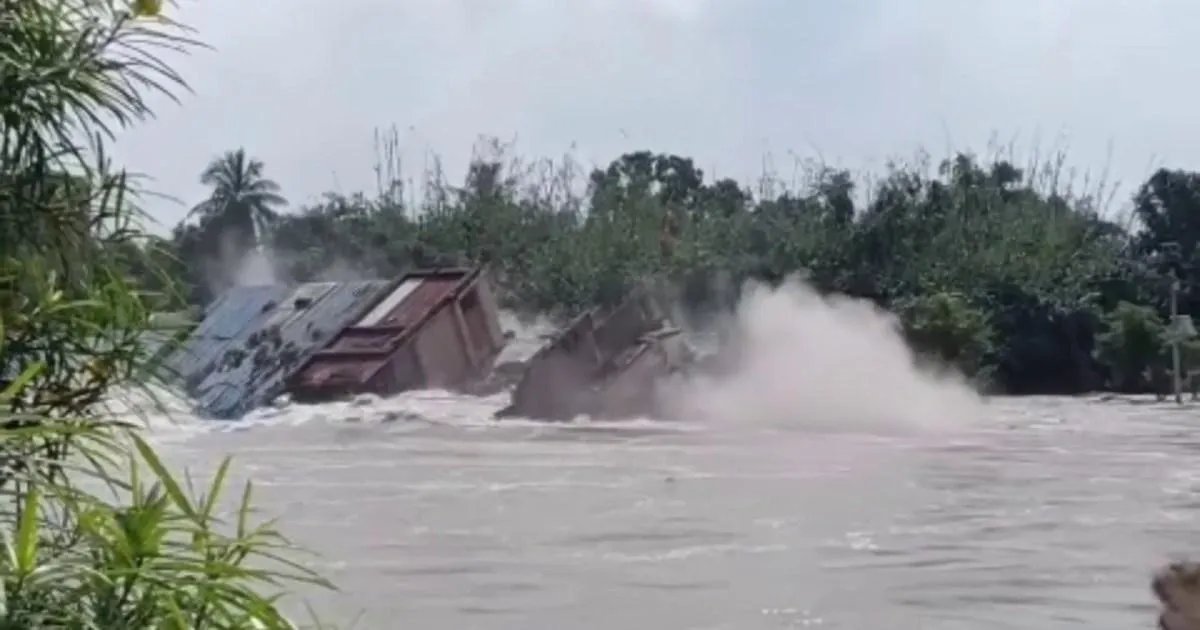
Against the backdrop of one of the most severe flood emergencies to grip the eastern Indian state of Bihar, a simple act of mercy turned into an unforeseen tragedy. For days, the Gandak River had been rising, swollen by relentless monsoon rain and by water rushing down from the Himalayan catchment in Nepal. In Saran district, the river finally burst its banks, and the landscape changed almost beyond recognition. Roads that had once connected villages became muddy canals. Fields of crops became shallow lakes. Homes stood half-submerged, their lower walls stained dark with water, and families huddled on roofs, on raised embankments, and on any patch of dry ground they could find. The rain continued, turning the sky a bruised grey and filling the air with the sound of water lapping against walls. In Parshurampur village, people had gathered near an aid camp, hoping to receive food from relief workers. They had survived the initial flood by moving to higher ground, but to survive in the days ahead they needed supplies. Indian Air Force helicopters had been dispatched to drop relief packages because the roads were impossible to use. The sound of the approaching helicopter must have been a comfort, a sign that the outside world had not forgotten them. Children pointed at the aircraft, and exhausted adults allowed themselves a moment of relief. Then the aircraft appeared overhead, and bundles began to fall. At first, the dark shapes descending through the grey sky looked like food, like life. What happened next was unimaginable. Anil Kumar Singh, a 58-year-old hawker and father, was hit by the falling relief material. One packet struck his head, another his chest. He died on the spot, beside people who had come for the same reason he had: to receive help.
Anil Kumar Singh was not a stranger to hardship. As a hawker, he spent his days moving through villages with goods to sell, relying on the rhythms of local markets and the trust of his customers. He was 58 years old, still working, still carrying the weight of his family on his shoulders. His son, Avinash, remembered the horror with painful clarity in an interview with The Hindu. “The helicopter was dropping the relief materials in bulk, and one of the packets hit my father’s head, and another hit his chest, and he died on the spot,” Avinash said. The words are simple, but the image is devastating: a man standing where help was supposed to arrive, only to be killed by the weight and speed of that help. The packets had been dropped in bulk from a military helicopter, likely gaining momentum as they fell. To be struck twice, first in the head and then in the chest, left no chance of survival. His body lay in the aid camp area as other villagers scrambled to understand what had happened. Chaos quickly turned to grief, then to anger. Neighbors who had arrived with hope in their eyes suddenly found themselves witnesses to a death caused not by the flood, but by the response to the flood. For Avinash, the loss is unbearable. His father was not a soldier or a distant official; he was a man who walked the same streets every day, who called out his wares, who came home tired at night. The flood had already taken his livelihood, and in a cruel twist, the rescue mission took his life. What should have been a story of survival became a story of sorrow, and a family that was already struggling to cope with the disaster now has to bury a man whose only mistake was standing in the wrong place at the wrong time.
Parshurampur seemed to be singled out for misfortune that day. In a second incident, terror struck again. A woman had climbed onto the roof of her home with her two children, perhaps hoping to signal to the helicopter or watch for an airdrop, or perhaps simply trying to find a place with better air and a clear view of what was happening around her. As the helicopter flew low and close to the building, the force of its rotor wash exploded across the rooftops. The sudden blast of air was strong enough to tear loose pieces of tin and send them flying like shards of shrapnel. One piece of tin hit the mother in the leg, wounding her seriously. Her two children were also hurt in the swirl of debris and wind. According to the Times of India, the three were taken to hospital for treatment. The children, still young, must have been terrified; one moment they were standing beside their mother, watching a great machine in the sky, and the next they were being thrown to the ground by a violent gust and struck by pieces of their own roof. The mother’s injury was serious enough to require medical care, and her children were also bruised and shaken. Though their wounds were not said to be life-threatening, the incident captures the hidden dangers of military-style airdrops in civilian settings. Helicopters are not designed for delicate deliveries; they are machines of speed and force. The same downwash that helps a pilot hover in tight conditions can become a dangerous windstorm for people on the ground, especially in fragile, flood-damaged communities where rooftops are made of lightweight materials and buildings are already weakened by water. What happened to this small family is a warning that the presence of a rescue helicopter, once a symbol of safety, can itself become a source of danger.
These tragedies sit inside a much larger catastrophe that has unfolded across the region. Floods have engulfed a wide area of Saran district and neighboring areas after days of non-stop rain. The Gandak River, which runs roughly 505 miles from the heights of the Himalayas through parts of Nepal and into the plains of northern India, has been one of the main culprits. Its catchment area in Nepal received intense rainfall, and the resulting overflow pushed the river far beyond its banks. A network of smaller rivers and streams linked to the same catchment has also burst, turning farmland into lakes and streets into canals. The water did not rise all at once. It crept up slowly at first, then surged, swallowing low-lying settlements and forcing families to abandon their homes in the middle of the night. Villages that once stood beside the river are now isolated islands. Roads have been submerged, in some places under several feet of water, making travel impossible for ordinary vehicles. Boats are scarce, and many families have had to wade through waist-deep water carrying children, livestock, and whatever belongings they could save. With roads blocked, land rescue teams cannot reach those in need, and the scale of the flooding makes ground response slow and dangerous. The government’s answer has been to take to the air. Indian Air Force helicopters have been flying sorties over the flooded villages, carrying food packets and dropping them wherever groups of people have gathered. For thousands of families, those packets are the only source of food in days. The airdrops have likely saved many lives, but as the deaths and injuries in Parshurampur show, they are a blunt instrument in a crisis that requires care as much as speed. Every bundle that falls from the sky is a reminder of how fragile life has become in this waterlogged corner of India.
The scale of the relief operation is impressive, though it cannot erase the pain caused by its unforeseen consequences. An official involved in the response said that more than 28 tonnes of food supplies had been airdropped so far, including over 5,600 dry ration packets, in 15 sorties by Indian Air Force helicopters across the flood-affected regions of Saran district. “This airdropping method ensures that essential food reaches affected families, providing timely relief even when normal transportation routes are disrupted by the floods,” the official said. It is true that, without these airdrops, many more people might face starvation in the coming days. The calculation made by disaster managers is simple: when roads are gone and water is everywhere, the only way in is from the sky. The packets contain dry rations, items that can be eaten without cooking, which is crucial in a place where fuel and stoves may have been lost. Yet the official explanation does not address the specific risks that became visible on Friday. The exact cause of Anil Kumar Singh’s death has not yet been officially confirmed, pending investigation. But eyewitness accounts from his son and other villagers leave little doubt that the falling packets dropped in bulk were responsible. The injuries to the woman and her children from rotor wash raise further questions about how low and how fast helicopters should fly when dropping supplies near homes. In the rush to deliver aid, protocols may not have accounted for the realities of a crowded, desperate civilian population. Officials may argue that the number of beneficiaries outweighs the risks, but for the family of the dead man, that arithmetic is impossible to accept. The relief effort will continue, and more sorties will likely be flown, but each one must now be weighed against the memory of a man who was killed by help itself.
In the end, this story is not just about logistics or weather; it is about a man who went out to receive help and never returned home. Anil Kumar Singh was one of many people caught between a merciless river and an imperfect rescue. His death is a reminder that disaster aid, however well-intentioned, must be carried out with great care to avoid inflicting new wounds. Relief planners will need to learn from Parshurampur: perhaps by lowering packets more gently with slings or winches, by choosing drop zones away from people, by coordinating with ground volunteers, or by using smaller, guided packages rather than bulk deliveries from military aircraft. They may need to establish clear no-fly zones above homes, or at least ensure that low passes are avoided when rooftops are occupied. They may also need to begin training villagers in what to do when a helicopter appears, so that people do not gather directly beneath the falling bundles. But for Avinash and his family, these lessons will always be cold comfort. Their father is gone, killed by something that was meant to save him. In the days ahead, as the floodwaters recede and the damaged villages begin to recover, the memory of that Friday will remain: a man standing under the sky, waiting for food, and seeing death fall down from the hands of rescuers. The greatest tragedy is that in a disaster already defined by so much loss, the act of giving became another source of grief. No quantity of dry rations can replace a father, no airdrop can restore a childhood disrupted by injury and fear, and no official statement can soften the image of a body lying in the mud of an aid camp. The floods will eventually pass, the water will drain away, and the fields will dry, but the families of Parshurampur will carry this memory with them for the rest of their lives.