

Paragraph 1
It was meant to be just another morning of protest, but for one 15-year-old boy in the northern French town of Lens, it became a moment that will change his life forever. The teenager had joined a gathering of up to 250 young people near the Auguste-Béhal high school, a crowd driven by anger over crumbling classrooms, sweltering heat, and a school system that students say has abandoned them. What began as collective frustration quickly turned into tragedy. According to local reports, a stun grenade—a device used by French riot police to disperse crowds—lay on the ground. The boy, described as a second-year high school pupil, picked it up. In an instant, the device detonated in his left hand, tearing it off in front of his schoolmates. The scene, already charged with tension, dissolved into panic and horror. Emergency services rushed the boy to a hospital in Lille, roughly 24 miles north of Lens. By the evening, officials said his condition was not life-threatening, but the physical and emotional scar left on him, his family, and everyone who witnessed the explosion will not heal quickly. Public prosecutor Étienne Thieffry was cautious in his initial comments, saying it was not yet clear whether the teenager had voluntarily picked up the grenade or whether it had been thrown toward him. What is clear is that a child is now maimed, and a country already on edge must confront the consequences of a confrontation that spiraled far beyond anyone’s control.
Paragraph 2
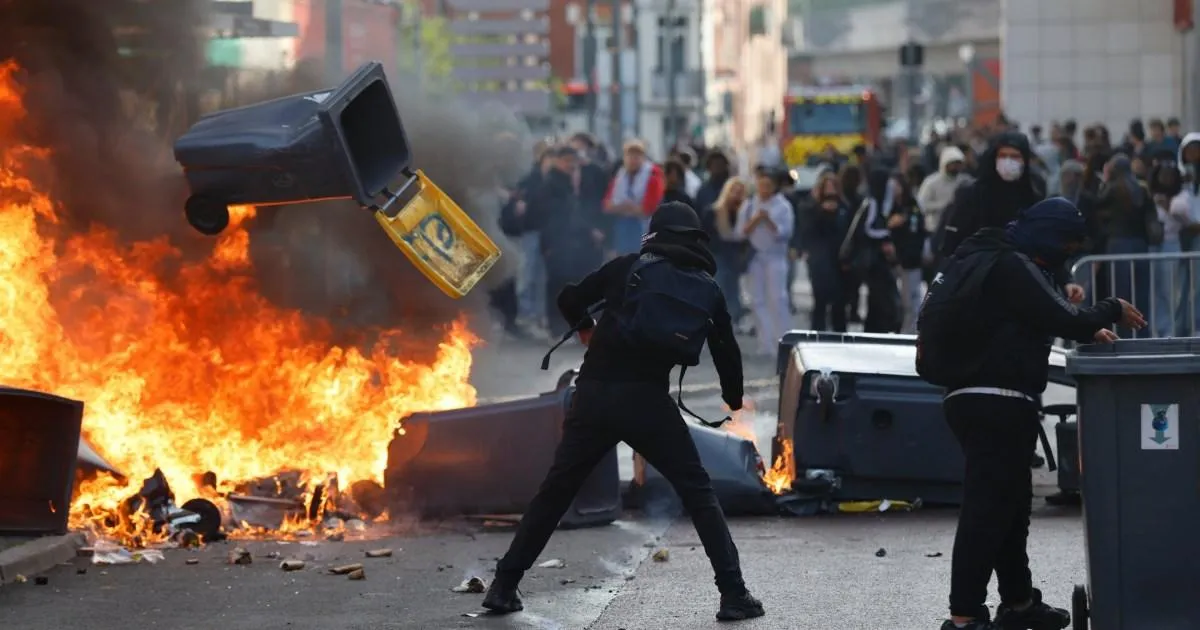
This incident did not happen in a vacuum. It came at the end of weeks of growing unrest among students across France, a movement that has swept through cities, towns, and even spilled across the border into Belgium. At its heart are grievances that many adults might recognize: classrooms that become unbearable during record-breaking heatwaves, a chronic shortage of teachers, and a system that students feel is neglecting their needs. Young people have taken to the streets not out of recklessness but out of desperation, hoping to be heard by a government that they believe has turned a deaf ear to their suffering. In Lille, bins were set ablaze; in Lens, tension exploded into violence. Dozens of schools have been ransacked and burned, with around 400 schools closed today as a precaution. The images circulating on social media are jarring: masked protesters clashing with riot police, smoke rising from streets, and teachers being shoved or assaulted as they tried to leave their workplaces. The violence has overshadowed the original demands, but for many students, the destruction is a symptom of a deeper rage—a sense that peaceful protest has failed to bring about any meaningful change. They are angry about being taught in overcrowded, poorly ventilated rooms during extreme heat; angry about classes that are canceled because no teacher can be found; angry about a government that prioritizes spectacle over substance. The protest movement has become a release valve for years of frustration, and the explosion in Lens is a tragic reminder of what can happen when that frustration meets heavy-handed policing.
Paragraph 3
For teachers and school staff, the protests have created an atmosphere of fear and uncertainty. Many have found themselves caught in the middle, trying to protect their students while also navigating the anger directed at the institutions where they work. Shocking footage has emerged of educators being assaulted as they attempted to leave their schools, and several have reported being trapped inside buildings while demonstrators clashed with police outside. The decision to close hundreds of schools was not made lightly; it was a recognition that the situation had become too volatile. Parents have been left scrambling to arrange childcare, while students have been told to stay home or log into remote lessons. In Lens, all teaching at the Auguste-Béhal school was switched to online learning following the grenade incident, and a support service was set up to help students process what they had witnessed. The psychological toll cannot be overstated. Young people who went to school expecting to make their voices heard instead saw a classmate lose a hand. Teachers who went to work with the intention of educating the next generation found themselves fleeing their own classrooms. The physical damage to schools is measurable—broken windows, burned bins, spray-painted walls—but the damage to trust, safety, and the sense of shared community may be far more profound. Schools are meant to be sanctuaries, places where young people learn and grow. Now, across France, they have become battlegrounds, and the innocent are paying the price.
Paragraph 4
In the aftermath of the Lens tragedy, attention has turned to the actions of the police and the rules governing the use of so-called stun grenades. The French police watchdog, the IGPN, has launched a full investigation, not only into the incident itself but also into whether the use of this type of grenade met the strict criteria laid down by regulations. These devices are intended to be used as a means of dispersing crowds, but they are inherently dangerous, and when they end up in the hands of a child, the consequences can be devastating. Prosecutor Étienne Thieffry has stated that investigators are examining all possibilities, including whether the grenade was thrown at the teenager or simply picked up from the ground. The distinction is legally crucial, but for the boy and his family, it may feel like a detail. What matters to them is that their son has lost part of his body, and that no explanation or investigation can undo that reality. The school has responded with compassion, offering psychological support to students and staff who are struggling to cope with the aftermath. But the questions raised by this incident extend far beyond Lens. They reach into the highest levels of government and the broader debate about how law enforcement should handle protests, especially when many of the protesters are minors. Is it acceptable for riot police to use explosive devices in close proximity to children? Are there alternative tactics that could prevent such tragedies? These are uncomfortable questions, but they demand answers. For too long, the conversation has focused on the violence of protesters while ignoring the violence of the state. The image of a 15-year-old boy, handless and bleeding, should compel every lawmaker and police official to reflect on the consequences of their choices.
Paragraph 5
The French government, however, has been quick to shift the narrative. Education minister Édouard Geffray has accused unrelated activists of “infiltrating” the student movement, suggesting that the protests are being exploited by outside forces with their own agendas. There is some evidence to support this—footage from various cities shows individuals who are not students engaging in acts of vandalism and confrontation with police. But for many observers, this framing feels like a convenient distraction. It is easier to blame a shadowy group of agitators than to address the legitimate grievances that brought thousands of students into the streets in the first place. The minister’s words have also angered student leaders, who argue that dismissing the movement as infiltrated undermines their genuine concerns. They point to the sweltering classrooms, the overworked and underpaid teachers, and the chronic underfunding of public education. They highlight the fact that this is not a spontaneous, chaotic uprising but a coordinated, passionate campaign for better conditions. And they note that the protests have not been confined to France. In Belgium, marches and blockades have been reported in Liège, Charleroi, and Mons, suggesting that students across borders share the same frustrations. The movement has become transnational, but the response has been remarkably uniform: police in riot gear, tear gas, stun grenades, and accusations of outside interference. By refusing to engage with the substance of the protests, the government risks alienating an entire generation. Young people are not just demanding better schools; they are demanding to be taken seriously. Every time their concerns are dismissed or their protests are met with force, the divide between the youth and the state grows deeper.
Paragraph 6
The tragedy in Lens is a wake-up call, but it is not just about one boy, one grenade, or one school. It is about a society that has failed to listen to its young people and a system that has failed to protect them. Behind the headlines and the hashtags are countless students who are genuinely afraid—afraid of the heat, afraid of the chaos, afraid of the police, and afraid of what their future holds. They are growing up in a world of climate crises, economic uncertainty, and political polarisation, and they are being told that they must simply accept the way things are. But they refuse. They have taken to the streets, risking arrest and injury, to demand better. The violence that has erupted around the protests is tragic and often counterproductive, but it does not erase the validity of their cause. The task now is not to assign blame but to find a path forward. This means investing in schools, ensuring that every classroom is safe and comfortable, recruiting and retaining qualified teachers, and creating spaces where students can voice their concerns without fear of reprisal. It also means critically examining the use of force in policing protests, especially those involving minors. Stun grenades, tear gas, and batons have no place in a society that claims to value its children. The boy in Lens should never have been in that situation, and the fact that he is now facing a lifetime of rehabilitation should weigh heavily on the conscience of everyone involved. Ultimately, this is a moment for reflection and compassion, not just for policy debates. It is a moment to remember that behind every statistic and every headline are real human beings—parents, teachers, and especially students, who deserve better. Their voices must be heard, not drowned out by the sounds of explosions and violence. The future belongs to them, and it is time we started acting like it.