


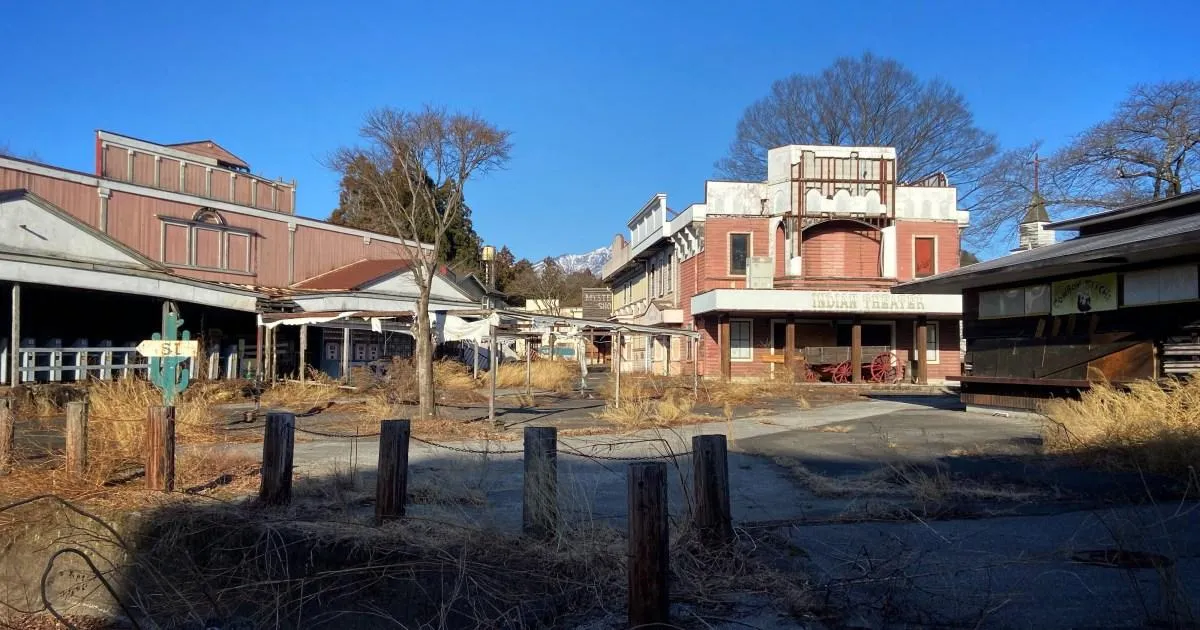
There is something inherently haunting about an abandoned theme park—a place designed for joy, laughter, and high-energy escapism that has been suddenly severed from its purpose. While we often associate summer with the hum of rollercoasters and the smell of cotton candy at bustling resorts like Alton Towers, the reality for many ventures is far grimmer. Across the globe, forgotten attractions lie dormant, reclaimed by nature and time. One of the most striking examples of this phenomenon is Western Village, a once-thriving entertainment park in Nikko, Japan, which has spent the last seventeen years slowly crumbling into a state of post-apocalyptic silence.
When Western Village first opened as “Kinugawa Family Ranch” in 1973, it was a modest space focused on wholesome activities like fishing and horseback riding. However, in 1975, the park underwent a dramatic transformation, rebranding itself with an ambitious Wild West theme that captured the public’s imagination. For decades, it was a bustling hub where families could step into a meticulously crafted 19th-century frontier town. Complete with a sheriff’s office, a barber shop, and rowdy saloons where actors staged convincing gunfight stunts, the park offered an immersive American experience deep in the heart of Japan. It even featured a train line that frequently served as the backdrop for theatrical “robberies,” delighting generations of visitors.
The park’s commitment to spectacle reached its zenith in 1995 with the unveiling of a breathtaking, one-third scale replica of Mount Rushmore. Carved directly into the landscape at a cost of roughly £20 million, this massive monument stood as a testament to the park’s enduring success. Yet, internal investments totaling over £75 million could not insulate the venture from the shifting tides of the tourism industry. As global giants like Universal Studios Japan and Tokyo Disneyland began to dominate the market, Western Village found its remote location and niche theme struggling to compete. By 2007, the dream had run its course, and the gates were shuttered for the final time.
When urban explorer Luke Bradburn visited the site in 2024, he walked into a world frozen in a state of suspended animation. Unlike many abandoned locations in other countries that are often looted or vandalized, Western Village remains remarkably intact, a byproduct of Japan’s famously low crime rate. To walk through the park today is to witness a strange, silent tableau of the past: arcade machines sit under heavy layers of dust, abandoned beverage bottles remain exactly where they were placed two decades ago, and decaying animatronic figures loom in the shadows of empty saloons. It is a quiet, eerie landscape where the silence feels heavy with the memory of the thousands of families who once filled the paths with noise and excitement.
The contrast between the park’s former grandeur and its current state of organic decay is a sharp reminder of how quickly the world moves on. For explorers and photographers, the attraction is hypnotic; the sight of a weathered Mount Rushmore standing sentinel over a forest of rotted timber is something that feels like a hallucination. The site has become a pilgrimage for those fascinated by “ruin porn” and architectural history, as social media posts frequently document the slow, inevitable collapse of the frontier town. Despite the park’s resilience, nature is slowly doing its work, and the wooden structures continue to sag under the weight of the elements.
Ultimately, Western Village serves as a melancholic monument to the impermanence of human ambition. Recent reports suggest that what remains of the site is finally being demolished piece by piece, as the land is reclaimed for the future. While the replica of Mount Rushmore has stood as a surreal totem for years—puzzling and delighting those who wander the outskirts of Nikko—it too will likely fade into history. For now, the site remains an evocative time capsule, capturing the fleeting magic of a bygone era and the quiet, inevitable reclamation of space by the passage of time. It is a poignant, if slightly unsettling, lesson that even the most elaborate stage sets eventually dim their lights for good.