


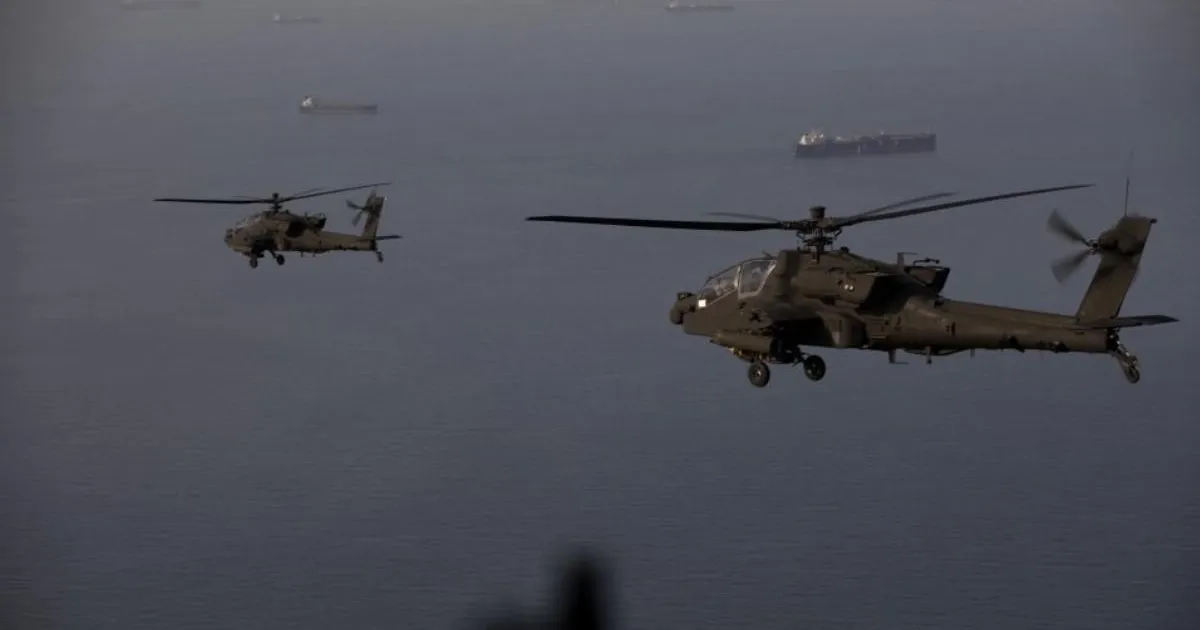
The enigmatic crash of a U.S. Apache helicopter near the Strait of Hormuz has peeled back the curtain on a covert and highly complex military-led logistics operation. Initially dismissed by official channels as a routine patrol gone wrong at 3:30 a.m. off the Omani coast, the incident has since evolved from a local aviation accident into the focal point of a massive investigation. Reports from Reuters reveal that the aircraft was not merely patrolling the skies; rather, it was a cog in an intricate, state-run machine designed to circumvent regional blockades and facilitate the large-scale transfer of oil. This revelation has shifted the public narrative, forcing a reconsideration of how far global powers will go to protect energy lifelines in one of the planet’s most volatile maritime bottlenecks.
Behind the scenes, the U.S. military orchestrated an operation that utilized an array of high-tech assets, including aerial drones and underwater surveillance craft, to guide oil tankers safely through contested waters. Satellite imagery indicates that this clandestine ship-to-ship transfer program began in early May, serving as a desperate measure to keep the flow of energy moving when the Strait of Hormuz—the global economy’s primary artery—was effectively choked by conflict. While the U.S. Department of Defense has officially denied involvement in these offshore transfers, the sheer scale of the operation is staggering; estimates suggest that upwards of 90 million barrels of crude oil were moved under the radar using methods that mirror, if not replicate, the tactics Iran has utilized for years to bypass international economic sanctions.
This operation highlights just how critical the Strait of Hormuz remains to our global standard of living. As a vital passage linking the Persian Gulf to the Indian Ocean, it handles roughly one-fifth of the world’s daily oil consumption. When this shipping lane is jeopardized by threats or blockades, the downstream effects are felt in every gasoline pump and heating system across the globe. By deploying an unconventional, military-escorted logistics network, the U.S. proved that in the face of restricted access to international waters, the traditional rules of maritime trade are easily set aside in favor of a “covert-first” approach to resource management. The helicopter crash act as a harsh reminder that the environment surrounding these operations remains dangerous, with the price of energy independence being measured in both economic volatility and the peril faced by military personnel.
The recent announcement that a peace deal between the United States and Iran has finally been struck offers a cautious breath of relief to a world exhausted by brinkmanship. This agreement, which promises the reopening of the Strait without the threat of tolls or military interference, effectively resets the region to a precarious status quo. However, the cost of arriving at this destination has been catastrophic, involving immense loss of life and a profound shift in geopolitical leverage. Iran now emerges from the conflict possessing a new form of power: the demonstrated ability to disrupt the global supply chain, a tool that Tehran will undoubtedly keep close at hand during future diplomatic navigation.
Perhaps most concerning is the unresolved tension regarding Iran’s nuclear program, which continues to simmer beneath the surface of the new peace agreement. International watchdogs, including the IAEA, have confirmed that Iran holds a significant stockpile of uranium enriched to near-weapons-grade levels, stored deep within subterranean facilities that were heavily targeted during previous military exchanges. Despite the cease-fire and the resumption of trade, the core ideological and strategic conflict remains largely unaddressed. Iran maintains that its nuclear ambitions are purely peaceful, yet the regime has shown no public intent to dismantle the infrastructure that grants them such significant leverage on the world stage. The peace may be real, but it is clearly fragile, built on the shifting sands of old grievances and high-stakes nuclear capability.
Ultimately, the Apache crash serves as a lens through which we can view the uncomfortable realities of modern international relations. It exposes the hidden interplay between high-stakes military strategy and the mundane reality of oil logistics—a world where drones monitor tankers by night and diplomatic bargains with nuclear-capable nations are made by day. As we move forward, the challenge for the international community is to move beyond these cycles of blockade and covert maneuvering. Until the underlying issues of energy security and nuclear proliferation are addressed with more than just temporary treaties, the world will remain a few bad moves away from the next crisis in the Gulf, forever dancing on the edge of a conflict that no one can truly afford to win.