



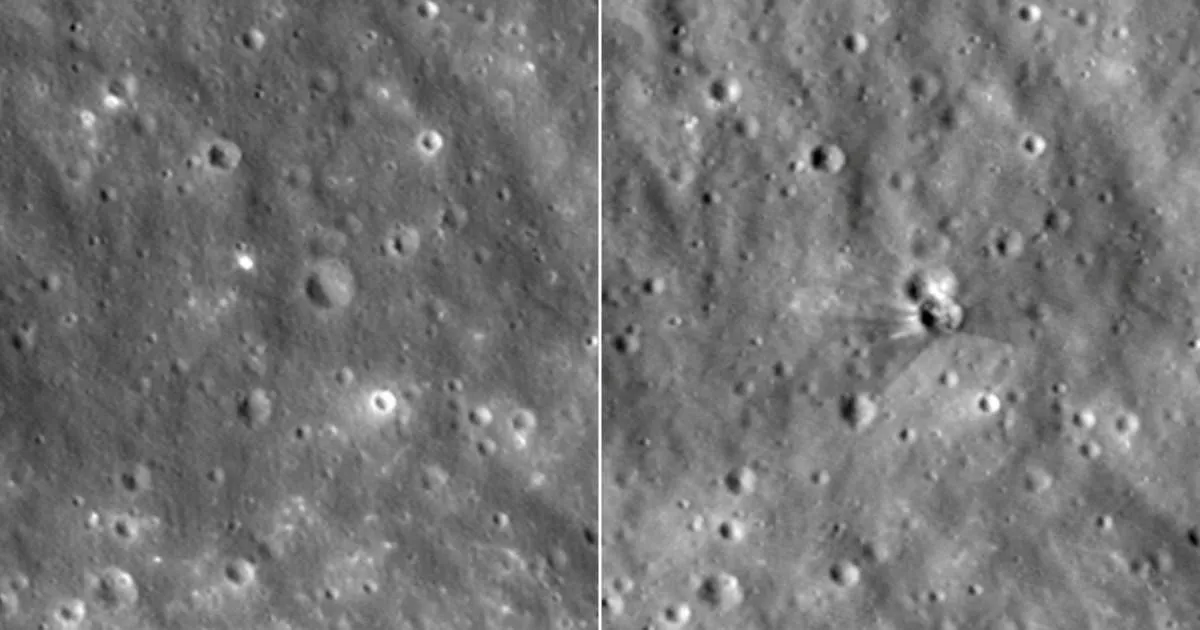
The Moon has always been a museum of collisions. Its cratered face is a long, silent archive of the solar system’s violent history, where every major impact has left a story written in rock. But the latest entry in that archive is not from an asteroid or a comet. It is from a machine we built and then abandoned in space. NASA’s Lunar Reconnaissance Orbiter has captured images of a brand-new crater on the Moon, formed when a discarded SpaceX Falcon 9 upper stage crashed into the lunar surface on August 5, 2026. The rocket stage had been left in orbit after launching Firefly’s Blue Ghost 1 mission in January 2025. Until recently, it was just another piece of space junk, drifting silently above a world that no human visits regularly. Then it hit the Moon, and suddenly it became a landmark. The images, released by NASA and taken on August 11 and 12, show a dark scar cut into the grey, dotted terrain, surrounded by pale streaks of debris fanning outward. In a statement, NASA said: ‘Our Lunar Reconnaissance Orbiter has captured images of a new crater on the Moon.’ For scientists, the crater offers a rare chance to study an impact with a known source and a known time. For the rest of us, it is a strange sight: a human-made object leaving a permanent mark on a celestial body that has outlasted civilizations. The Moon has been hit before, of course, countless times; but this time, the impact was not natural. It was the accidental end of a piece of our own history. There is something humbling about seeing our discarded machinery become part of the Moon’s face, as if the ancient, untouched surface is now being written upon by humans, whether we intend it or not.
Capturing that crater was not as simple as pointing a camera at the Moon. The Lunar Reconnaissance Orbiter circles the Moon from pole to pole every two hours, but the Moon itself rotates slowly beneath it. After the crash, the impact site was hidden from view, waiting for the slow turn of the lunar surface to bring it into range. The team had to wait six full days for the crater to rotate into the orbiter’s line of sight. When the moment came, engineers tilted the entire spacecraft onto its side so that the Narrow-Angle Camera could look directly down at the fresh scar. Timing was everything. A camera shutter firing ten seconds too early or too late would have thrown the target around ten miles off target, turning the attempt into a blur of empty regolith. The camera is powerful enough to pick out objects less than a metre across, so once it found the crater, it could reveal details ordinary telescopes would never see. The measurements put the crater at about 60 feet wide and ten feet deep. In everyday terms, that is roughly six car lengths across and deep enough to swallow an adult standing upright. Around the crater, the ground looks as if it had been clawed open: dark fragments thrown outward, bright rays of pulverized rock stretching across the surface. Scientists note that those pale streaks are being shaped by solar wind, cosmic rays and micrometeorite strikes, the slow space weathering that gives old lunar soil its darker, duller tone. The fresh crater, by contrast, is still bright and raw. It will eventually fade into the gray landscape, but that will take millions of years. For now, it is a crisp, sharp feature in the harsh sunlight, a perfect example of what happens when something moving at enormous speed meets a world with no atmosphere to slow it down.
How did a discarded rocket stage end up crashing into the Moon? In January 2025, a SpaceX Falcon 9 rocket lifted off carrying Firefly Aerospace’s Blue Ghost 1 lunar lander. The upper stage did its job, sending the lander toward the Moon, and then it was left behind. That is standard practice: after a launch, upper stages are usually either deorbited over Earth or left in high orbits where they are no one’s problem. This particular stage, however, stayed in a complex gravitational no-man’s-land between Earth and the Moon. Over the following months, the gravity of both bodies pulled at it, changing its orbit in ways that are difficult to predict precisely. There was no steering system on board, no one monitoring it closely, and no plan for where it would eventually go. On August 5, 2026, the Moon’s gravity won. The Falcon 9 upper stage struck the lunar surface at high speed, exploding into the ground and carving out the crater that NASA later photographed. Because the Moon has no atmosphere, there was no braking, no heat shield, no graceful fall. It came in like a hammer. The impact was not intentional, unlike NASA’s LCROSS mission in 2009, which was deliberately crashed into the Moon’s south pole to kick up material for water-ice research. It was an accident of orbital mechanics, not a science experiment. And it is part of a growing pattern. As commercial spaceflight expands, the number of large objects left in orbit is rising, and the Moon—a large, airless target—is one of the places where those objects sometimes end up. The Moon is not just a witness to natural history; it is increasingly a graveyard for our hardware.
Astronomers, for the most part, are taking the news in stride. Dr Ed Bloomer, an astronomer at the Royal Observatory Greenwich in London, told Metro that the piece of space junk did not have the capability to seriously damage the Moon. The Moon has been hit by meteors and asteroids for four and a half billion years, and a 60-foot-wide crater from a spent rocket stage is a minor scratch on a world that is already covered in scars. But the crater is also permanent. There is no wind or rain on the Moon, no flowing water, no tectonic activity to wear it away. That fresh hole in the ground will still be there for millions of years, long after every person alive today is gone. What is more, Dr Bloomer said, even British stargazers with a decent telescope might be able to see it. The crater is small, but the fresh dark material and bright rays around it stand out against the older, darker regolith. For observers in Europe, catching a glimpse would require clear skies and a good telescope, but it is not out of the question. There is something humbling about that thought: the same Moon that has inspired poets, lovers and scientists for centuries now carries a mark made by a piece of our own machinery. We are used to thinking of space as clean and untouched, but the Moon’s surface is becoming a sort of celestial canvas, recording not just the history of the solar system but also the history of our technological ambition—and our carelessness. The crater will be there for future astronauts to visit, inspect and wonder about. It is a reminder that what we leave behind in space is not harmless.
The bigger concern is what this crater represents. SpaceX now conducts roughly half of all global launches, according to a space race report by Accu Component. With that many launches comes an enormous amount of hardware: rocket stages, fairings, payload adapters, satellites that failed, spent upper stages. Much of it is left in orbit, where it becomes space junk. Some of it eventually falls back to Earth; some remains in permanent graveyard orbits; and some, like this Falcon 9 upper stage, crashes into the Moon. The impact in 2026 is far from the first. In 2022, a segment of a Chinese rocket dug out a pair of craters on the Moon’s far side—sometimes referred to as the dark side, though it is only dark in the sense that we never see it from Earth. In 2009, NASA’s Lunar Crater Observation and Sensing Satellite, or LCROSS, was intentionally aimed at the Moon’s south pole to see whether the impact would throw up water ice. That was a deliberate experiment, and it did its job. But the 2022 Chinese impact and the 2026 SpaceX impact were not deliberate. They were examples of what happens when objects are abandoned in unstable orbits. Dr Bloomer put it bluntly: the skies above our heads are becoming a stellar dumping ground, and Wednesday’s rocket smash will not be the last. There is no international law firm for space debris on the Moon, no cleanup service for lunar litter. The Moon has no atmosphere to burn up incoming junk, no ocean to hide it, no wind to scatter it. Every object that hits it leaves a permanent mark. As launch rates set new records every year, the probability of more unintended lunar impacts only increases.
Perhaps the most unsettling thing about the new crater is how ordinary it is. It was not caused by a dramatic asteroid discovered at the last minute, nor by a strange cosmic event. It was caused by a machine we built, launched, used and then forgot about. The Moon now has a scar that will outlive the people who made it, and future generations will be able to see exactly where our space junk hit. That is a strange kind of legacy. In a way, the crater is tiny—only 60 feet across, dwarfed by the vast basins and old impact sites that cover the Moon. But it is also permanent. There is no weather on the Moon to smooth it over, no plate tectonics to bury it, no atmosphere to erode it. It will be there, sharp and clear, when the last human being alive has died. It will be there when space agencies and private companies are just distant memories. It might be one of the most lasting artifacts of our civilization. That is a powerful reason to think about how we treat space. The rocket stage was not meant to hit the Moon; it was simply abandoned, and nature did the rest. But we can do better. We can design upper stages with controlled descents, or send them into heliocentric orbits where they will never hit anything. We can track large objects more carefully and make sure they are not left in chaotic orbits around the Moon. And we can start treating the Moon not as a junkyard, but as the scientific, cultural and historical treasure it is. The images released by NASA are more than just a photo of a hole. They are a warning: the traces we leave in space are going to outlast the reasons we left them.