


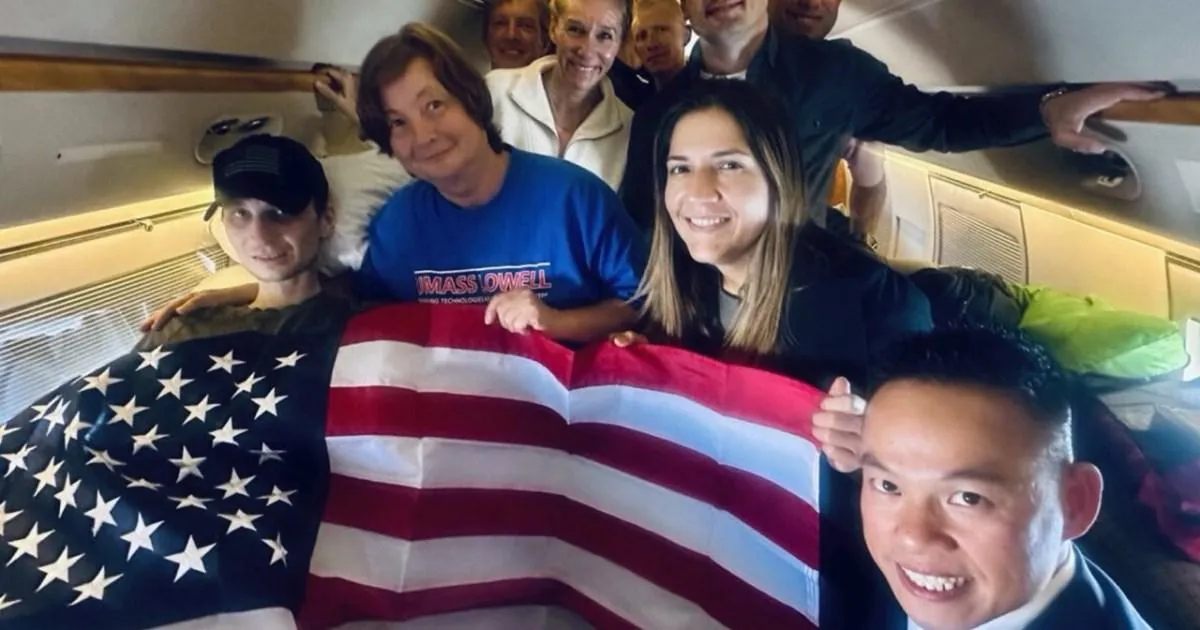
After four long, harrowing years, an American man is finally coming home. Robert Gilman, a 32-year-old former U.S. Marine, has been released from a Russian penal colony, a place that his family feared would become his grave. His release, announced by former President Donald Trump, comes at a critical moment, as Gilman’s health had deteriorated to a point where his loved ones were preparing for the worst. The news of his freedom is not just a political development but a deeply human story of survival, resilience, and the desperate hope that has kept a family praying across an ocean. He is now on a specialized medical plane, heading toward American soil for the urgent care his body so desperately needs.
Gilman’s ordeal began in early 2022, a time of immense geopolitical tension. He was arrested by Russian officials who claimed he was intoxicated and involved in an altercation with a police officer. Gilman has consistently denied these accusations, maintaining his innocence even as he was sentenced to four and a half years in prison. For his family back in the United States, the arrest was the beginning of a nightmare. They knew the man they had raised and loved, and they believed the charges were a pretext for a much more sinister reality. The distance, the lack of information, and the fear of the notoriously harsh Russian prison system created an agonizing backdrop for their daily lives, as they campaigned for his release and clung to any shred of hope they could find.
Inside the penal colony, the conditions were brutal. Gilman’s family reported that he had endured years of alleged physical and psychological torture, a campaign of abuse that left him in a dire state. As the months turned into years, his health declined sharply. His case saw a glimmer of attention, but it wasn’t until this week that the situation became truly critical. His family went public with their fear that he would not survive much longer, painting a stark picture of a man whose life was hanging in the balance. It was this humanitarian emergency that seemingly tipped the scales, prompting a direct conversation between former President Trump and Russian President Vladimir Putin, which ultimately led to Gilman’s release.
The announcement of his freedom was made on Truth Social, where Trump shared the news that Russia had agreed to release Gilman on a purely humanitarian basis. In a notable twist, he emphasized that no exchange took place and that Russia asked for nothing in return. This marks a departure from other high-profile prisoner swaps, suggesting a diplomatic goodwill gesture or a recognition that Gilman’s condition was too severe to continue denying him medical care. The Kremlin subsequently confirmed this narrative, stating that Gilman was freed for humanitarian reasons, a rare acknowledgment that perhaps even they could no longer ignore the failing health of a man who had become a symbol of the human cost of international conflict.
This isn’t the first time Americans have found themselves in this terrifying position. Gilman’s release brings to mind the massive prisoner swap in 2024 that freed Wall Street Journal reporter Evan Gershkovich, former Marine Paul Whelan, and radio journalist Alsu Kurmasheva, among others. While that deal was a complex, multi-national negotiation, Gilman’s case is a stark reminder of the many other detainees whose fates are decided in less publicized, quieter channels. It is a world where a person’s life can be held in the balance of international relations, where a simple request for a ‘great cheeseburger’ upon reaching home can be the most profound expression of a simple, long-awaited wish.
Trump has already spoken with Gilman and his family, and the story of the cheeseburger offers a poignant glimpse of the man behind the headlines. It is a deeply human desire, a craving for the normalcy and comfort of home after years of deprivation. Once he lands, Gilman will be transported to a military hospital in Texas, where he will receive comprehensive medical care to treat the physical and psychological scars of his imprisonment. The journey to recovery will be long and arduous, but it is one he now gets to take on his own soil, surrounded by the people who fought so relentlessly for him.
For Robert Gilman, the nightmare is finally over. He is no longer a prisoner in a foreign land but a survivor coming home to heal. His story is a testament to the resilience of the human spirit and the tireless advocacy of a family that refused to give up hope. While the political implications of his release will be debated, the core of this story is simple and powerful: a son is coming home to his parents, a veteran is returning to his country, and a man who was given a death sentence by a foreign system has been given a second chance at life. As he flies over the ocean, the sight of the American coast will be the sweetest vision he has seen in years, promising a future he might have believed he would never see.